
All About Data Science: Complete 2025 Roadmap to Become a Data Scientist
All About Data Science is your complete guide to launching a high-paying, globally relevant data science career in 2025. Whether you’re a beginner or transitioning from another field, this roadmap helps you master skills, build projects, and land your first role.
All About Data Science: What It Is and Why It Matters in 2025
Data Science is the science of turning raw data into actionable insights using math, algorithms, programming, and domain knowledge.
Key Highlights of Data Science in 2025:
- 💼 One of the top 3 most in-demand skills globally
- 📈 Industry growth expected to reach $322.9 billion by 2026
- 🔐 Used in cybersecurity, health tech, fintech, space tech, retail, and beyond
- 🧠 Critical for AI, machine learning, automation, and robotics
Real-World Applications of Data Science
- Netflix uses it to recommend what you’ll watch next
- Tesla uses it to train autonomous vehicles
- Zomato predicts delivery times using time-series models
- PayPal flags fraudulent transactions using predictive analytics
Why You Should Learn Data Science in 2025
- 🔥 Data is the fuel of the digital economy
- 🌐 Every organization, large or small, now runs on data
- 💸 Entry-level data science jobs average $75,000+ globally
- 🚀 You can learn it without a CS degree
- 💼 Remote and hybrid data jobs are increasing every year
Skills Required to Master Data Science
Core Technical Skills
- Programming: Python (preferred), R (optional)
- Data wrangling and manipulation: Pandas, NumPy
- Machine Learning: Scikit-learn, TensorFlow, PyTorch
- Math & Stats: Linear Algebra, Probability, Calculus, Distributions
- SQL: SELECT, JOIN, GROUP BY, subqueries
- Visualization: Matplotlib, Seaborn, Power BI, Tableau
- Cloud Platforms: AWS, Azure, GCP
- Git, GitHub: Version control and collaboration
Important Soft Skills
- Communication & data storytelling
- Critical thinking and problem solving
- Domain knowledge (e.g., finance, healthcare)
- Curiosity and self-learning mindset
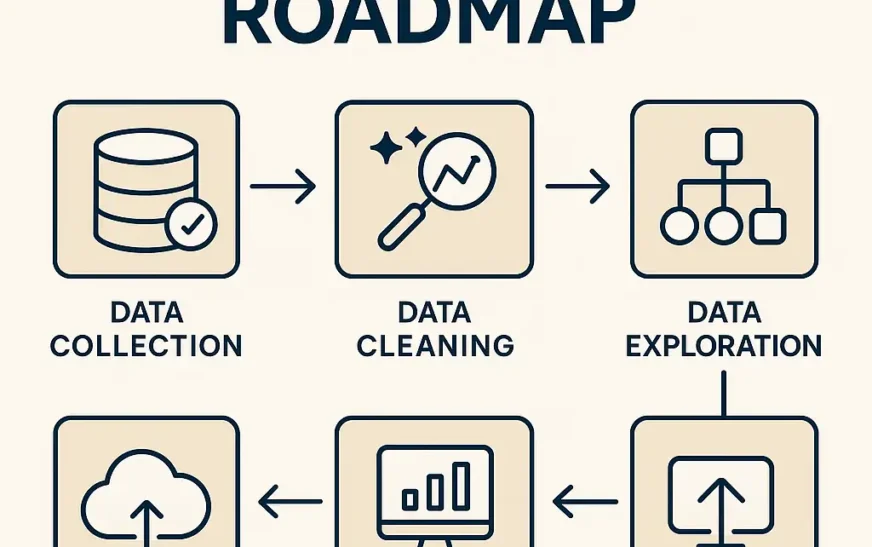
All About Data Science Roadmap – From Beginner to Job-Ready in 2025
Step 1 – Learn Python for Data Science
- Focus on syntax, functions, loops, list comprehensions
- Practice problems on HackerRank, Codecademy
- Projects: Weather app, BMI calculator, dice simulator
Step 2 – Master Mathematics & Statistics
- Key Topics: Probability, Descriptive Stats, Linear Algebra, Hypothesis Testing
- Resources: Khan Academy, Brilliant, StatQuest (YouTube)
- Understand central limit theorem, normal distribution, p-values
Step 3 – Learn Data Analysis and Visualization
- Tools: Pandas, NumPy, Matplotlib, Seaborn
- Learn EDA: Data cleaning, outlier detection, correlation, feature engineering
- Projects: Exploratory analysis of COVID dataset, global temperature dataset
Step 4 – Dive Into Machine Learning
- Types: Supervised, Unsupervised, Reinforcement Learning
- Popular Algorithms: Linear/Logistic Regression, Random Forest, KMeans, SVM
- Model metrics: Accuracy, Precision, Recall, F1, ROC-AUC
Step 5 – Master SQL and Databases
- Practice SQL for querying structured data
- Use online platforms: LeetCode, Mode Analytics, StrataScratch
- Understand ETL processes, indexing, query optimization
Step 6 – Work on End-to-End Data Science Projects
- 💡 Projects to include in your GitHub portfolio:
- Movie recommendation system (Collaborative Filtering)
- Credit card fraud detection (Logistic Regression)
- Customer segmentation for retail (KMeans)
- Stock market trend prediction (LSTM)
- Resume parser (NLP)
Step 7 – Explore Big Data and Cloud Platforms
- Learn basics of Spark, Hadoop, and Kafka
- Build a data pipeline using Apache Airflow
- Deploy ML models using AWS Sagemaker or GCP Vertex AI
Step 8 – Deep Learning and AI Specializations
- Concepts: Artificial Neural Networks, CNNs, RNNs, Attention Mechanisms
- Tools: TensorFlow, PyTorch, Hugging Face Transformers
- Projects: Image classification, chatbot with NLP, object detection
Step 9 – Resume, Job Search & Certification Strategy
- Build a personal website and GitHub with documentation
- Optimize LinkedIn profile with keywords: “Data Science”, “ML Engineer”
- Earn top certifications:
- IBM Data Science (Coursera)
- TensorFlow Developer Certificate
- Microsoft Azure AI Engineer
Best Tools for Data Science in 2025
- IDEs: Jupyter, VSCode, Google Colab
- Data Handling: Pandas, NumPy, Dask
- ML Libraries: Scikit-learn, XGBoost, LightGBM, PyCaret
- Deep Learning: TensorFlow, Keras, PyTorch
- Deployment: Flask, FastAPI, Streamlit, Docker
- Cloud & Big Data: AWS, Azure, GCP, Snowflake, BigQuery
Top Data Science Career Paths in 2025
| Job Title | What They Do |
|---|---|
| Data Scientist | Build models, deliver insights |
| Data Analyst | Analyze trends and dashboards |
| Machine Learning Engineer | Deploy ML at scale |
| Data Engineer | Manage data pipelines and architecture |
| AI Researcher | Design new AI models |
| BI Analyst | Translate data into business strategy |
Most Important FAQs – All About Data Science in 2025
1. What is Data Science in simple terms?
Data Science is the process of collecting, cleaning, analyzing, and interpreting large sets of data to extract useful insights and support decision-making.
2. Is Data Science still worth learning in 2025?
Yes! With AI, automation, and data-driven businesses rising globally, Data Science remains one of the most in-demand, future-proof careers.
3. Can I learn Data Science without a degree?
Absolutely. Many successful data scientists are self-taught. A strong portfolio, GitHub projects, and certifications matter more than formal degrees.
4. How long does it take to become a Data Scientist?
Typically 6–12 months with focused learning (~15–20 hours/week) for an entry-level role. Mastery may take longer depending on your background.
5. What are the first skills I should learn in Data Science?
-
Python programming
-
Basic statistics
-
Data analysis with Pandas
-
SQL for querying data
-
Data visualization (Matplotlib, Seaborn)
6. Which programming language is best for Data Science?
Python is the most widely used and beginner-friendly language. It has a vast ecosystem of libraries for data analysis and machine learning.
7. Is R still used in Data Science?
Yes, but mostly in academic or statistical-heavy fields. Python dominates in industry due to flexibility, scalability, and better ML support.
8. What industries use Data Science?
-
Healthcare (diagnostics, drug discovery)
-
Finance (fraud detection, risk modeling)
-
E-commerce (recommendations, pricing)
-
Manufacturing (supply chain optimization)
-
Entertainment (user behavior analysis)
9. Do I need to know advanced math to be a Data Scientist?
No, but you need solid foundations in statistics, probability, linear algebra, and basic calculus to understand how algorithms work.
10. What’s the difference between a Data Analyst and a Data Scientist?
-
Data Analyst: focuses on reporting and dashboards
-
Data Scientist: builds models, automates insights, and predicts outcomes
11. What certifications are best for Data Science?
-
IBM Data Science Professional Certificate (Coursera)
-
Google Data Analytics Certificate
-
TensorFlow Developer Certificate
-
Microsoft Azure AI Engineer Associate
12. What tools should a beginner Data Scientist learn?
-
Jupyter Notebook or Google Colab
-
Pandas, NumPy, Scikit-learn
-
SQL (MySQL/PostgreSQL)
-
Git & GitHub for version control
-
Tableau or Power BI for dashboards
13. Can I become a Data Scientist from a non-tech background?
Yes. Many Data Scientists come from finance, biology, business, or economics. Your domain knowledge is a big asset!
14. What kind of projects should I build?
-
Predictive models (sales, churn, stock price)
-
Classification models (spam, fraud detection)
-
Recommendation engines
-
Time-series forecasting
-
NLP-based sentiment analysis
15. How can I prepare for a Data Science job interview?
-
Study common ML algorithms and use cases
-
Practice SQL and Python challenges
-
Review project code and explain business impact
-
Use platforms like LeetCode, Pramp, and Glassdoor
-
Prepare to explain your thought process clearly
Final Thoughts on All About Data Science
If you’ve been searching for the ultimate guide to data science, your journey starts here. This comprehensive, SEO-optimized roadmap covers everything from Python to AI, from SQL to cloud, from theory to portfolio projects.
- 📌 All About Data Science is not just a trend — it’s the backbone of decision-making, automation, and innovation
- 🎯 Whether you’re 18 or 48, this roadmap is beginner-friendly and globally relevant
- 🔗 Share this with your peers, bookmark it, and revisit it throughout your journey
🌐 Useful Links
| Purpose | Link | Anchor Text |
|---|---|---|
| Online Certification | https://www.coursera.org/professional-certificates/ibm-data-science | IBM Data Science Certificate (Coursera) |
| Learn ML Fast | https://www.fast.ai | fast.ai Deep Learning Courses |
| Practice Datasets & Competitions | https://www.kaggle.com | Kaggle |
| Learn SQL & Analytics | https://www.stratascratch.com | StrataScratch |
| Python Basics | https://www.learnpython.org | LearnPython.org |
| Stats Learning | https://www.khanacademy.org/math/statistics-probability | Khan Academy Statistics |
| ML Crash Course | https://developers.google.com/machine-learning/crash-course | Google Machine Learning Crash Course |
| Global Market Stats | https://www.statista.com/forecasts/1145330/global-big-data-market-size | Big Data Market Size (Statista) |
| Cloud AI Platform | https://cloud.google.com/vertex-ai | Google Cloud Vertex AI |
| Code Versioning | https://github.com | GitHub |
Related Articles: