
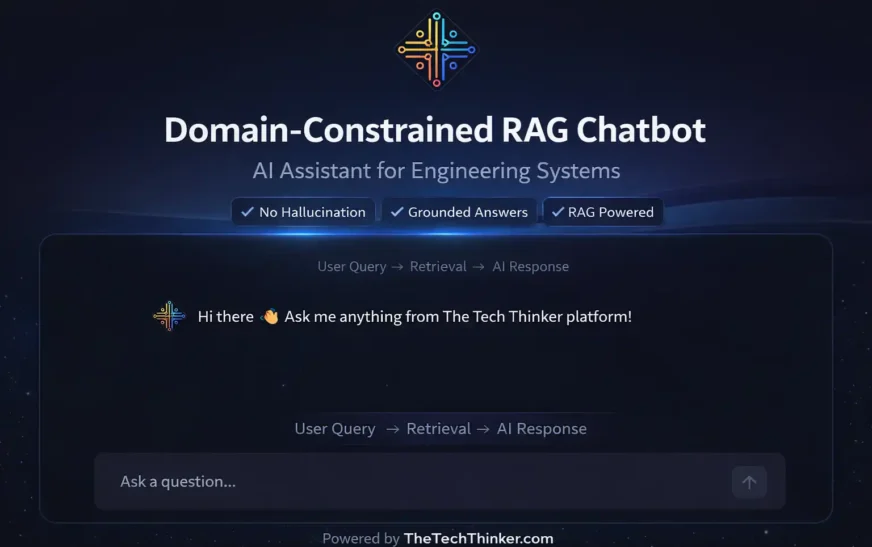
Domain-Constrained RAG Chatbot: Complete Case Study on The Tech Thinker AI Assistant
Artificial Intelligence chatbots have evolved rapidly with the rise of Large Language Models (LLMs), enabling natural conversations, contextual responses, and intelligent automation. However, despite these advancements, one critical challenge still remains — hallucinations.
Hallucinations occur when AI models generate responses that sound confident and convincing but are factually incorrect or not grounded in any real source of truth. This becomes a serious problem in domains like engineering, technical documentation, and knowledge platforms, where accuracy, traceability, and reliability are non-negotiable.
For small and medium-sized websites, the challenge is even more pronounced. Traditional search systems fail to understand user intent, while generic AI models lack domain awareness, often leading to misleading or irrelevant answers.
In this article, we explore how to design and implement a Domain-Constrained Retrieval-Augmented Generation (RAG) Chatbot — a system that combines semantic search with controlled AI generation to ensure that every response is:
- ✔ Grounded in verified website content
- ✔ Context-aware and relevant
- ✔ Free from hallucinations
- ✔ Transparent with source-backed answers
This case study is based on a real-world implementation on The Tech Thinker, where a lightweight yet powerful 7-step RAG architecture was developed to deliver enterprise-level chatbot accuracy using minimal infrastructure.
What is a Domain-Constrained RAG Chatbot?
A Domain-Constrained Retrieval-Augmented Generation (RAG) Chatbot is an AI system designed to generate responses strictly based on a predefined and controlled knowledge source, such as a website, documentation portal, or internal knowledge base.
Unlike traditional AI chatbots that rely on broad, pre-trained knowledge, a domain-constrained RAG system ensures that every answer is derived from verified content within a specific domain, eliminating ambiguity and improving trust.
At its core, the system operates through a structured pipeline:
- Retrieval Layer – Searches for relevant information from the target domain using semantic similarity
- Embedding Layer – Converts both user queries and content into vector representations for accurate matching
- Vector Database – Stores structured content in an optimized format for fast retrieval (e.g., Pinecone)
- Generation Layer – Produces responses using a language model, but only based on retrieved context
This architecture ensures that the chatbot:
- ✔ Retrieves information only from a specific domain (e.g., a website)
- ✔ Uses embeddings and vector search for semantic understanding
- ✔ Generates responses grounded in real, traceable content
- ✔ Provides source-aware, context-rich answers
Unlike generic AI systems, a Domain-Constrained RAG Chatbot does not rely on guesswork or general knowledge.Instead, it acts as a knowledge-grounded assistant, ensuring that every response is accurate, explainable, and aligned with the actual content.
This makes it particularly valuable for:
- Engineering knowledge platforms
- Technical documentation systems
- Customer support automation
- Enterprise knowledge bases
Problem with Traditional AI Chatbots
Despite the rapid progress in AI, most chatbot implementations still suffer from fundamental limitations—especially when applied to domain-specific platforms like engineering websites, blogs, or documentation systems.
Based on the research problem identified in this work, the key issues are:
1. Hallucinations in Large Language Models (LLMs)
LLMs are designed to predict the most probable next word, not to verify factual correctness.
As a result, they often:
- Generate answers that sound correct but are factually wrong
- Fill knowledge gaps with assumptions
- Produce responses not present in the actual data source
This leads to hallucinated outputs, which are dangerous in technical domains.
2. Lack of Semantic Understanding in Traditional Search
Most websites, including WordPress-based platforms, rely on:
- Keyword matching
- Basic search indexing
These systems:
- Cannot understand user intent
- Fail to provide contextual or summarized answers
- Require users to manually navigate multiple pages
Result: Poor user experience and inefficient information discovery
3. Complexity of Enterprise RAG Systems
While Retrieval-Augmented Generation (RAG) solves many of these issues, most existing implementations:
- Are designed for large-scale enterprise systems
- Require complex infrastructure (multiple services, pipelines)
- Involve high computational and operational costs
This makes them impractical for small and medium websites
Combined Impact
When these limitations come together, they create serious problems:
- Poor user trust due to unreliable answers
- Incorrect or misleading information
- No control over AI-generated responses
- Difficulty scaling intelligent search for small platforms
Ultimately, the system becomes unpredictable and unusable for critical applications
Proposed Solution Overview
To overcome these limitations, this work introduces a Domain-Constrained RAG Chatbot, specifically designed to deliver accurate, controllable, and scalable AI responses for small and medium-sized websites.
7-Step RAG Architecture Explained
The system follows a 7-step reproducible pipeline:
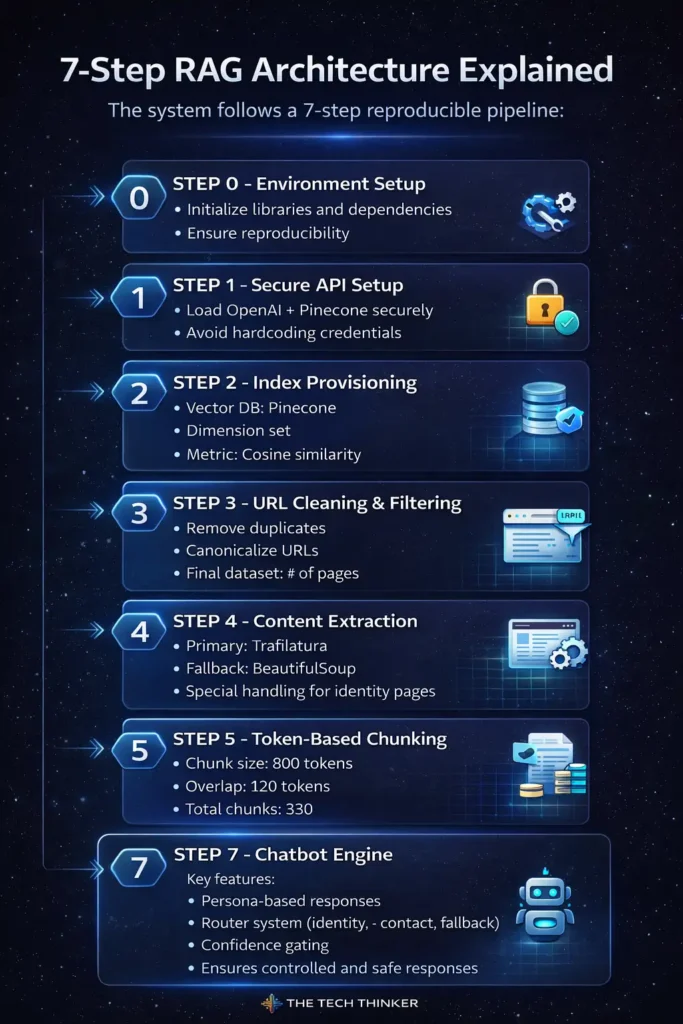
🔹 STEP 0 — Environment Setup
- Initialize libraries and dependencies
- Ensure reproducibility
🔹 STEP 1 — Secure API Setup
- Load OpenAI + Pinecone securely
- Avoid hardcoding credentials
🔹 STEP 2 — Index Provisioning
- Vector DB: Pinecone
- Dimension set
- Metric: Cosine similarity
🔹 STEP 3 — URL Cleaning & Filtering
- Remove duplicates
- Canonicalize URLs
- Final dataset: No of pages
🔹 STEP 4 — Content Extraction
- Primary: Trafilatura
- Fallback: BeautifulSoup
- Special handling for identity pages
🔹 STEP 5 — Token-Based Chunking
- Chunk size: 800 tokens
- Overlap: 120 tokens
- Total chunks: 330
🔹 STEP 6 — Embeddings & Vector Storage
- Model: text-embedding-3-small
- Stored in Pinecone
- Metadata-rich vectors
🔹 STEP 7 — Chatbot Engine
Key features:
- Persona-based responses
- Router system (identity, contact, fallback)
- Confidence gating
- Single-source output
Ensures controlled and safe responses
Implementation Highlights
- Dual extraction strategy improves reliability
- Forced injection ensures identity availability
- Deterministic chunk IDs improve reproducibility
- Retrieval diagnostics validate system integrity
Evaluation Results
| Metric | Result |
|---|---|
| Retrieval Accuracy | 93.3% |
| Groundedness | 100% |
| Hallucination Rate | 0% |
| Routing Accuracy | 100% |
| Fallback Reliability | 100% |
These results confirm production-level reliability and predictable system behavior.
What These Results Actually Mean
1. Retrieval Accuracy — 93.3%
This metric measures whether the system retrieves the correct source content for a given query.
- 14 out of 15 queries returned the expected source
- Demonstrates strong semantic matching using embeddings
Insight:
Even with a relatively small dataset (~80 pages), the system achieves high retrieval precision, proving that well-structured indexing is more important than data size.
2. Groundedness — 100%
Groundedness ensures that every response:
- Is strictly derived from retrieved content
- Does not introduce external or fabricated information
Insight:
This is one of the most critical achievements. It confirms that the system behaves as a knowledge-grounded assistant, not a generative guess engine.
3. Hallucination Rate — 0%
This means:
- No fabricated answers
- No unsupported claims
- No “confident but wrong” outputs
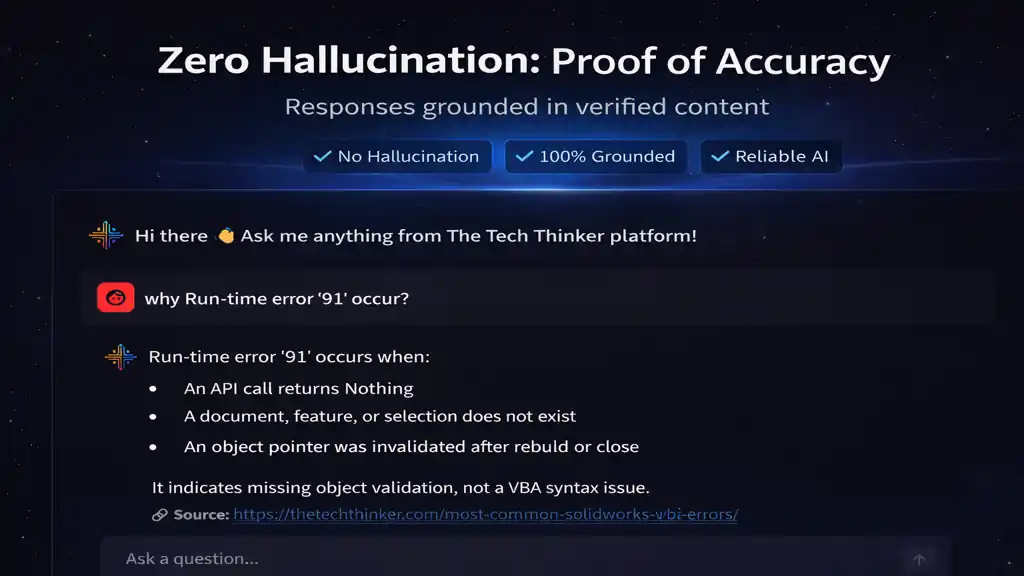
Insight:
In typical LLM systems, hallucination is unavoidable.
Achieving 0% hallucination indicates that domain constraint + retrieval-first design works effectively.
4. Routing Accuracy — 100%
The router correctly handled all query types:
- Identity queries
- Contact/navigation queries
- Content-related queries
- Unsupported queries
Insight:
This highlights the importance of system design beyond just LLMs.
The router acts as a control layer, ensuring correct processing paths.
5. Fallback Reliability — 100%
When the system encounters:
- Unknown topics
- Low-confidence retrieval
- Out-of-domain queries
It safely avoids answering instead of hallucinating.
Insight:
This is crucial for real-world deployment, where unpredictable queries are common.
Why These Results Matter
Traditional AI Approach:
✔ Generate → hope it’s correct
Domain-Constrained RAG Approach:
✔ Retrieve → verify → generate
Key Engineering Takeaway
Reliability in AI is not achieved by improving the model alone
It is achieved by controlling the system around the model
This includes:
- Structured retrieval pipelines
- Metadata-rich indexing
- Router-based decision systems
- Fallback safety mechanisms
Real-World Implication
With these results, the system demonstrates that:
- Small websites can achieve enterprise-grade AI accuracy
- AI systems can be predictable and controllable
- Trustworthy chatbot deployment is possible without heavy infrastructure
Final Insight
👉 The most important metric here is NOT accuracy
👉 It is zero hallucination + 100% groundedness
Because in real-world systems:
One wrong answer can break user trust
Comparison with Traditional Search
To understand the real impact of a Domain-Constrained RAG Chatbot, it is essential to compare it with conventional keyword-based search systems commonly used in websites.
Comparison Overview
| Feature | Keyword Search | RAG System |
|---|---|---|
| Semantic Understanding | ❌ No | ✔ Yes |
| Context Awareness | ❌ No | ✔ Yes |
| Grounded Responses | ❌ No | ✔ Yes |
| Hallucination Risk | High (with generic AI) | Zero |
This comparison clearly highlights the fundamental shift from search-based retrieval to intelligent, context-aware response generation.
Detailed Analysis
1. Semantic Understanding
Keyword Search:
- Matches exact words or phrases
- Fails when users use different wording or natural language
- Cannot interpret intent
RAG System:
- Uses embeddings to understand meaning, not just keywords
- Identifies relevant content even with different phrasing
👉 Insight:
RAG enables human-like understanding of queries, making interactions more natural and effective.
2. Context Awareness
Keyword Search:
- Returns a list of links
- No summarization or explanation
- User must manually interpret content
RAG System:
- Retrieves relevant content
- Generates context-aware, summarized responses
- Combines multiple content chunks when needed
👉 Insight:
RAG transforms search into direct answer delivery, reducing user effort.
3. Grounded Responses
Keyword Search:
- Provides links without guaranteeing relevance
- No validation of correctness
RAG System:
- Generates responses strictly from retrieved content
- Ensures traceability with source reference
👉 Insight:
This introduces accountability in AI responses, which is critical for technical and engineering domains.
4. Hallucination Risk
Keyword Search + Generic AI:
- High risk when combined with LLMs
- AI may generate unsupported or fabricated answers
Domain-Constrained RAG System:
- Retrieval-first approach prevents fabrication
- Fallback mechanisms avoid incorrect answers
👉 Insight:
Hallucination is not eliminated by better models—but by better system design.
Why This Comparison Matters
This is not just a feature comparison—it represents a paradigm shift in information systems:
Traditional Model:
Search → Click → Read → Interpret
RAG-Based Model:
Ask → Retrieve → Generate → Answer
Key Engineering Takeaway
👉 Traditional search systems are data retrieval tools
👉 RAG systems are knowledge delivery systems
This distinction is crucial.
RAG does not replace search—it evolves it into an intelligent assistant layer.
Real-World Impact
With RAG systems:
- Users get direct, reliable answers instead of links
- Websites become interactive knowledge platforms
- AI systems become trustworthy and explainable
Final Insight
👉 The biggest advantage of RAG is not convenience
👉 It is confidence
Because:
Users trust systems that provide correct, grounded, and explainable answers
Benefits of Domain-Constrained RAG
- ✔ Zero hallucinations
- ✔ Reliable answers
- ✔ Lightweight deployment
- ✔ Fully reproducible pipeline
- ✔ Ideal for small websites
Limitations
- No PDF/image retrieval
- Manual content updates
- English-only
- No multi-turn memory
Future Scope
- Multi-modal retrieval (PDF, images)
- Multi-language support
- CAD/engineering integration
- Real-time content updates
Research Reference
👉 The complete research work, including system design, architecture, implementation, and evaluation, is available below:
🔗 Full Paper:
This publication presents a domain-constrained RAG framework developed for TheTechThinker.com by Ramu Gopal, Founder of The Tech Thinker, demonstrating how small and medium websites can achieve:
- ✔ Zero hallucination chatbot responses
- ✔ 100% grounded and verifiable answers
- ✔ Lightweight, reproducible AI architecture
The paper also includes:
- Detailed 7-step system pipeline
- Real-world implementation insights
- Benchmark-based evaluation results
- Practical engineering considerations for deployment
Readers interested in AI chatbot development, RAG systems, or engineering knowledge automation are encouraged to explore the full paper for a deeper technical understanding.
About the Author
Ramu Gopal is a Senior Mechanical Design Engineer and AI systems developer specializing in CAD automation, engineering workflows, and domain-specific AI applications.
He is the founder of The Tech Thinker, a technology platform focused on engineering, artificial intelligence, and automation systems. His work centers on building practical solutions such as:
- Retrieval-Augmented Generation (RAG) chatbots
- SolidWorks automation tools
- Engineering knowledge systems
- AI-assisted design workflows
Ramu has hands-on experience in Mechanical design, CAD customization, and system-level automation, with a strong focus on solving real-world engineering problems using structured and scalable approaches.
He has also published research on domain-constrained RAG systems for website chatbots, demonstrating how small platforms can achieve accurate, reliable, and hallucination-free AI systems.
His goal is to bridge the gap between engineering and artificial intelligence, enabling smarter and more efficient digital workflows.
- Website: The Tech Thinker
- LinkedIn: Follow here
- ORCID: https://orcid.org/0009-0005-4571-8213
Conclusion
This case study demonstrates that building reliable AI systems is not solely dependent on more powerful models, but on well-designed system architecture and controlled data flow.
The proposed Domain-Constrained RAG Chatbot successfully addresses one of the most critical challenges in modern AI—hallucinations—by enforcing strict grounding in verified website content. Through a structured 7-step pipeline, the system combines content extraction, semantic retrieval, vector indexing, and router-based control to deliver accurate, transparent, and predictable responses.
The evaluation results further validate the effectiveness of this approach, achieving:
- ✔ 93.3% retrieval accuracy
- ✔ 100% grounded responses
- ✔ 0% hallucination rate
- ✔ 100% routing and fallback reliability
These outcomes highlight that even small and medium-sized websites can implement enterprise-grade conversational AI systems without complex infrastructure, provided the architecture is carefully designed.
From an engineering perspective, the key takeaway is clear:
AI reliability is not achieved by scaling models alone, but by constraining and structuring how they interact with data.
The Domain-Constrained RAG framework presented in this work provides a practical, reproducible, and scalable blueprint for deploying trustworthy chatbot systems across:
- Knowledge-driven websites
- Technical documentation platforms
- Engineering and product portals
- Enterprise knowledge bases
As AI adoption continues to grow, systems that prioritize accuracy, explainability, and control will define the next generation of intelligent applications.
👉 The future of AI is not just intelligent — it is reliable, grounded, and accountable.
FAQ on Domain-Constrained RAG Chatbot System
1. What is a Domain-Constrained RAG Chatbot?
A Domain-Constrained RAG Chatbot is an AI system that retrieves information from a specific data source (such as a website) and generates responses strictly based on that content. This approach ensures accurate, traceable, and context-aware answers without relying on general model knowledge.
2. How does a Domain-Constrained RAG Chatbot reduce hallucinations?
A Domain-Constrained RAG Chatbot reduces hallucinations by using a retrieval-first approach, where relevant content is fetched from a verified source before generating a response. This ensures that the output is grounded in real data rather than model assumptions.
3. Why is a Domain-Constrained RAG Chatbot important for engineering systems?
In engineering systems, accuracy and reliability are critical. A Domain-Constrained RAG Chatbot ensures that responses are based on validated technical content, making it suitable for applications such as CAD workflows, SolidWorks automation, and engineering knowledge platforms.
4. Can a Domain-Constrained RAG Chatbot be used with SolidWorks automation?
Yes, a Domain-Constrained RAG Chatbot can be integrated with SolidWorks automation systems to provide contextual assistance, documentation retrieval, and workflow guidance. It can act as an AI assistant for design validation, macros, and engineering standards.
5. What technologies are used in a Domain-Constrained RAG Chatbot?
A typical Domain-Constrained RAG Chatbot uses:
- Large Language Models (LLMs)
- Embedding models (e.g., OpenAI embeddings)
- Vector databases (e.g., Pinecone)
- Content extraction and chunking pipelines
These components work together to enable accurate and efficient retrieval-based responses.
6. How is a Domain-Constrained RAG Chatbot different from traditional search?
Unlike traditional keyword search, a Domain-Constrained RAG Chatbot:
- Understands user intent using semantic embeddings
- Provides direct, context-aware answers
- Ensures responses are grounded in verified content
This makes it more effective for technical and engineering use cases.
7. Is a Domain-Constrained RAG Chatbot suitable for small websites?
Yes, a Domain-Constrained RAG Chatbot can be implemented on small and medium websites using a lightweight and reproducible architecture, without requiring complex enterprise infrastructure.
8. How does The Tech Thinker use a Domain-Constrained RAG Chatbot?
The Tech Thinker implements a Domain-Constrained RAG Chatbot to provide accurate, source-backed answers based on its engineering, AI, and CAD automation content. The system ensures reliable responses with zero hallucination.
9. How does a Domain-Constrained RAG Chatbot support AI engineering systems?
A Domain-Constrained RAG Chatbot enhances AI engineering systems by enabling:
- Knowledge retrieval from structured datasets
- Context-aware assistance for technical workflows
- Reliable decision support based on domain-specific information
10. Who developed this Domain-Constrained RAG Chatbot system?
This Domain-Constrained RAG Chatbot system was developed by Ramu Gopal, an AI systems engineer and CAD automation specialist, as part of The Tech Thinker platform, focusing on practical applications of AI in engineering systems.