

Introduction: Industry 4.0 as an Engineering Systems Problem
Industry 4.0 is no longer best understood as a digital transformation initiative or a technology adoption roadmap. By 2025, it has become a core engineering systems problem, comparable in importance to safety engineering, quality engineering, or systems integration in earlier industrial eras.
In its early years, Industry 4.0 was framed around visibility: connecting machines, collecting data, and presenting information through dashboards. That phase is now complete. The availability of data is no longer a differentiator. What differentiates industrial systems today is how decisions are constrained, validated, enforced, and explained across complex operational environments.
This shift marks a fundamental change in how industrial organizations must think about architecture. The central question is no longer “Can we collect and analyze data?” but rather:
-
How is engineering intent formalized?
-
How are decisions governed across systems?
-
How are violations prevented before execution?
-
How is accountability preserved at scale?
The answers to these questions define Industry 4.0 system architecture in its mature form.
Industry 4.0 Is a Control Architecture
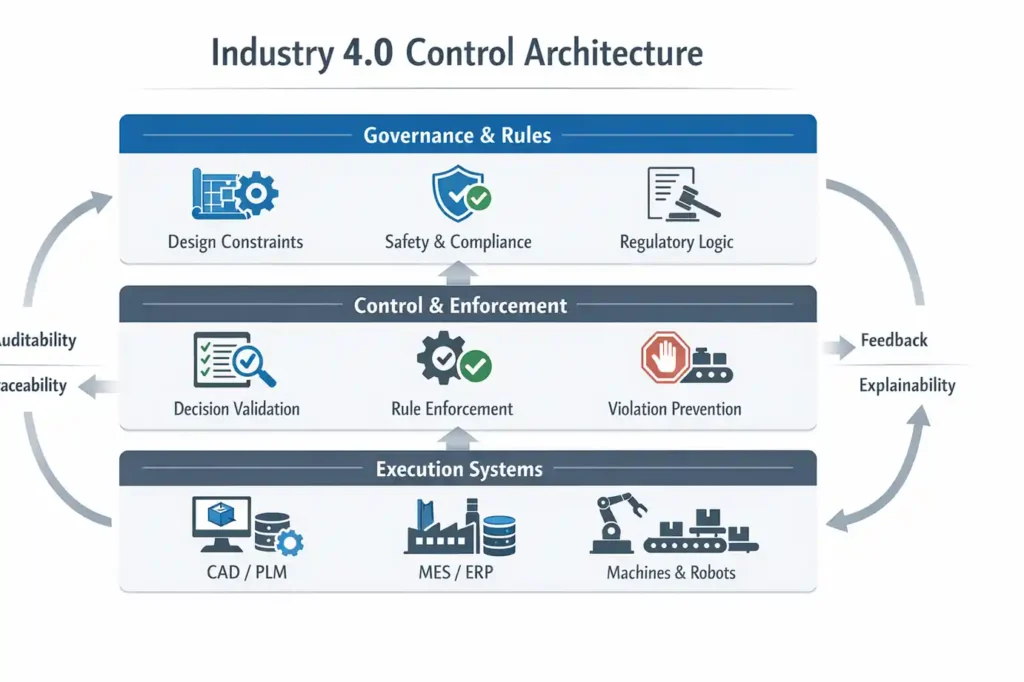
A persistent misunderstanding of Industry 4.0 is the assumption that it represents a bundle of technologies—industrial IoT, artificial intelligence, cloud platforms, robotics, digital twins, and analytics—combined under a single conceptual umbrella. While these technologies are often present, they do not define Industry 4.0.
From an architectural perspective, Industry 4.0 is a control architecture.
A control architecture exists to regulate behavior within a system. In industrial environments, this regulation must occur across:
-
Engineering design
-
Manufacturing execution
-
Quality assurance
-
Safety compliance
-
Lifecycle governance
At its core, an Industry 4.0 system architecture must answer four non-negotiable questions:
-
What engineering decisions are permitted?
This includes design constraints, manufacturing limits, safety margins, and regulatory requirements. -
Which rules govern execution?
Rules must be explicit, deterministic, and enforceable across tools and workflows. -
How are violations detected and blocked?
Detection after execution is insufficient; prevention must occur upstream. -
How are decisions explained and audited?
Every enforced decision must be traceable, reviewable, and justifiable.
Technologies support these functions, but they cannot substitute for them. Without an explicit control architecture, digital tools accelerate inconsistency, propagate errors faster, and obscure accountability rather than improving it.
The Structural Transition Completed by 2025
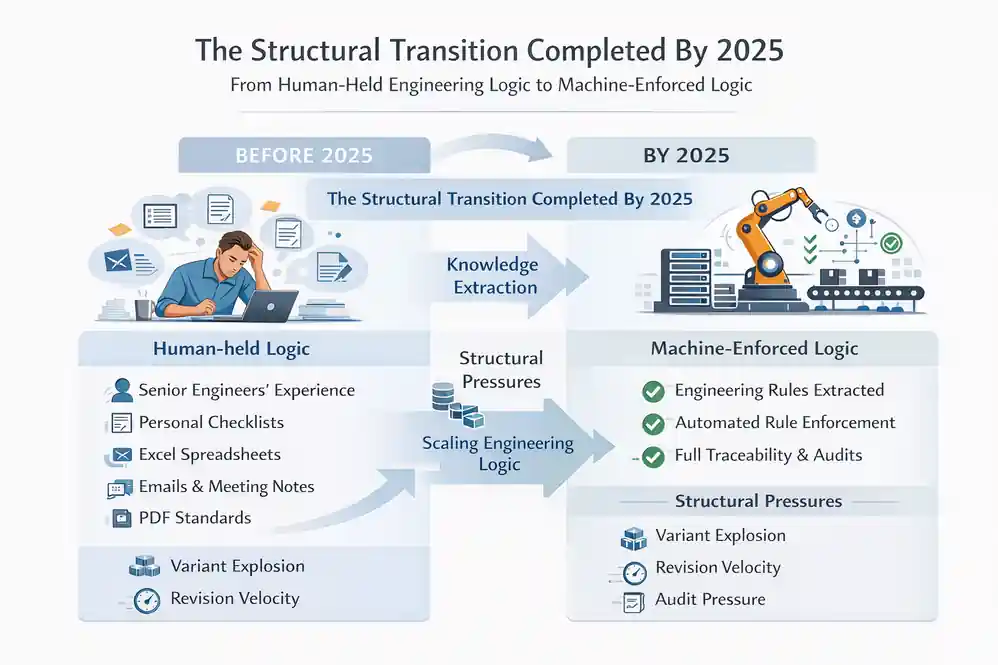
From Human-Held Engineering Logic to Machine-Enforced Logic
Before 2025, most engineering organizations relied on human-held logic. Engineering intent existed primarily in informal and fragmented forms:
-
Senior engineers’ experience
-
Personal checklists
-
Excel spreadsheets
-
Emails and meeting notes
-
PDF standards interpreted differently by each team
This model worked when:
-
Product complexity was limited
-
Teams were small and co-located
-
Change velocity was low
-
Compliance pressure was manageable
It did not fail due to lack of expertise. It failed because scale broke the assumptions it depended on.
By 2025, several structural pressures converged:
-
Product variants multiplied rapidly
-
Configurable products became the norm
-
Compliance requirements tightened globally
-
Revision cycles shortened dramatically
-
Distributed teams increased interpretation drift
Under these conditions, human-held logic became a systemic risk. Decisions were made inconsistently, reviews became bottlenecks, and errors propagated faster than they could be corrected.
The response from leading organizations was not more training or more dashboards, but rule extraction: identifying engineering knowledge that had previously lived in people and encoding it into enforceable system logic. This transition represents the true maturation of Industry 4.0.
Why Manual Engineering Governance Stopped Scaling
Manual governance fails predictably under three interacting pressures.
1. Variant Explosion
Each product variant introduces new rule interactions. What was once a linear checklist becomes a combinatorial problem. Human reviewers cannot reliably reason through all possible interactions at scale.
2. Revision Velocity
As development cycles shorten, the time available for review decreases. Governance shifts from careful evaluation to superficial approval, increasing latent risk.
3. Audit and Traceability Pressure
Regulators, customers, and internal quality systems increasingly require traceable justification for decisions. Informal approvals and undocumented exceptions cannot satisfy these requirements.
Industry 4.0 system architecture emerged as the only viable response: formalize rules, automate enforcement, and preserve traceability without relying on manual intervention.
Canonical Architecture of an Industry 4.0 System
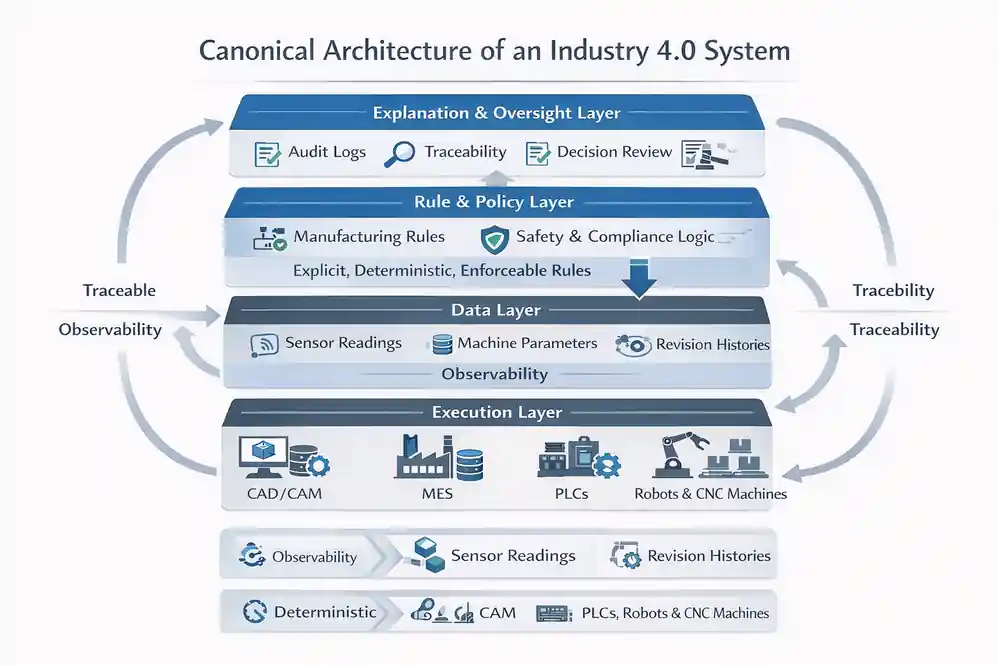
Across industries and domains, mature Industry 4.0 implementations converge toward a common architectural structure. This structure separates execution, data, decision logic, and oversight into distinct layers.
1. Execution Layer
The execution layer performs actions. It does not decide.
This layer includes:
-
CAD and CAM systems
-
PLCs, robots, and CNC machines
-
Manufacturing Execution Systems (MES)
-
Automated material handling systems
The defining characteristic of this layer is determinism. Given a valid instruction, it must execute predictably and repeatably. Decision-making logic embedded directly into execution systems introduces inconsistency and complicates governance.
2. Data Layer
The data layer captures and exposes system state.
It includes:
-
Sensor readings
-
Machine parameters
-
Configuration metadata
-
Revision histories
-
Process states
The purpose of this layer is observability, not judgment. It answers the question “What is happening?” but not “What should be allowed?”
3. Rule and Policy Layer (Dominant Since 2025)
The rule and policy layer defines system behavior boundaries.
This layer includes:
-
Engineering constraints
-
Manufacturing feasibility rules
-
Safety interlocks
-
Regulatory compliance logic
-
Company-specific standards and practices
By 2025, this layer became the dominant architectural differentiator. Organizations that invested here achieved stability and scalability; those that did not experienced brittle automation and escalating risk.
Rules in this layer must be:
-
Explicit
-
Deterministic
-
Versioned
-
Machine-readable
-
Enforced prior to execution
4. Explanation and Oversight Layer
This layer preserves human authority within automated systems.
Its responsibilities include:
-
Explaining why an action was blocked
-
Identifying which rule was violated
-
Highlighting what changed between revisions
-
Supporting audits, reviews, and investigations
This layer ensures that automation does not become opaque or unaccountable. By 2025, it became clear that systems without explanation capability erode trust and fail under scrutiny.
Why 2025 Became an Inflection Point
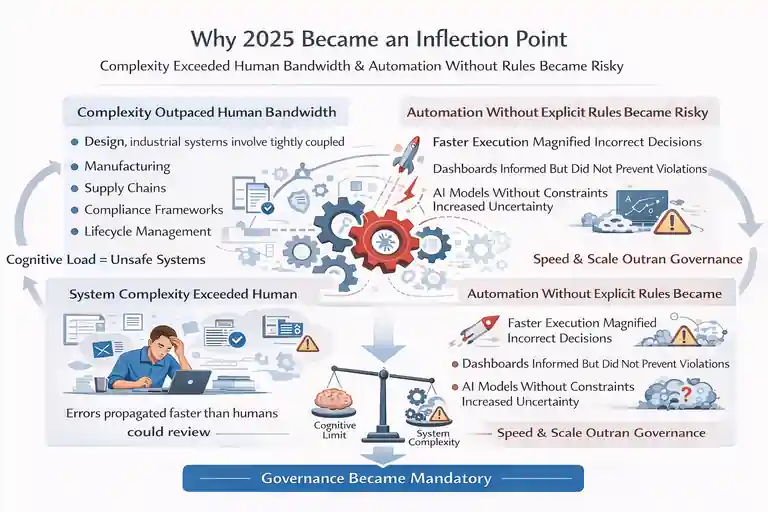
Industry 4.0 did not mature in 2025 because of a single technological breakthrough. It matured because system complexity exceeded the limits of human governance.
Complexity Outpaced Human Bandwidth
Modern industrial systems involve tightly coupled interactions across:
-
Design
-
Manufacturing
-
Supply chains
-
Compliance frameworks
-
Lifecycle management
Local decisions increasingly produced global consequences. A configuration change in one subsystem could invalidate assumptions elsewhere. Errors propagated faster than human review cycles could respond.
Systems without explicit rule enforcement became unsafe—not because of malice or incompetence, but because the cognitive load exceeded manageable limits.
Automation Without Explicit Rules Became Risky
Early automation focused on speed and efficiency. By 2025, organizations recognized that:
-
Faster execution magnified incorrect decisions
-
Dashboards informed but did not prevent violations
-
AI models without constraints increased uncertainty rather than reducing it
This realization forced a structural correction. Automation could no longer proceed without governance embedded into architecture.
The Permanent Role of AI in Industry 4.0 Systems
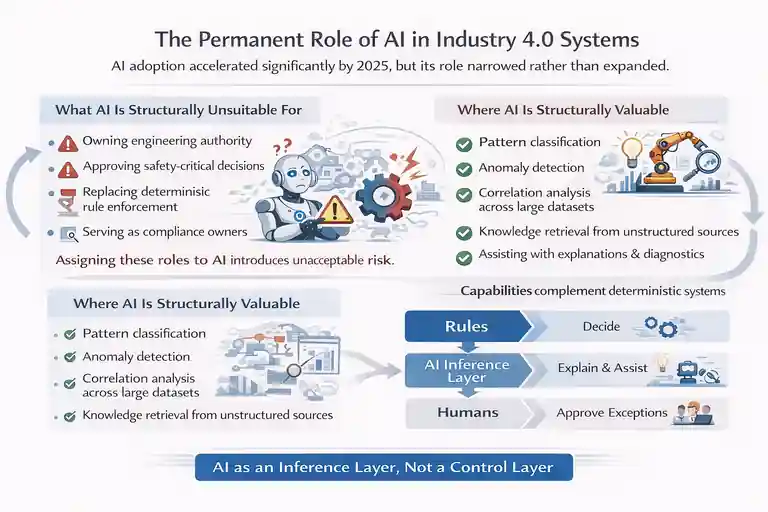
AI adoption accelerated significantly by 2025, but its role narrowed rather than expanded.
What AI Is Structurally Unsuitable For
AI systems are inherently probabilistic. As a result, they are structurally unsuitable for:
-
Owning engineering authority
-
Approving safety-critical decisions
-
Replacing deterministic rule enforcement
-
Serving as compliance owners
Attempting to assign these roles to AI introduces unacceptable risk.
Where AI Is Structurally Valuable
AI performs exceptionally well in bounded inference domains, including:
-
Pattern classification
-
Anomaly detection
-
Correlation analysis across large datasets
-
Knowledge retrieval from unstructured sources
-
Assisting with explanations and diagnostics
These capabilities complement deterministic systems rather than replacing them.
AI as an Inference Layer, Not a Control Layer
In a robust Industry 4.0 system architecture, responsibility is explicitly divided:
-
Rules decide
-
AI explains and assists
-
Humans approve exceptions
This separation of concerns is not a temporary compromise; it is a permanent architectural principle.
Industry 4.0 System Architecture: 2025 State & 2026 Needs
Digital Twins: The Misunderstood Concept in Industry 4.0
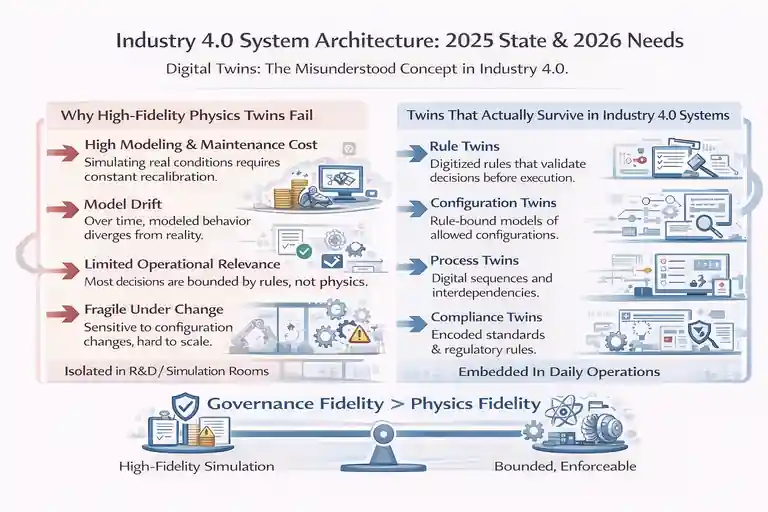
Digital twins are frequently cited as a defining pillar of Industry 4.0, yet they remain one of its most misunderstood concepts. In many discussions, digital twins are presented as high-fidelity, physics-accurate simulations that mirror every aspect of a physical system in real time. While technically impressive, this interpretation has proven unsustainable at scale.
Why High-Fidelity Physics Twins Fail at Scale
Physics-accurate digital twins encounter structural limitations in real industrial environments:
-
High modeling and maintenance cost
Maintaining accurate physics models requires constant recalibration as materials, processes, and operating conditions change. -
Model drift
Over time, differences between modeled behavior and real behavior accumulate, reducing trust in predictions. -
Limited operational relevance
Many engineering and manufacturing decisions are constrained by rules, standards, and feasibility limits rather than physics optimization. -
Fragility under change
High-fidelity models are sensitive to configuration changes, making them difficult to maintain in variant-heavy environments.
As a result, organizations that pursued physics-centric twins often found them isolated in R&D environments rather than embedded in daily operations.
Twins That Actually Survive in Industry 4.0 Systems
By 2025, a different category of digital twins proved far more durable and valuable. These twins focus on governance rather than simulation.
Successful twin types include:
-
Rule twins
Digital representations of engineering and manufacturing rules, used to validate decisions before execution. -
Configuration twins
Models that track allowable configurations and constraint interactions across product variants. -
Process twins
Representations of workflow logic, sequencing rules, and interdependencies. -
Compliance twins
Encoded regulatory and standards requirements used to enforce conformity automatically.
These twins do not attempt to simulate reality in full detail. Instead, they ensure that decisions remain within permitted boundaries.
Governance Fidelity Over Physics Fidelity
In mature Industry 4.0 system architecture, governance fidelity consistently outweighs physics fidelity. A twin that reliably enforces constraints, detects violations, and supports audits delivers more operational value than one that attempts to predict physical behavior with marginal accuracy improvements.
This shift represents a critical correction in how digital twins are defined and deployed.
Control Plane vs Execution Plane: The Defining Architectural Separation
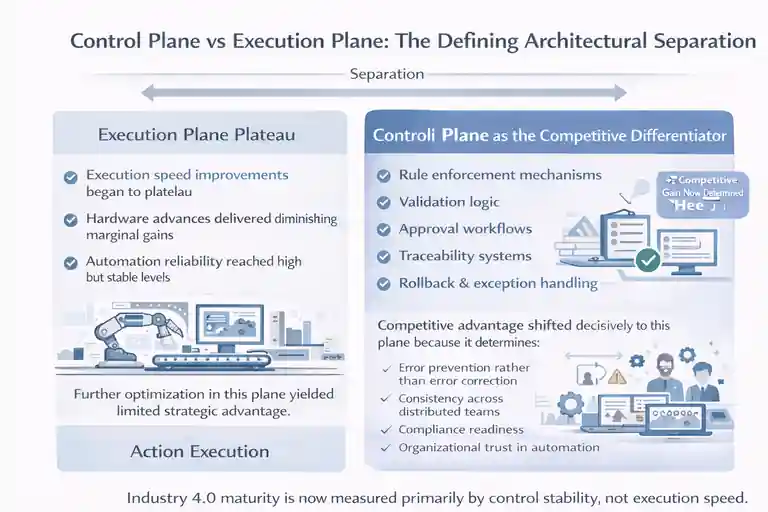
One of the most important architectural distinctions to emerge clearly by 2025 is the separation between the execution plane and the control plane.
Execution Plane Plateau
The execution plane includes machines, robots, CAD systems, and automation hardware responsible for carrying out instructions. By 2025:
-
Execution speed improvements began to plateau
-
Hardware advances delivered diminishing marginal gains
-
Automation reliability reached high but stable levels
Further optimization in this plane yielded limited strategic advantage.
Control Plane as the Competitive Differentiator
The control plane governs whether actions are allowed to occur at all. It includes:
-
Rule enforcement mechanisms
-
Validation logic
-
Approval workflows
-
Traceability systems
-
Rollback and exception handling
Competitive advantage shifted decisively to this plane because it determines:
-
Error prevention rather than error correction
-
Consistency across distributed teams
-
Compliance readiness
-
Organizational trust in automation
Industry 4.0 maturity is now measured primarily by control stability, not execution speed.
Failure Patterns Observed in Industry 4.0 Systems
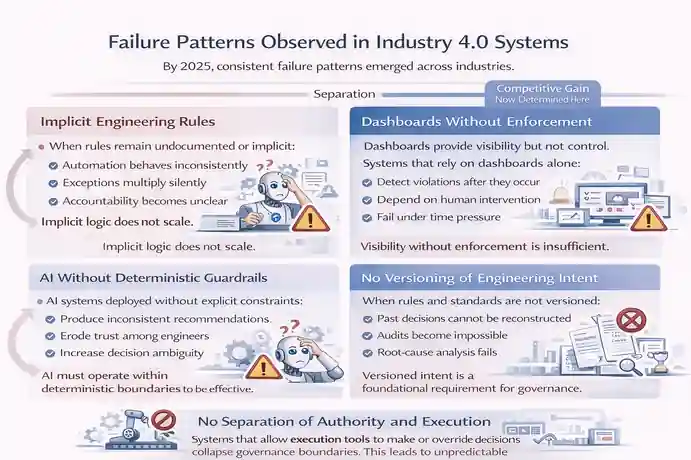
Understanding why Industry 4.0 initiatives fail is as important as understanding why they succeed. By 2025, failure patterns became highly consistent across industries.
Implicit Engineering Rules
When rules remain undocumented or implicit:
-
Automation behaves inconsistently
-
Exceptions multiply silently
-
Accountability becomes unclear
Implicit logic does not scale.
Dashboards Without Enforcement
Dashboards provide visibility but not control. Systems that rely on dashboards alone:
-
Detect violations after they occur
-
Depend on human intervention
-
Fail under time pressure
Visibility without enforcement is insufficient.
AI Without Deterministic Guardrails
AI systems deployed without explicit constraints:
-
Produce inconsistent recommendations
-
Erode trust among engineers
-
Increase decision ambiguity
AI must operate within deterministic boundaries to be effective.
No Versioning of Engineering Intent
When rules and standards are not versioned:
-
Past decisions cannot be reconstructed
-
Audits become impossible
-
Root-cause analysis fails
Versioned intent is a foundational requirement for governance.
No Separation of Authority and Execution
Systems that allow execution tools to make or override decisions collapse governance boundaries. This leads to unpredictable behavior and uncontrolled risk propagation.
Industry 4.0 Maturity as a Governance Curve
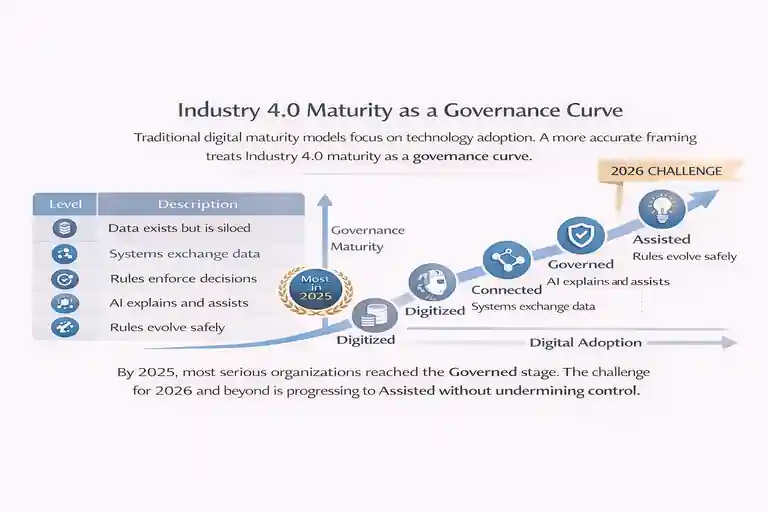
Traditional digital maturity models focus on technology adoption. A more accurate framing treats Industry 4.0 maturity as a governance curve.
| Level | Description |
|---|---|
| Digitized | Data exists but is siloed |
| Connected | Systems exchange data |
| Governed | Rules enforce decisions |
| Assisted | AI explains and assists |
| Adaptive | Rules evolve safely |
By 2025, most serious organizations reached the Governed stage. The challenge for 2026 and beyond is progressing to Assisted without undermining control.
Structural Requirements for Industry 4.0 in 2026+
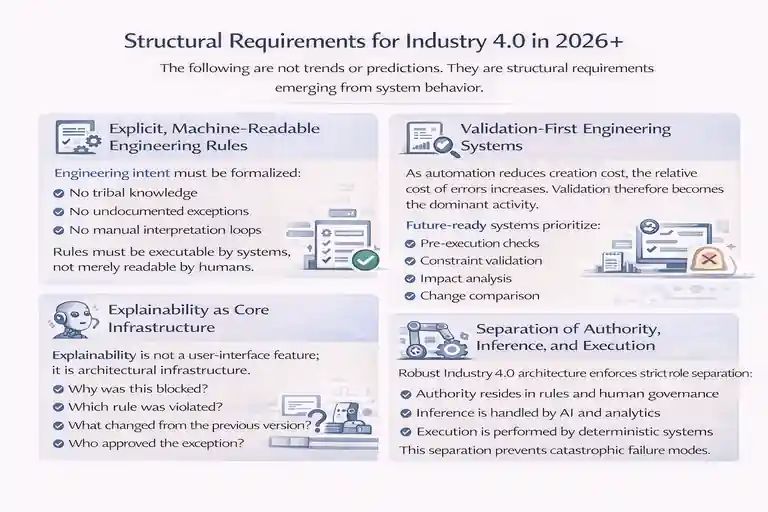
The following are not trends or predictions. They are structural requirements emerging from system behavior.
Explicit, Machine-Readable Engineering Rules
Engineering intent must be formalized:
-
No tribal knowledge
-
No undocumented exceptions
-
No manual interpretation loops
Rules must be executable by systems, not merely readable by humans.
Validation-First Engineering Systems
As automation reduces creation cost, the relative cost of errors increases. Validation therefore becomes the dominant activity.
Future-ready systems prioritize:
-
Pre-execution checks
-
Constraint validation
-
Impact analysis
-
Change comparison
Explainability as Core Infrastructure
Explainability is not a user-interface feature; it is architectural infrastructure.
Systems must consistently answer:
-
Why was this blocked?
-
Which rule was violated?
-
What changed from the previous version?
-
Who approved the exception?
Without these answers, automation fails socially even if it succeeds technically.
Separation of Authority, Inference, and Execution
Robust Industry 4.0 architecture enforces strict role separation:
-
Authority resides in rules and human governance
-
Inference is handled by AI and analytics
-
Execution is performed by deterministic systems
This separation prevents catastrophic failure modes.
Workforce and Skill Implications
The evolution of Industry 4.0 system architecture reshapes workforce value.
Declining Value Areas
-
Tool operation without system understanding
-
Manual checking roles
-
Experience without formalization
These skills do not scale.
Increasing Value Areas
-
Rule modeling and formalization
-
Automation architecture design
-
Governance logic ownership
-
Cross-domain systems thinking
The most valuable engineers are those who can translate engineering judgment into enforceable system logic.
Industry 4.0 and Industry 5.0
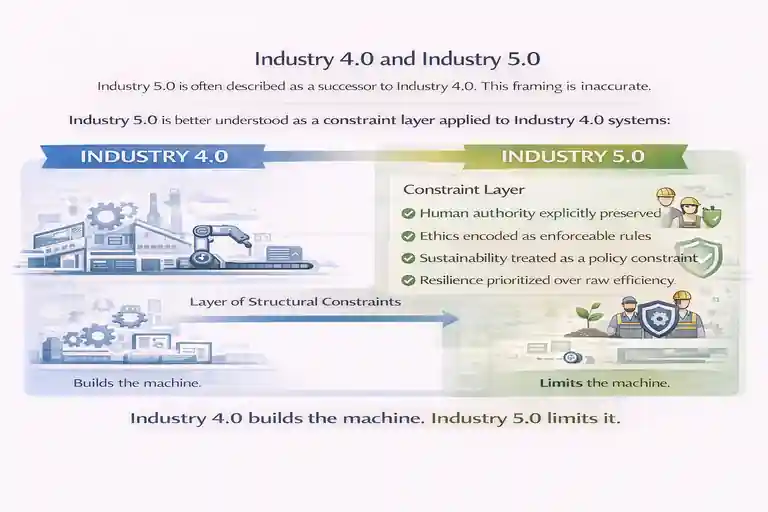
Industry 5.0 is often described as a successor to Industry 4.0. This framing is inaccurate.
Industry 5.0 is better understood as a constraint layer applied to Industry 4.0 systems:
-
Human authority explicitly preserved
-
Ethics encoded as enforceable rules
-
Sustainability treated as a policy constraint
-
Resilience prioritized over raw efficiency
Industry 4.0 builds the machine.
Industry 5.0 limits it.
Conclusion
Industry 4.0 is the discipline of converting engineering knowledge into enforceable systems.
By 2025, this conversion became unavoidable as complexity exceeded human governance capacity.
From 2026 onward, success will belong not to organizations that automate the fastest, but to those that control automation correctly.
Related Posts
External Reference
- European Commission
- NIST – Cyber-Physical Systems Framework (Governance & Control Perspective)
- ISO / IEC – ISO 23247: Digital Twin Framework for Manufacturing
FAQ on Industry 4.0 System Architecture
1. What is Industry 4.0 System Architecture?
Industry 4.0 System Architecture is a governance-centric architectural model that separates execution, data, rules, AI inference, and human oversight into distinct layers. Its goal is to enforce engineering decisions deterministically before execution, rather than correcting errors afterward.
2. How is Industry 4.0 System Architecture different from traditional automation?
Traditional automation focuses on speed and efficiency. Industry 4.0 System Architecture focuses on control, validation, and traceability, ensuring that only permitted actions can be executed across engineering and manufacturing systems.
3. Why is Industry 4.0 System Architecture not a technology stack?
Industry 4.0 System Architecture defines how decisions are governed, not which tools are used. Technologies like IoT, AI, and cloud platforms support the architecture but do not define it.
4. What are the core layers of Industry 4.0 System Architecture?
A mature Industry 4.0 System Architecture typically includes:
-
Execution layer
-
Data layer
-
Rule and policy layer
-
Explanation and oversight layer
Each layer has a clearly defined responsibility.
5. Why did Industry 4.0 System Architecture mature around 2025?
By 2025, system complexity exceeded human governance capacity. Industry 4.0 System Architecture matured because manual reviews, tribal knowledge, and dashboards could no longer prevent errors at scale.
6. What is the role of the control plane in Industry 4.0 System Architecture?
The control plane determines whether actions are allowed at all. In Industry 4.0 System Architecture, it enforces rules, validation logic, approvals, traceability, and rollback mechanisms—separate from execution systems.
7. What is the execution plane in Industry 4.0 System Architecture?
The execution plane performs actions deterministically using machines, robots, CAD/CAM, PLCs, and MES. Industry 4.0 System Architecture deliberately prevents execution systems from making governance decisions.
8. Why is separation of control and execution essential in Industry 4.0 System Architecture?
Without separation, execution tools override authority, leading to unpredictable behavior and compliance failure. Industry 4.0 System Architecture enforces this separation to maintain system stability and accountability.
9. What role does AI play in Industry 4.0 System Architecture?
In Industry 4.0 System Architecture, AI functions as an inference and assistance layer. It explains, detects patterns, and supports diagnostics—but never owns engineering authority or safety decisions.
10. Why can’t AI control Industry 4.0 System Architecture decisions?
AI is probabilistic and non-deterministic. Industry 4.0 System Architecture requires explicit, deterministic, and auditable rule enforcement, making AI unsuitable for direct control roles.
11. How do digital twins fit into Industry 4.0 System Architecture?
Effective digital twins in Industry 4.0 System Architecture focus on rules, configurations, processes, and compliance, rather than high-fidelity physics simulations that fail to scale operationally.
12. What is validation-first engineering in Industry 4.0 System Architecture?
Validation-first engineering prioritizes pre-execution checks, constraint validation, impact analysis, and change comparison. In Industry 4.0 System Architecture, validation becomes more important than creation speed.
13. What are common failure patterns in Industry 4.0 System Architecture?
Failures typically occur when:
-
Engineering rules remain implicit
-
Dashboards exist without enforcement
-
AI operates without deterministic guardrails
-
Engineering intent is not versioned
-
Authority and execution are not separated
These are architectural failures, not tool failures.
14. How is Industry 4.0 System Architecture maturity measured?
Industry 4.0 System Architecture maturity follows a governance curve:
-
Digitized
-
Connected
-
Governed
-
Assisted
-
Adaptive
By 2025, most serious organizations reached the Governed stage.
15. What are the structural requirements for Industry 4.0 System Architecture beyond 2026?
Future-ready Industry 4.0 System Architecture requires:
-
Machine-readable engineering rules
-
Validation-first workflows
-
Built-in explainability and auditability
-
Strict separation of authority, AI inference, and execution
These are permanent structural requirements, not trends.