
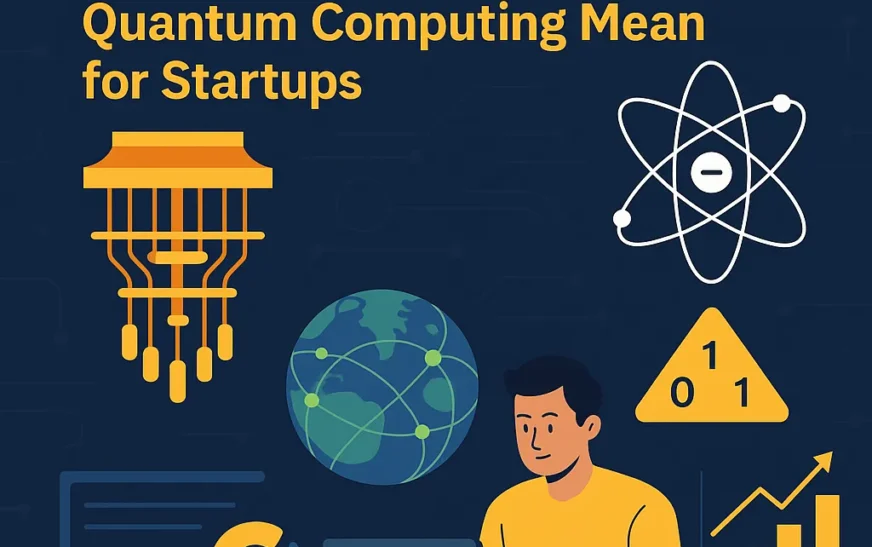
Introduction-Quantum Leap: What 2025’s Breakthroughs in Quantum Computing Mean for Startups
2025 is shaping up to be a game-changer in the world of quantum computing. While giants like IBM, Google, and Intel race to scale up quantum hardware, new software platforms are making quantum power accessible to businesses of all sizes—including startups.
But here’s the big question: How can quantum computing, something that sounds like pure science fiction, actually impact your startup today?
In this article, we break down the buzz around quantum computing, the real opportunities it brings in 2025, and why even small businesses should keep this on their radar.
🧩 What Is Quantum Computing (In Simple Terms)?
Unlike traditional computers that use bits (0 or 1), quantum computers use qubits, which can be 0, 1, or both at the same time (thanks to a principle called superposition). They also leverage entanglement, allowing qubits to work together in ways classical bits cannot.
The result? Quantum computers can process certain complex calculations millions of times faster than today’s best supercomputers.
Example:
-
Cracking complex encryption? Quantum computers could do it in minutes (what would take classical computers thousands of years).
-
Optimizing logistics routes across a city? Quantum can explore every possible path at once.
🌐 Why Startups Should Pay Attention
| Area | How Quantum Can Help | Example for Startups |
|---|---|---|
| Cybersecurity | Quantum-safe encryption to protect customer data | Future-proof your user accounts & payments |
| Machine Learning / AI | Speed up training of models and improve accuracy | Faster fraud detection or product recommendations |
| Logistics & Scheduling | Optimize delivery routes or resource allocation | Plan deliveries, workforce shifts efficiently |
| Drug Discovery / Healthcare | Model molecules at atomic scale | Healthtech startups may shorten R&D cycles |
| Finance & Trading | Risk analysis, portfolio optimization | Fintechs can run faster simulations |
💡 Did You Know?
Startups like Classiq, IonQ, and Q-CTRL are already offering tools to help non-quantum experts build quantum-ready solutions.
🔥 2025 Breakthroughs That Are Changing the Game
✅ IBM’s 1,000+ Qubit System: Now commercially available via the cloud, opening doors for real-world applications.
✅ Quantum as a Service (QaaS): Platforms like Amazon Braket and Microsoft Azure Quantum allow startups to rent quantum computing time without needing their own quantum machine.
✅ Open-source Quantum SDKs: Tools like Qiskit (IBM), Cirq (Google), and PennyLane make quantum programming more beginner-friendly.
🛠️ How Startups Can Get Started
-
Learn the Basics: Check out free courses from IBM Quantum, Great Learning, or Qiskit Textbook.
-
Try Quantum Simulators: Use cloud-based tools like IBM Quantum Experience or Azure Quantum to run simple experiments.
-
Partner with Experts: Collaborate with universities, research labs, or quantum-focused startups.
-
Focus on Use Cases That Matter: Don’t chase quantum hype—explore where optimization or simulation can directly impact your business.
⚡ Real-World Example:
💼 A supply chain startup in Germany used quantum algorithms to optimize warehouse picking paths, reducing labor costs by 30% and cutting delivery time by 20%—without owning any quantum hardware themselves.
🚀 Final Thoughts: Quantum Is Closer Than You Think
While full-scale quantum supremacy is still on the horizon, 2025’s breakthroughs are lowering the entry barrier. Early movers who explore quantum now will be better prepared when these technologies mature.
Startups that keep an eye on quantum—not as a far-off dream, but as an emerging tool—could unlock competitive advantages in optimization, AI, security, and innovation.