
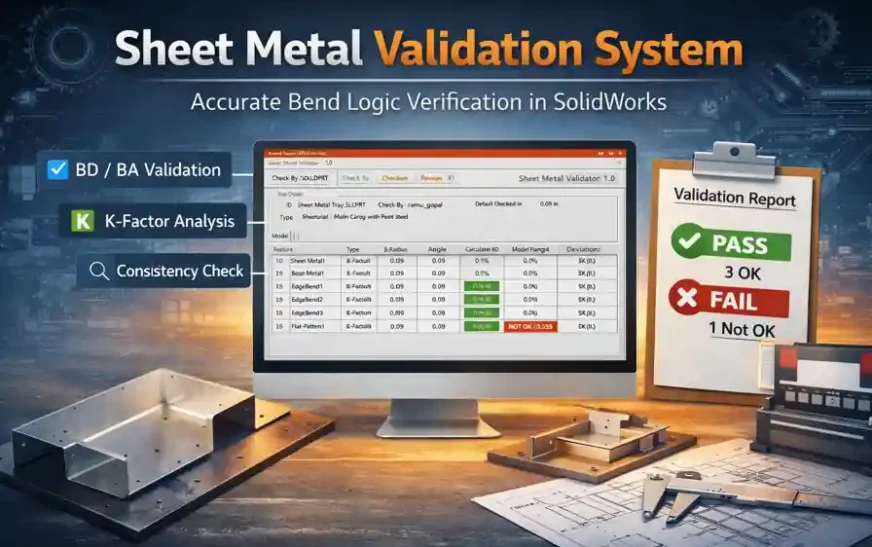
Introduction to Sheet Metal Validation System
A Sheet Metal Validation System is essential for detecting bend deduction errors, validating design logic, and ensuring manufacturing accuracy before production begins. In modern engineering workflows, even a small mistake in bend calculation or method selection can lead to costly rework, incorrect flat patterns, and production delays.
Sheet Metal Validation Sytem was Developed by Ramu Gopal, Founder of The Tech Thinker, this system is designed as a pre-manufacturing quality assurance engine that validates not just bend values, but also the underlying logic—whether it is based on Bend Deduction (BD), Bend Allowance (BA), or K-Factor in SolidWorks.
Traditional design approaches often rely on manual checks, assumptions, or experience. However, with increasing complexity in sheet metal components, relying solely on manual validation is no longer sufficient. This is where an automated Sheet Metal Validation System plays a critical role.
What is a Sheet Metal Validation System?
Definition of Sheet Metal Validation System
A Sheet Metal Validation System is an engineering validation framework that analyzes sheet metal models and verifies whether they are mathematically and manufacturably correct.
Unlike simple macros or calculators, this system:
- Evaluates bend logic
- Compares calculated vs model values
- Detects deviations
- Identifies inconsistencies across features
👉 It acts as a decision-making system, not just an automation script.
Core Functions of a Sheet Metal Validation System
The system performs multiple validation layers:
- Bend Deduction (BD) calculation and comparison
- Detection of method used (BD / BA / K-Factor)
- Feature-level validation (EdgeBend, EdgeFlange, etc.)
- Deviation analysis and pass/fail classification
This multi-layer validation ensures that the design is not only correct numerically but also consistent in engineering logic.
Why Sheet Metal Validation System is Important
Common Sheet Metal Design Errors
Even experienced engineers encounter issues such as:
- Incorrect K-factor values
- Wrong bend radius assumptions
- Using Bend Allowance instead of Bend Deduction
- Mixing BD, BA, and K-factor methods in a single model
- Manual calculation mistakes
These errors often go unnoticed during design and appear only during manufacturing.
Impact on Manufacturing
The consequences of these errors can be significant:
- Incorrect flat pattern development
- CNC bending mismatches
- Assembly misalignment
- Increased scrap and rework
- Delays in production
A Sheet Metal Validation System eliminates these risks by validating designs before they reach the shop floor.
How a Sheet Metal Validation System Works
Step-by-Step Workflow of Sheet Metal Validation System
The system follows a structured validation workflow:
- Model Detection
- Identifies active SolidWorks sheet metal part
- Feature Extraction
- Reads features such as EdgeFlange, EdgeBend, Flat Pattern
- Parameter Reading
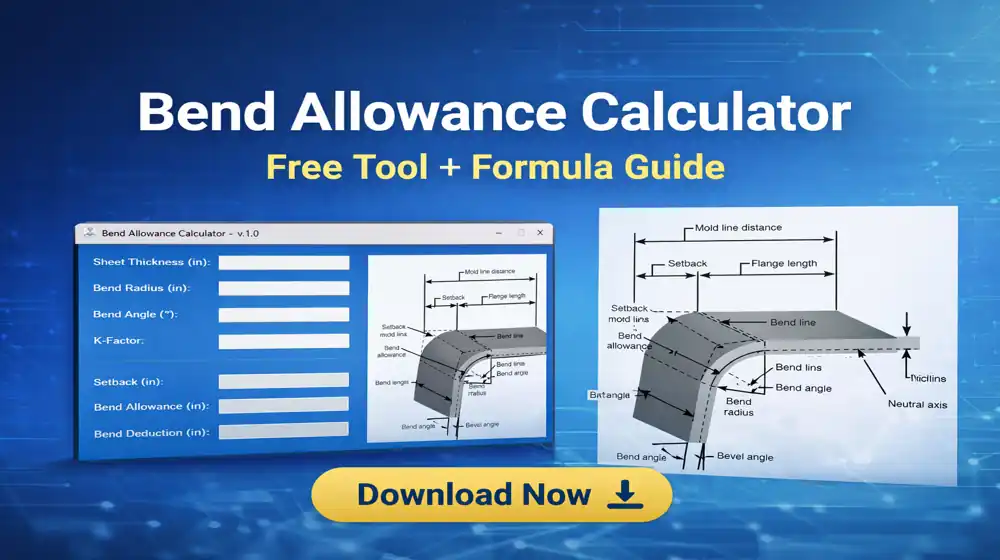
- Extracts thickness, radius, angle, and K-factor
- Bend Deduction Calculation
- Computes BD using engineering formulas
- Model Value Extraction
- Reads BD/BA from SolidWorks feature
- Comparison Engine
- Compares calculated vs model values
- Deviation Detection
- Identifies mismatch and classifies OK / NOT OK
Key Parameters Used in Validation
| Parameter | Purpose |
|---|---|
| Thickness | Base dimension for calculation |
| Bend Radius | Influences neutral axis |
| Bend Angle | Determines bend geometry |
| K-Factor | Defines material behavior |
Types of Validation in Sheet Metal Validation System
This is the most powerful part of the system.
1. Bend Deduction (BD) Validation
- Compares calculated BD with model BD
- Detects numerical mismatch
2. Bend Allowance (BA) Validation
- Identifies if BA is used instead of BD
- Evaluates conversion accuracy
3. K-Factor-Based Validation
- Recalculates BD using K-factor
- Verifies correctness of design assumptions
4. Method Validation (BD vs BA vs K-Factor)
- Detects which method is used
- Validates if the chosen method is appropriate
5. Consistency Validation Across Features
- Ensures all bends follow the same logic
- Detects mixed definitions in a single model
👉 This is a key differentiator of the system.
7 Powerful Ways a Sheet Metal Validation System Prevents Errors
1. Detect Bend Deduction Errors Automatically
The system calculates BD independently and compares it with the model, instantly identifying deviations.
2. Validate BD / BA / K-Factor Method Usage
It ensures that the correct method is used and prevents incorrect logic selection.
3. Perform Feature-Level Validation
Each bend feature is validated individually, providing precise insights.
4. Identify Manufacturing-Critical Deviations
Even small deviations (e.g., 0.185 mm) are detected before production.
5. Provide Instant Pass/Fail Summary
The system generates a clear summary of total, passed, and failed bends.
6. Eliminate Manual Calculation Errors
Removes dependency on manual formulas and spreadsheets.
7. Standardize Sheet Metal Design Across Teams
Ensures consistent design practices across engineers and projects.
Real-World Example of Sheet Metal Validation System
Example Scenario
- Total bends: 4
- Passed: 3
- Failed: 1
One feature shows deviation of 0.185, marked as NOT OK.
Before vs After Validation
| Scenario | Without System | With System |
|---|---|---|
| Error detection | Late | Early |
| Rework | High | Minimal |
| Accuracy | Uncertain | High |
Manual Checking vs Sheet Metal Validation System
| Criteria | Manual | System |
|---|---|---|
| Accuracy | Medium | High |
| Time | High | Low |
| Feature-Level Insight | No | Yes |
| Consistency Check | Limited | Advanced |
Sheet Metal Validation System in SolidWorks by Ramu Gopal
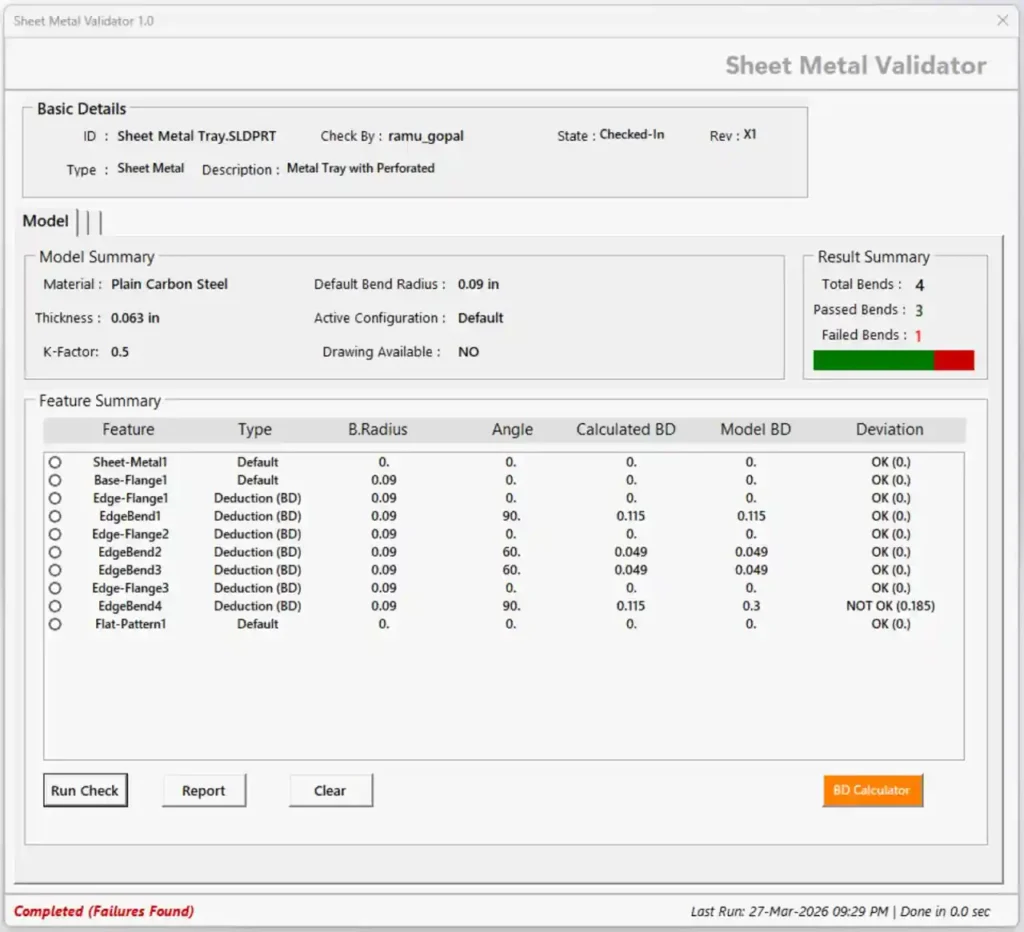
Integration with SolidWorks API
A robust Sheet Metal Validation System is deeply integrated with SolidWorks through its API (Application Programming Interface), enabling direct access to model data, feature definitions, and sheet metal parameters.
Unlike manual inspection or static tools, API-based integration allows the system to interact dynamically with the CAD model, ensuring real-time validation and accurate data extraction.
How the System Interacts with SolidWorks
The system leverages SolidWorks API capabilities to perform the following operations:
🔹 Read Sheet Metal Features
- Traverses the FeatureManager Tree
- Identifies key features such as:
- Base Flange
- Edge Flange
- Edge Bend
- Flat Pattern
👉 This ensures that validation is performed at the feature level, not just globally.
🔹 Extract Engineering Parameters
For each identified feature, the system extracts:
- Sheet thickness
- Bend radius
- Bend angle
- K-factor
- Bend type (BD / BA / K-factor driven)
This data forms the foundation for accurate validation.
🔹 Validate Bend Logic
Using extracted parameters, the system:
- Recalculates Bend Deduction (BD)
- Compares it with the model-defined value
- Evaluates deviation
- Classifies each feature as:
- ✅ OK
- ❌ NOT OK
👉 This transforms SolidWorks from a design tool into a validation-enabled environment.
🔹 Real-Time Model Evaluation
Because the system runs directly within the SolidWorks environment:
- Validation can be triggered instantly
- Engineers receive immediate feedback
- Errors are corrected during design—not after
Workflow Integration
Beyond standalone validation, a Sheet Metal Validation System can be integrated into broader engineering workflows, making it a key component of digital manufacturing pipelines.
🔹 PDM Check-in Validation
The system can be integrated with Product Data Management (PDM) workflows to:
- Automatically validate models during check-in
- Prevent incorrect designs from entering the vault
- Enforce validation rules before approval
👉 This ensures only validated and production-ready designs are stored.
🔹 Quality Assurance (QA) Workflows
In QA environments, the system can act as:
- A pre-release validation tool
- A checklist for design verification
- A compliance verification mechanism
This reduces dependency on manual review and improves consistency.
🔹 Design Approval Systems
The validation system can also be embedded into approval workflows:
- Engineers run validation before submission
- QA teams verify results
- Managers approve only validated designs
👉 This creates a structured and reliable approval pipeline.
🔹 Team Standardization
By integrating validation into workflows:
- All engineers follow the same logic
- Design inconsistencies are minimized
- Best practices are enforced automatically
Future of Sheet Metal Validation System
As engineering systems evolve, the Sheet Metal Validation System is moving beyond rule-based validation toward intelligent, adaptive systems.
AI-Based Sheet Metal Validation
The next generation of validation systems will incorporate Artificial Intelligence to enhance accuracy and decision-making.
Future Capabilities
🔹 Predictive Error Detection
- Identify potential errors before they occur
- Analyze patterns across multiple designs
🔹 Intelligent Correction Suggestions
- Suggest correct BD / BA values
- Recommend proper K-factor
- Auto-adjust inconsistent features
🔹 Learning from Historical Data
- Learn from past validated models
- Improve accuracy over time
- Adapt to different manufacturing standards
🔹 Context-Aware Validation
- Understand material type
- Consider machine-specific bending behavior
- Adjust validation rules dynamically
Engineering Compliance Systems
The evolution of the Sheet Metal Validation System leads to a broader concept:
👉 Engineering Compliance Systems
What is an Engineering Compliance System?
It is a unified platform that ensures all engineering designs:
- Follow defined standards
- Meet manufacturing requirements
- Pass validation rules
- Maintain consistency across projects
How this System Fits This Vision
Your current system already includes:
- Bend logic validation
- Method validation (BD / BA / K-factor)
- Feature-level analysis
- Deviation detection
👉 These are the core building blocks of a compliance system.
Future Expansion Possibilities
This system can evolve into:
- Multi-module validation platform
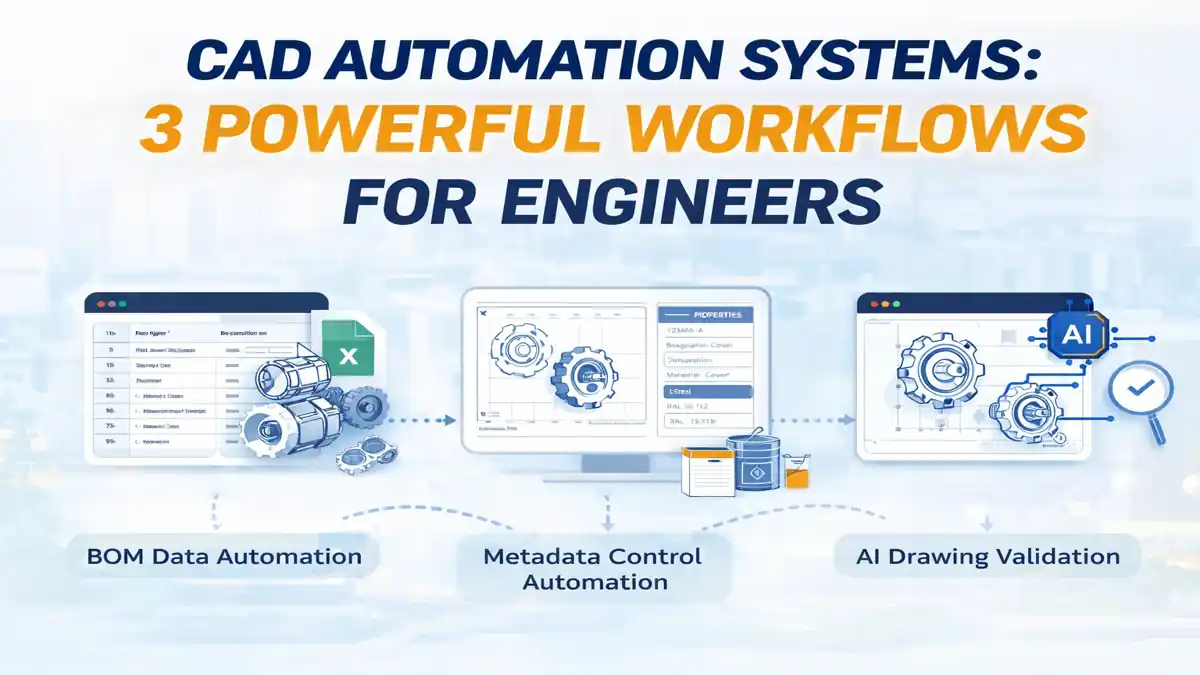
- Drawing validation (dimensions, notes, BOM)
- Assembly-level validation
- Integration with ERP / MES systems
Final Vision
The long-term direction is clear:
👉 From Validation Tool → Validation System → Engineering Compliance Suite
Conclusion
A Sheet Metal Validation System is no longer a luxury—it is a necessity for modern engineering workflows. By validating bend logic, detecting deviations, and ensuring consistency, it transforms sheet metal design into a reliable, scalable process.
Sheet Metal Validation Sytem was Developed by Ramu Gopal, Founder of The Tech Thinker, this system represents a shift from manual checking to intelligent validation.
If you aim to reduce errors, improve accuracy, and build scalable engineering workflows, adopting a Sheet Metal Validation System is the next logical step.
FAQ on Sheet Metal Validation System
1. What is a Sheet Metal Validation System?
A Sheet Metal Validation System is a CAD validation framework that verifies bend logic, Bend Deduction (BD), Bend Allowance (BA), K-factor, and feature-level consistency before a model is released for manufacturing. At The Tech Thinker, this is positioned as a complete engineering system and framework, not just a bend calculator.
2. How does a Sheet Metal Validation System work in SolidWorks?
A Sheet Metal Validation System in SolidWorks uses the SolidWorks API to:
- read sheet metal features
- extract thickness, bend radius, angle, and K-factor
- identify BD / BA / K-factor method
- compare calculated vs model-defined values
- detect deviations and pass/fail status
This makes it ideal for SolidWorks automation and CAD quality assurance workflows.
3. Why is a Sheet Metal Validation System important for manufacturing?
Small bend logic mistakes can create:
- incorrect flat patterns
- CNC bend mismatch
- scrap
- rework
- design approval delays
A Sheet Metal Validation System prevents these issues at the design stage, reducing downstream manufacturing risk.
4. What is the difference between BD, BA, and K-factor validation?
Here’s a quick comparison table for clarity:
| Validation Type | What It Checks | Why It Matters |
|---|---|---|
| BD Validation | Bend Deduction values | Prevents wrong flat length |
| BA Validation | Bend Allowance logic | Detects method misuse |
| K-factor Validation | Neutral axis placement | Improves bend accuracy |
| Method Validation | BD vs BA vs K-factor | Prevents mixed definitions |
This layered validation approach is one of the strengths of Ramu Gopal’s Sheet Metal Validation System framework.
5. Can this system validate individual bend features?
Yes. The framework performs feature-level validation on:
- Base Flanges
- Edge Flanges
- Edge Bends
- Flat Pattern definitions
This helps isolate the exact bend feature causing a validation failure.
6. How does this improve flat pattern accuracy?
By validating the bend method, parameters, and consistency, the system improves:
- developed length accuracy
- bend deduction reliability
- fabrication readiness
- press brake confidence
- downstream drawing correctness
This is critical for sheet metal design validation and manufacturing automation.
7. Is this only a tool or a complete engineering system?
This is best understood at three levels:
| Level | Meaning |
|---|---|
| Tool | The working UI and checker |
| System | End-to-end validation workflow |
| Framework | Reusable engineering logic for future compliance systems |
This is how The Tech Thinker positions the concept for long-term engineering automation.
8. Can it be integrated with SolidWorks PDM workflows?
Yes. A Sheet Metal Validation System can be integrated into:
- PDM check-in validation
- design approval gates
- QA release workflows
- revision-based validation rules
- enterprise CAD governance
This supports Engineering Compliance System growth.
9. What types of sheet metal errors can detect by this The Tech Thinker Sheet metal Validation System?
The system can detect:
- wrong BD values
- wrong BA usage
- K-factor inconsistency
- mixed logic across bends
- deviation beyond tolerance
- feature mismatch
- manufacturability risks
- design release errors
10. How is this better than manual checking?
Compared to spreadsheets and manual review, this system is:
- faster
- repeatable
- less error-prone
- feature-aware
- scalable for teams
- better for QA pipelines
This makes it a stronger fit for CAD automation systems and engineering validation frameworks.
11. Can this evolve into an Engineering Compliance System?
Yes. This is one of the strongest future directions discussed at The Tech Thinker.
The same framework can expand into:
- drawing validation
- metadata validation
- BOM validation
- design release checks
- PDM compliance
- workflow governance
- multi-CAD engineering compliance
This is where the Sheet Metal Validation System becomes a broader Engineering Compliance Suite.
12. Who developed this validation system concept?
This system-oriented approach is developed and presented by Ramu Gopal, Founder of The Tech Thinker, as part of a broader mission around:
- SolidWorks automation
- CAD validation systems
- engineering compliance frameworks
- manufacturability-first design systems
13. Can AI improve this Sheet Metal Validation System?
Yes. Future AI-based systems can:
- predict likely bend errors
- recommend BD / BA corrections
- suggest proper K-factor
- learn from validated models
- improve rule intelligence over time
This supports AI-assisted engineering validation systems. Ramu Gopal focusing on AI Implementation.
14. Is this useful for small teams and large enterprises?
Absolutely. The framework is useful for any team size:
- freelancers
- small CAD teams
- design offices
- QA departments
- enterprise PDM workflows
- OEM validation pipelines
Even one prevented bend error can justify the system.