
What Are Validation-First Engineering Systems?
Validation-first engineering systems are system architectures where validation is treated as a governing function, not a post-execution quality check.
In many modern digital systems, execution happens first and validation follows later. This approach assumes that errors can be detected, corrected, or rolled back after the fact. That assumption no longer holds in environments where automation interacts with physical assets, safety-critical operations, or regulated decision flows.
Validation-first engineering systems reverse this logic.
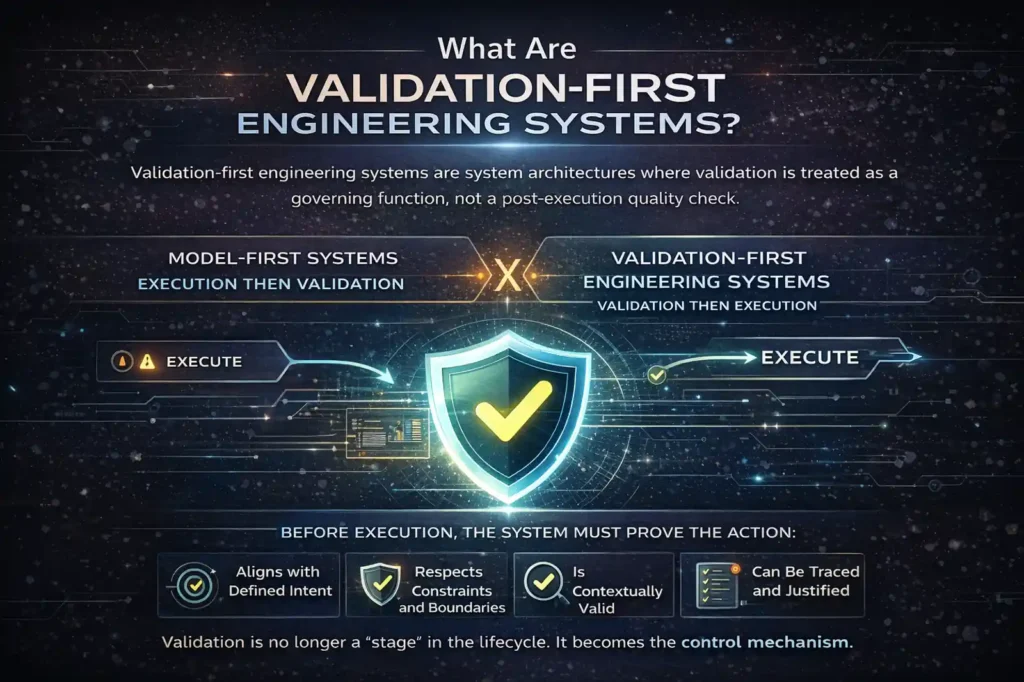
Before a system is allowed to act, it must prove that the action:
-
Aligns with defined intent
-
Respects constraints and boundaries
-
Is contextually valid
-
Can be traced and justified
Validation is no longer a “stage” in the lifecycle.
It becomes the control mechanism.
The “Guardian” Architecture
To achieve this, systems move from a single-stream execution to a Two-Plane Architecture. The Action Plane (where the AI or automation logic lives) is separated from the Governing Plane.
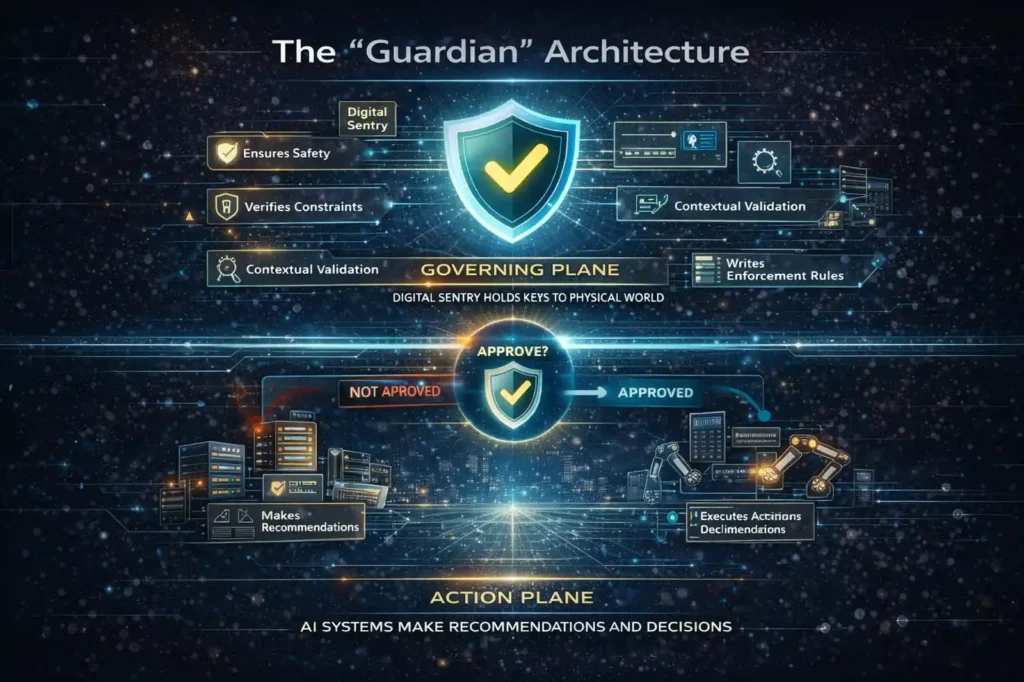
Think of the Governing Plane as a “Digital Sentry” that holds the keys to the physical world. It doesn’t generate the ideas; it mathematically verifies if the ideas are safe to execute before a single circuit is closed or a single line of data is written.
Why Technology Is Quietly Re-Architecting Itself
For years, technological progress was measured by:
-
Faster computation
-
Better algorithms
-
Larger datasets
-
Increased automation
Today, those are no longer limiting factors.
The real bottleneck is trust.
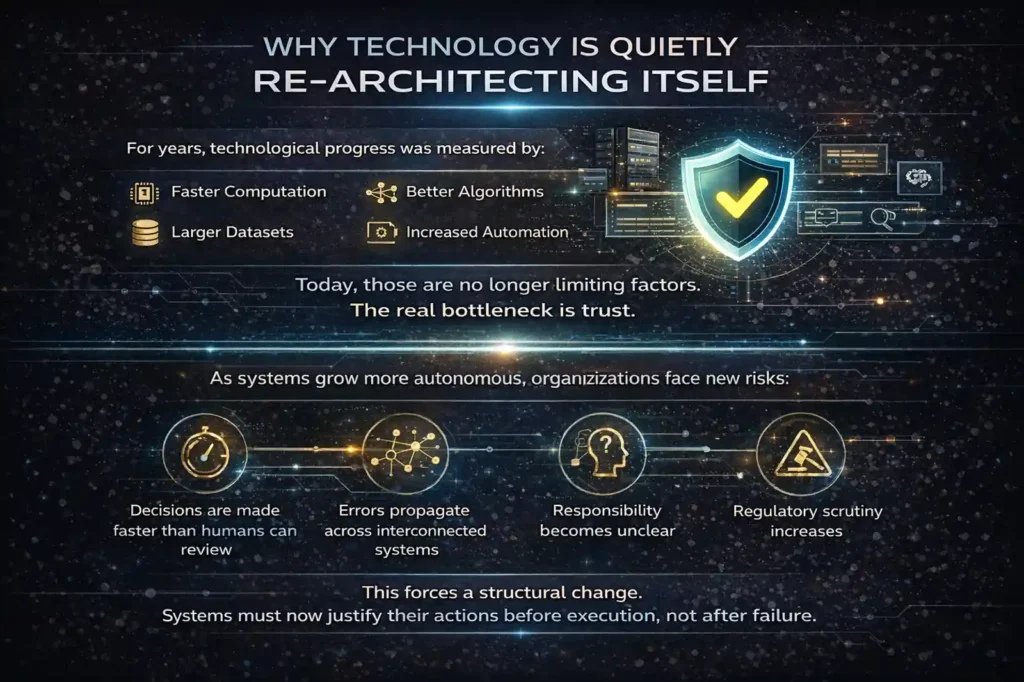
As systems grow more autonomous, organizations face new risks:
-
Decisions are made faster than humans can review
-
Errors propagate across interconnected systems
-
Responsibility becomes unclear
-
Regulatory scrutiny increases
This forces a structural change.
Systems must now justify their actions before execution, not after failure.
That requirement is the foundation of validation-first engineering systems.
The Hidden Cost of Model-First Thinking
Model-first systems focus on prediction accuracy, confidence scores, and benchmark results. While these metrics are useful, they do not represent real-world reliability.
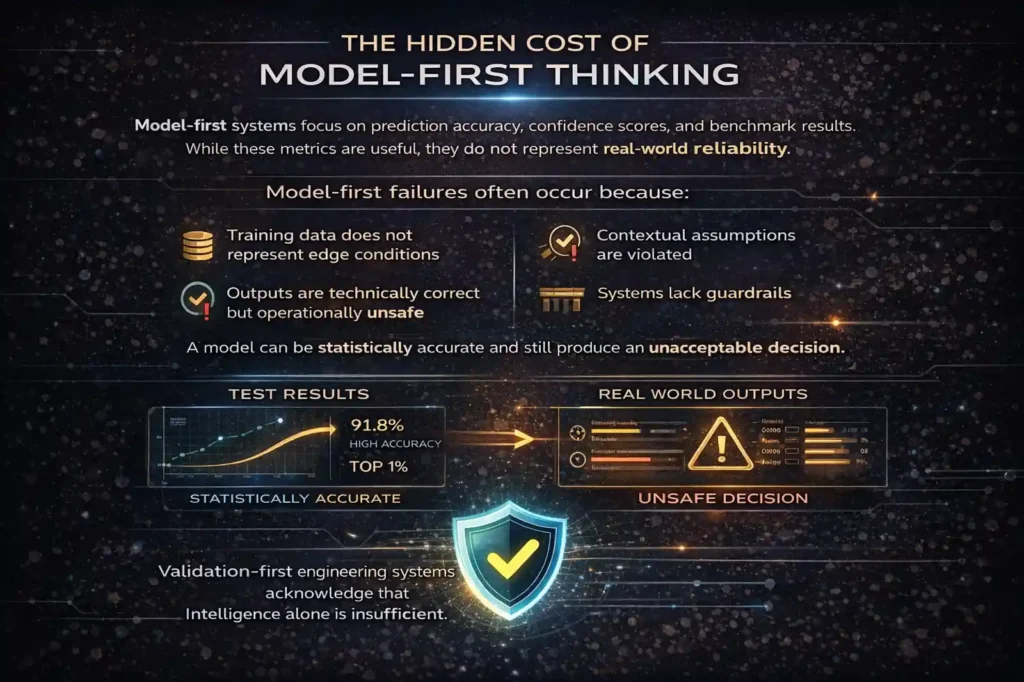
Model-first failures often occur because:
-
Training data does not represent edge conditions
-
Contextual assumptions are violated
-
Outputs are technically correct but operationally unsafe
-
Systems lack guardrails
A model can be statistically accurate and still produce an unacceptable decision.
Validation-first engineering systems acknowledge that intelligence alone is insufficient. Intelligence must operate within explicitly enforced boundaries.
The “Glass Box” Constraint
This shift solves the “Black Box Problem.” While modern AI models are statistical and probabilistic, Validation-First systems surround them with a Glass Box of deterministic constraints.
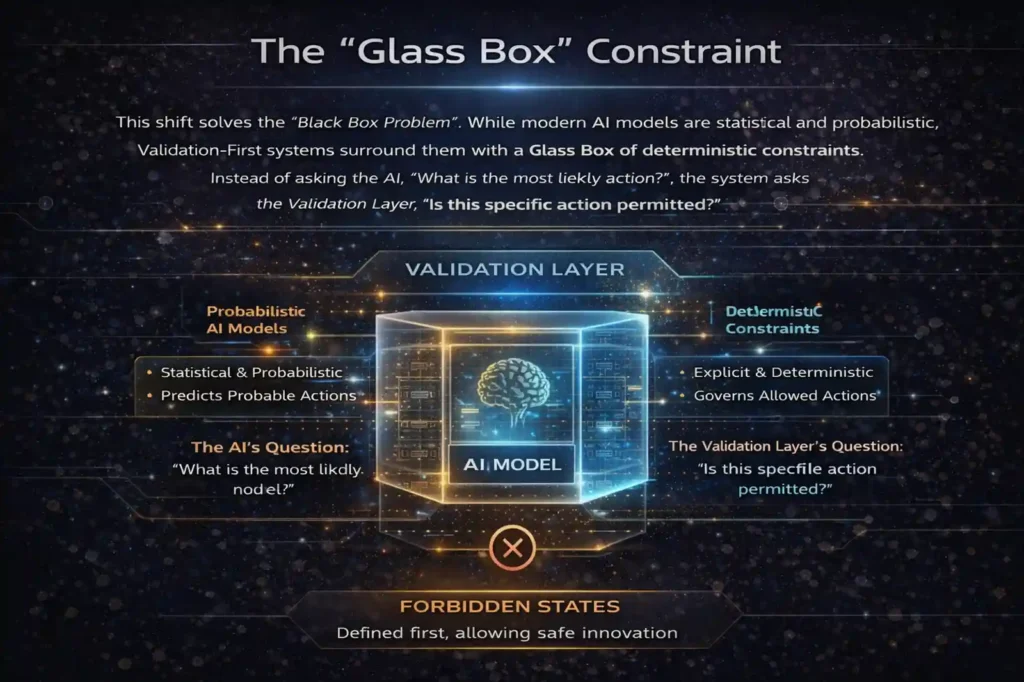
Instead of asking the AI, “What is the most likely action?”, the system asks the Validation Layer, “Is this specific action permitted?” By defining the ‘Forbidden States’ of a system first, we allow for maximum innovation within a guaranteed safety cage.
Validation-First Engineering Systems vs Traditional Architectures
| Dimension | Traditional Systems | Validation-First Engineering Systems |
|---|---|---|
| Execution priority | High | Conditional |
| Validation timing | After execution | Before execution |
| Error discovery | Reactive | Preventive |
| Human role | Post-incident | Pre-decision authority |
| AI role | Autonomous decision | Advisory reasoning |
| Audit readiness | Optional | Mandatory |
| Failure tolerance | Assumed manageable | Designed to be minimal |
This comparison highlights why validation-first engineering systems are becoming essential in complex environments.
Why Validation Cost Is Replacing Development Cost
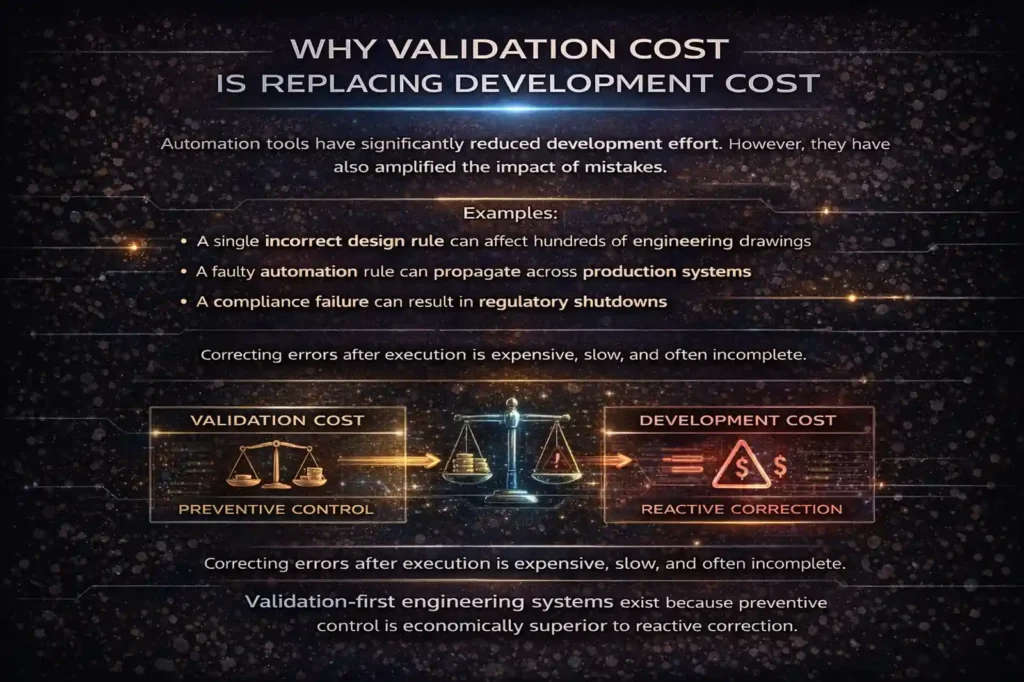
Automation tools have significantly reduced development effort. However, they have also amplified the impact of mistakes.
Examples:
-
A single incorrect design rule can affect hundreds of engineering drawings
-
A faulty automation rule can propagate across production systems
-
A compliance failure can result in regulatory shutdowns
Correcting errors after execution is expensive, slow, and often incomplete.
Validation-first engineering systems exist because preventive control is economically superior to reactive correction.
The “Rule of 10” in Automation
The economic drive behind this is the Shift-Left Principle. In traditional engineering, a bug caught in design costs $1, while that same bug caught in production costs $100.
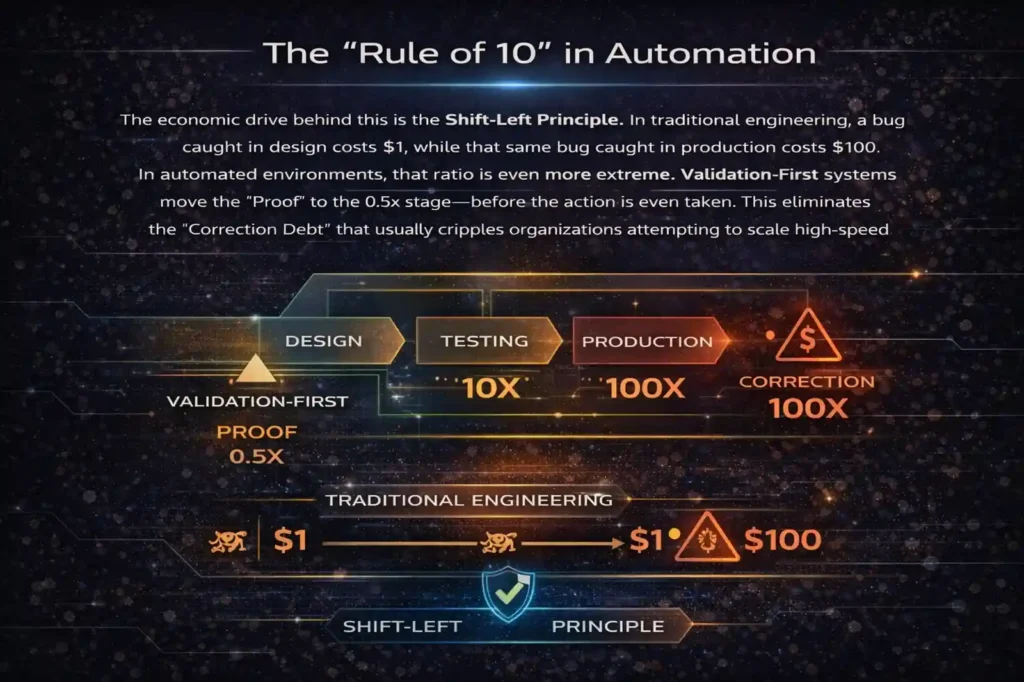
In automated environments, that ratio is even more extreme. Validation-First systems move the “Proof” to the 0.5x stage—before the action is even taken. This eliminates the “Correction Debt” that usually cripples organizations attempting to scale high-speed automation.
How Validation-First Engineering Systems Actually Work
Validation-first engineering systems rely on layered control rather than linear execution.
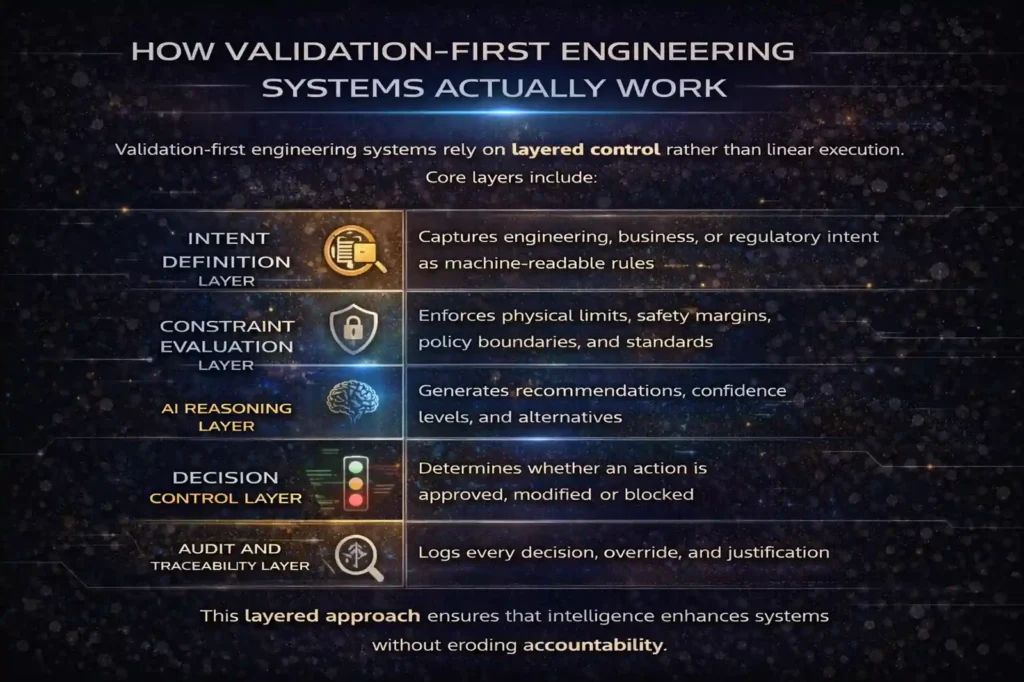
Core layers include:
-
Intent Definition Layer
Captures engineering, business, or regulatory intent as machine-readable rules -
Constraint Evaluation Layer
Enforces physical limits, safety margins, policy boundaries, and standards -
AI Reasoning Layer
Generates recommendations, confidence levels, and alternatives -
Decision Control Layer
Determines whether an action is approved, modified, or blocked -
Audit and Traceability Layer
Logs every decision, override, and justification
This layered approach ensures that intelligence enhances systems without eroding accountability.
The Digital Twin Gate
A primary tool in this layered approach is the Autonomous Digital Twin. In this setup, the “Constraint Evaluation Layer” runs a millisecond-fast simulation of the proposed action in a virtual mirror of the real world.
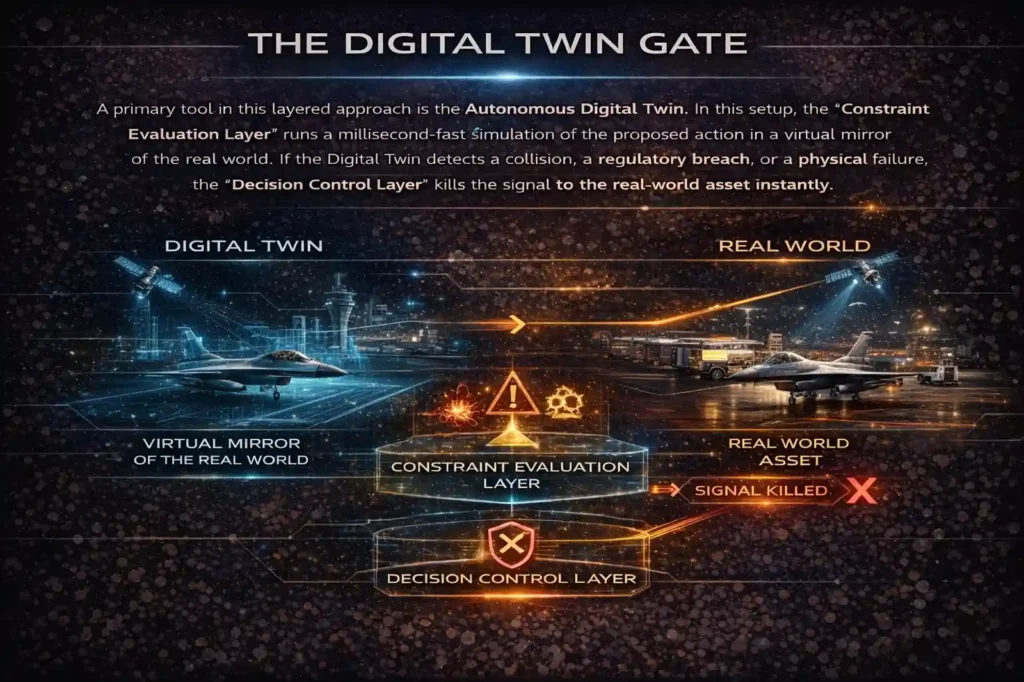
If the Digital Twin detects a collision, a regulatory breach, or a physical failure, the “Decision Control Layer” kills the signal to the real-world asset instantly.
Validation-First Engineering Systems and Industry 5.0
Industry 5.0 introduces explicit human-centric constraints into automated environments.
Validation-first engineering systems enable Industry 5.0 principles by:
-
Preserving human authority
-
Enforcing ethical boundaries programmatically
-
Embedding sustainability constraints
-
Prioritizing resilience over throughput
Industry 4.0 focused on automation.
Industry 5.0 focuses on permission to automate.
The Rise of the Trust Architect
As demand shifts, we are seeing the emergence of a new elite role: the Trust Architect. These professionals do not focus on how to make a system work—that is now the job of AI. Instead, Trust Architects focus on how to make a system fail-safe. They specialize in translating complex human ethics, safety laws, and physical constraints into the machine-readable code that forms the “Decision Control Layer.”
Validation-First Engineering Systems in High-Risk Domains
Validation-first engineering systems are not theoretical constructs. They are already emerging most clearly in domains where errors are expensive, irreversible, or legally consequential.
These environments expose the limitations of model-first thinking faster than consumer software ever could.
Aerospace and Defense Systems
In aerospace systems, a single incorrect automated decision can lead to catastrophic failure. Model-first AI systems struggle here because statistical confidence is meaningless when failure tolerance approaches zero.
Validation-first engineering systems address this by:
-
Enforcing deterministic flight, load, and safety constraints
-
Blocking AI-generated actions that violate certified envelopes
-
Logging every decision for post-event traceability
Here, AI may propose optimizations, but permission to act is always governed by validation logic.
Healthcare and Clinical Decision Support
Healthcare systems face a similar challenge. AI models can assist in diagnosis or treatment recommendations, but they cannot be allowed to act autonomously.
Validation-first engineering systems ensure that:
-
Recommendations are checked against patient context
-
Contraindications and safety limits are enforced
-
Human clinicians retain final authority
In this domain, validation-first engineering systems do not slow care—they prevent irreversible mistakes.
Manufacturing and Industrial Automation
In manufacturing, automation errors propagate quickly. A single incorrect parameter can affect hundreds of parts before detection.
Validation-first engineering systems prevent this by:
-
Validating design rules before fabrication
-
Enforcing process constraints at machine level
-
Blocking execution when tolerance violations occur
This approach transforms quality control from inspection-based to prevention-based.
Financial and Regulatory Systems
Financial systems operate under strict regulatory scrutiny. Model-first automation often fails because it cannot explain or justify decisions.
Validation-first engineering systems provide:
-
Rule-based compliance enforcement
-
Decision traceability for audits
-
Clear separation between recommendation and execution
In regulated environments, explainability is not optional—it is operationally mandatory.
Deterministic Systems and AI: A Necessary Partnership
Purely deterministic systems struggle with complexity.
Purely AI-driven systems struggle with predictability.
Validation-first engineering systems combine both approaches:
-
Deterministic rules define non-negotiable boundaries
-
AI explores valid options within those boundaries
This hybrid model provides scalability without sacrificing control.
Business Benefits of Validation-First Engineering Systems
Organizations adopting validation-first engineering systems gain long-term advantages:
-
Reduced operational risk
-
Improved regulatory compliance
-
Lower rework costs
-
Faster safe deployment of automation
-
Increased stakeholder trust
These benefits compound over time, especially in regulated industries.
Business Risk Reduction Through Validation-First Engineering Systems
Business Risk Reduction Through Validation-First Engineering Systems
For businesses, the true value of validation-first engineering systems lies not in performance gains, but in risk containment.
As automation scales, organizations face a new class of systemic risks:
-
Silent failures that go unnoticed
-
Errors that propagate across systems
-
Regulatory exposure without audit trails
Validation-first engineering systems directly address these risks.
Key Business Advantages
-
Lower cost of failure by preventing errors before execution
-
Audit-ready operations with complete decision traceability
-
Regulatory resilience in compliance-heavy industries
-
Brand protection by avoiding public automation failures
From a business perspective, validation-first engineering systems act as insurance policies embedded in architecture.
Traditional Automation vs Validation-First Systems (Business View)
| Business Dimension | Traditional Automation | Validation-First Engineering Systems |
|---|---|---|
| Failure detection | After impact | Before execution |
| Regulatory exposure | High | Controlled |
| Audit effort | Manual | Built-in |
| Scaling automation | Risky | Controlled |
| Executive confidence | Low | High |
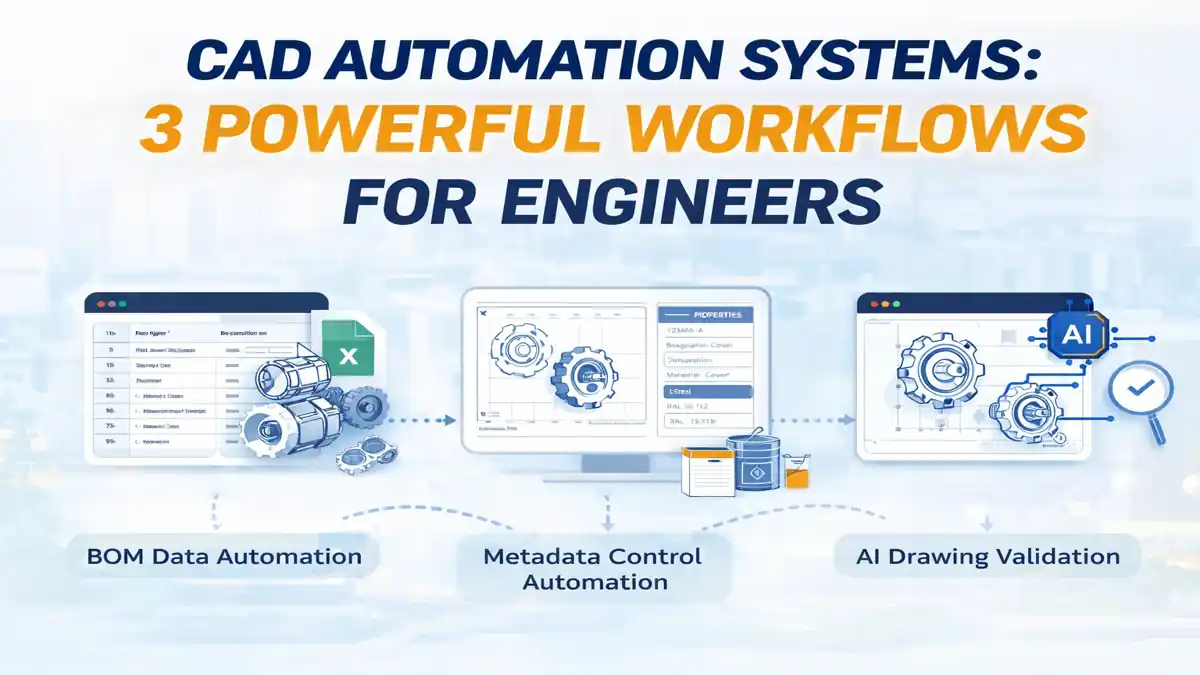
Engineerign Drawing Change Detection System: Pixel-Based Differencing vs. Semantic Engineering Validation
| Feature | BitBlt / Pixel XOR | AI-Powered ROI + OCR Approach |
| Core Philosophy | Graphical Differencing: Focuses on where pixels changed. | Engineering Validation: Focuses on what the change means. |
| Data Level | Unstructured: Sees the drawing as a flat grid of light/dark points. | Structured: Extracts “Engineering Tokens” (Dimensions, Labels, Notes). |
| Noise Handling | Poor: Flags every minor scan shift or line-weight variation as a “change.” | Strong: Uses Alignment and ROI to filter out visual noise and focus on real data. |
| Contextual Awareness | None: Cannot tell the difference between a title block change and a view change. | High: Understands regions like Section Views, Front Views, and Isometric Views. |
| Output Quality | Visual Map: A “heatmap” that still requires a human to manually audit every spot. | Audit Log: A structured report (e.g., “Dimension changed from 10 to 12”). |
| System Maturity | Industry 4.0: Automates a repetitive visual task. | Industry 5.0: Enables Human-AI collaboration by providing interpreted data. |
Above table shows Industry 4.0 vs Industry 5.0 Comparision
The shift from BitBlt to an ROI+OCR pipeline represents the evolution from Industry 4.0 automation to Industry 5.0 Validation-First Systems. Instead of generating a “noisy” heatmap that requires manual human verification, this approach uses AI to mimic an engineer’s logic—identifying specific views and reading annotations. It bridges the gap between “dead” 2D data and the “intelligent” reporting needed for modern, data-driven engineering workflows.
Career Impact of Validation-First Engineering Systems
The rise of validation-first engineering systems changes professional demand.
Increasing demand:
-
System architects
-
Automation engineers
-
Validation engineers
-
Compliance-aware technologists
Declining relevance:
-
Manual checkers
-
Tool-only operators
-
Isolated model developers
Professionals who understand system behavior, constraints, and failure modes will dominate future roles.
Why Validation-First Engineering Systems Are Creating the “Trust Architect” Role
As automation matures, a new professional role is emerging: the Trust Architect.
Trust Architects do not focus on how to build systems quickly. That problem has largely been solved by modern tooling and AI assistance. Instead, they focus on how to make systems fail-safe, auditable, and trustworthy.
Their responsibilities include:
-
Translating regulations and ethics into executable rules
-
Defining forbidden system states
-
Designing human override mechanisms
-
Ensuring traceability across automated decisions
This role sits at the intersection of engineering, governance, and systems design.
In validation-first engineering systems, trust is engineered—not assumed.
Real-World Use Cases Across Industries
Validation-first engineering systems are already used in:
-
Engineering design validation
-
Manufacturing process control
-
Healthcare decision-support systems
-
Financial compliance automation
-
Infrastructure safety monitoring
In each case, validation prevents failures that testing alone cannot detect.
Common Misconceptions About Validation-First Systems
-
“Validation slows innovation”
In reality, it enables safe scaling. -
“Validation replaces intelligence”
It governs intelligence, not replaces it. -
“Validation is just testing”
Validation checks intent and context, not just output correctness.
Why Validation-First Engineering Systems Will Outlive AI Trends
AI models will continue to evolve rapidly. Architectures will change. Tools will come and go.
However, validation-first engineering systems address a structural requirement, not a technological trend.
As systems gain autonomy, societies demand:
-
Accountability
-
Transparency
-
Control
These demands are independent of model architecture or algorithmic fashion.
Validation-first engineering systems provide a stable framework where new AI capabilities can be integrated without destabilizing trust.
That is why this approach is not temporary—it is foundational.
Final Thoughts: Why Validation-First Engineering Systems Will Endure
Technology is no longer limited by intelligence.
It is limited by trust.
Validation-first engineering systems provide the structure required for intelligent systems to operate safely, transparently, and responsibly.
As automation continues to expand into critical domains, validation will not be optional.
It will be the foundation of every system that deserves to be trusted.
Related Articles
- Machine Learning in Production
- Industry 4.0 System Architecture
- machine learning model evaluation metrics
External Reference
- NIST – AI Risk Management Framework (AI RMF 1.0)
- OECD – Principles on Artificial Intelligence
- ISO/IEC – AI Governance & Risk Management (ISO/IEC 23894 / 42001)
Frequently Asked Questions (FAQs)
1. What are Validation-First Engineering Systems in simple terms?
Validation-First Engineering Systems are architectures where every automated action is checked against rules, constraints, and intent before execution. Instead of correcting mistakes after failure, these systems prevent unsafe or invalid actions from occurring in the first place.
2. How are Validation-First Engineering Systems different from traditional testing?
Traditional testing verifies outputs after execution. Validation-First Engineering Systems verify permission to act before execution, ensuring that decisions align with safety, compliance, and contextual constraints rather than just producing correct-looking results.
3. Why are Validation-First Engineering Systems important in 2026 and beyond?
As AI-driven automation expands into safety-critical and regulated domains, trust becomes the limiting factor. Validation-First Engineering Systems provide the structural control required to scale automation responsibly without increasing systemic risk.
4. Do Validation-First Engineering Systems slow down automation?
No. Validation-First Engineering Systems reduce downstream delays by preventing costly failures, rework, and regulatory issues. While validation adds upfront checks, it significantly accelerates safe long-term scaling.
5. Can Validation-First Engineering Systems work with AI and machine learning models?
Yes. Validation-First Engineering Systems are designed to work alongside AI. AI generates recommendations, while the validation layer governs whether those recommendations are allowed to execute based on predefined constraints.
6. Are Validation-First Engineering Systems only for large enterprises?
No. While large enterprises adopt them first due to regulatory exposure, Validation-First Engineering Systems are equally valuable for small and mid-sized organizations that rely on automation and cannot afford cascading failures.
7. What industries benefit most from Validation-First Engineering Systems?
Industries such as manufacturing, healthcare, aerospace, finance, infrastructure, and engineering design benefit the most, as these domains have low tolerance for automation errors and high compliance requirements.
8. How do Validation-First Engineering Systems improve system trust?
They make decisions transparent, auditable, and explainable. By enforcing rules and logging every decision path, Validation-First Engineering Systems ensure that system behavior can always be justified and reviewed.
9. Are Validation-First Engineering Systems a replacement for human decision-making?
No. Validation-First Engineering Systems preserve human authority by introducing human-in-the-loop checkpoints for critical decisions, ensuring that automation supports human judgment rather than replacing it.
10. What is the role of rules in Validation-First Engineering Systems?
Rules define the non-negotiable boundaries of a system. In Validation-First Engineering Systems, rules encode engineering intent, safety limits, ethical constraints, and regulatory requirements in a machine-readable form.
11. How do Validation-First Engineering Systems handle edge cases?
Instead of relying on probabilistic confidence alone, Validation-First Engineering Systems explicitly define forbidden states and boundary conditions, preventing edge-case failures from reaching execution.
12. What skills are required to work with Validation-First Engineering Systems?
Professionals need strong understanding of system behavior, constraints, failure modes, and domain rules. Roles often combine engineering knowledge with automation, governance, and validation logic design.
13. Are Validation-First Engineering Systems related to Industry 5.0?
Yes. Validation-First Engineering Systems operationalize Industry 5.0 principles by enforcing human authority, ethical constraints, and sustainability requirements directly within system architecture.
14. How do Validation-First Engineering Systems support compliance and audits?
They maintain continuous audit trails by default. Every decision, override, and validation result is logged, making regulatory audits faster, more reliable, and less dependent on manual documentation.
15. Will Validation-First Engineering Systems remain relevant as AI models improve?
Yes. Regardless of how intelligent AI models become, Validation-First Engineering Systems address the permanent need for trust, control, and accountability—requirements that do not disappear with better algorithms.