
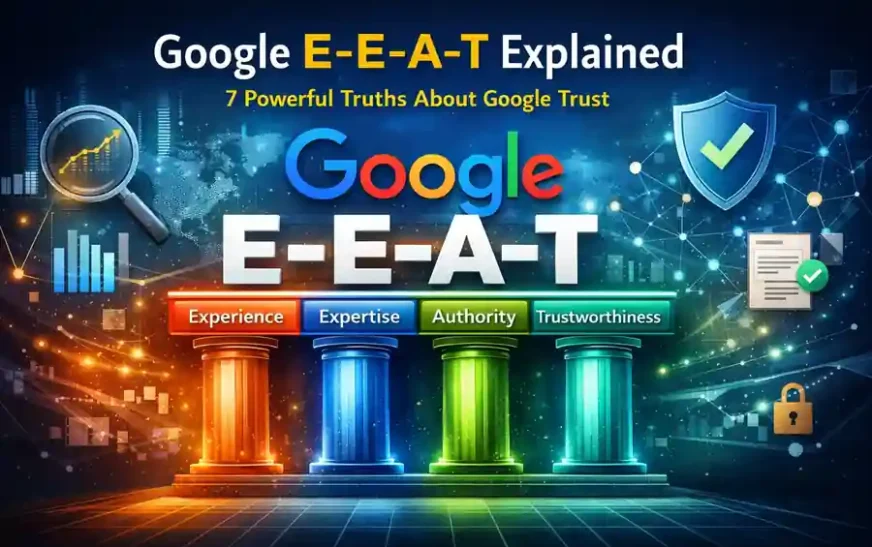
What is Google E-E-A-T?
In 2026, this question sits at the center of modern search visibility. Search is no longer driven purely by keywords, backlinks, or mechanical optimization. Instead, it increasingly evaluates credibility, authenticity, and reputation. E-E-A-T — which stands for Experience, Expertise, Authoritativeness, and Trustworthiness — represents the framework used by Google to assess content quality at scale.
Understanding what is E-E-A-T is not about chasing an algorithm trick. It is about understanding how search systems attempt to measure trust in a digital environment where content volume is unlimited.
This guide breaks down E-E-A-T historically, technically, and strategically — from its evolution to practical implementation.
Why E-E-A-T Matters in Modern SEO?
To clearly understand what is E-E-A-T, we must separate myth from mechanism.
According to Search Quality Raters Guidelines , E-E-A-T is not a single ranking factor. It is a quality framework documented in the Google Search Quality Rater Guidelines. These guidelines are used by human quality raters to evaluate search results and help improve search algorithms.
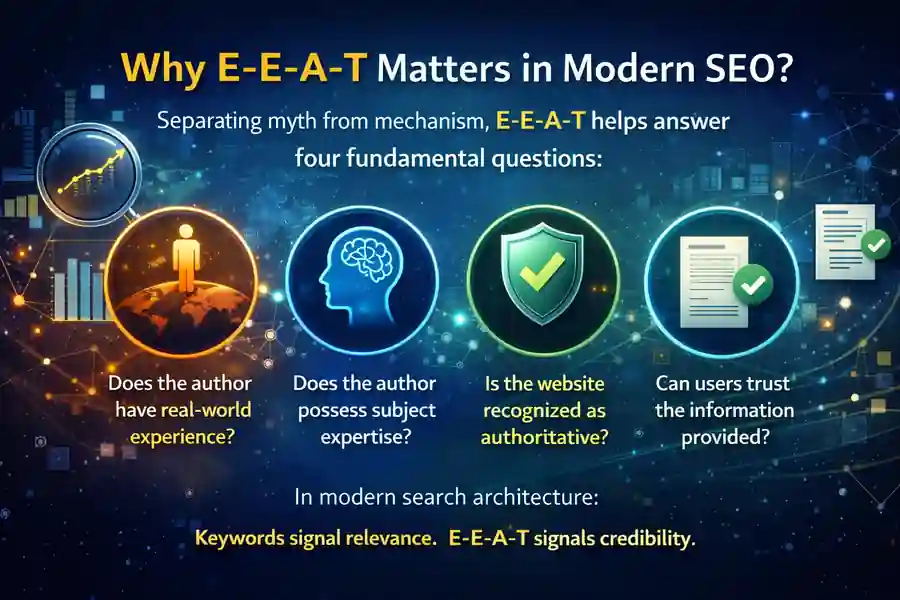
E-E-A-T helps answer four fundamental questions:
-
Does the author have real-world experience?
-
Does the author possess subject expertise?
-
Is the website recognized as authoritative?
-
Can users trust the information provided?
In modern search architecture, trust is foundational. Keywords signal relevance. E-E-A-T signals credibility.
Evolution of E-E-A-T — From E-A-T to E-E-A-T
Understanding what is E-E-A-T requires historical context.
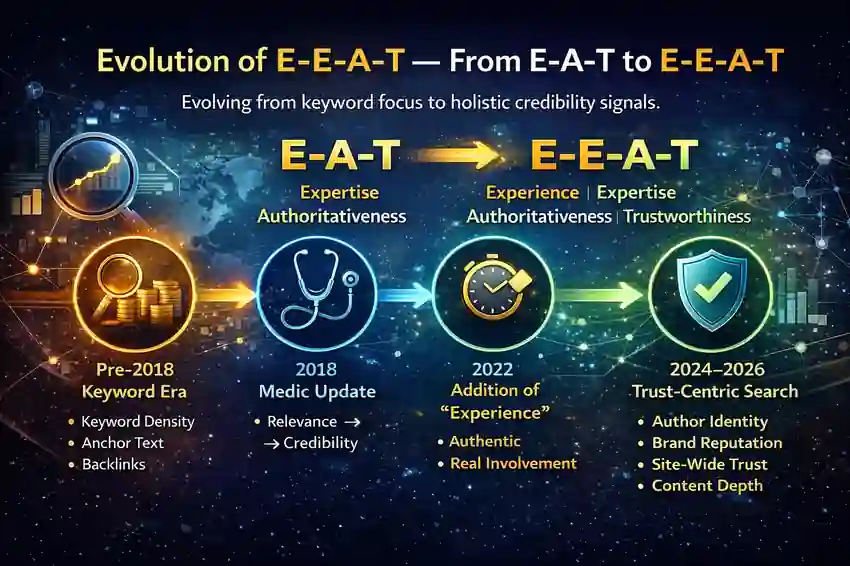
Pre-2018 — The Keyword Era
Before 2018, search rankings were heavily influenced by:
-
Keyword density
-
Backlink quantity
-
Anchor text optimization
While quality mattered, mechanical SEO strategies often dominated visibility. Refer Google Search Central explains how E-E-A-T supports content evaluation.
2018 — The Medic Update
In 2018, a core update commonly referred to as the “Medic Update” dramatically impacted health and finance websites. Sites lacking clear expertise or authority saw significant ranking drops.
This marked a philosophical shift:
From relevance-first search
→ to credibility-aware search.
E-A-T (Expertise, Authoritativeness, Trustworthiness) gained prominence.
2022 — Addition of “Experience”
As content automation increased, search systems needed a way to differentiate between:
-
Theoretical summaries
-
First-hand knowledge
The addition of “Experience” formalized this distinction.
Experience emphasizes authenticity: real usage, direct involvement, lived interaction.
2024–2026 — Trust-Centric Search
Modern search increasingly evaluates:
-
Author identity consistency
-
Brand reputation signals
-
Site-wide trust patterns
-
Content depth and originality
We are now in a trust-first era of search evaluation.
How Search Engines Evaluate Google E-E-A-T Signals
| Signal Type | Example | Why It Matters |
|---|---|---|
| Authority signals in SEO | Backlinks from niche sites | Reinforces credibility |
| Content credibility signals | Case studies | Demonstrates experience |
| Reputation signals | Brand mentions | Strengthens authority |
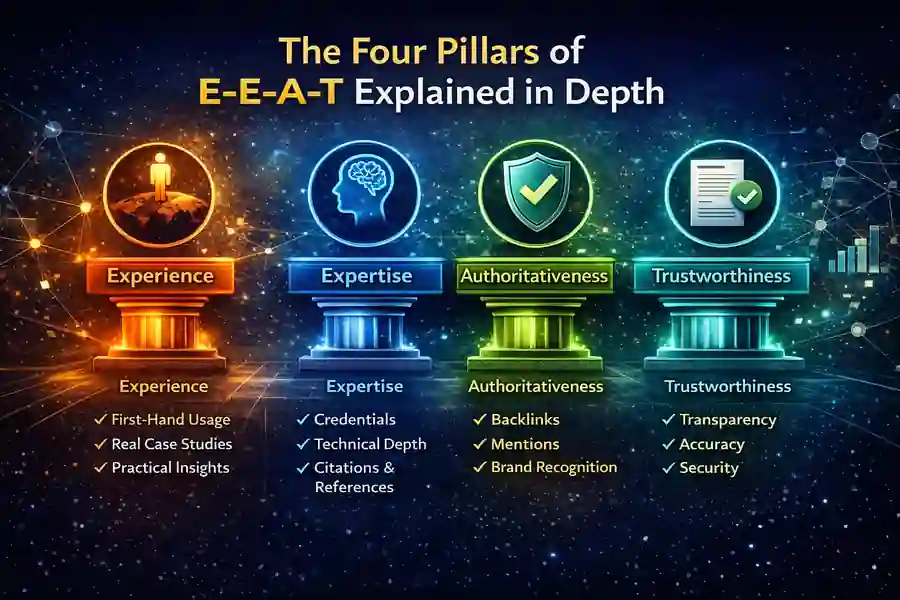
The Four Pillars of E-E-A-T Explained in Depth
Understanding what is E-E-A-T requires examining each pillar analytically.
Understanding what is E-E-A-T requires more than definitions. Each pillar plays a different role in how search engines evaluate credibility. They are not equal in function — and they do not carry equal weight depending on topic sensitivity.
Let me examine each one precisely.
Experience
Experience refers to first-hand involvement with the subject matter. It answers the question:
Has the author actually done, used, tested, or lived through what they are writing about?
This pillar became critical when content creation became scalable. The distinction between theoretical knowledge and lived experience became necessary.
Core Components of Experience in E-E-A-T
1️⃣ First-Hand Usage
-
Product reviews based on real testing
-
Field implementation write-ups
-
Screenshots, process breakdowns
-
Performance data from real deployment
Example:
An engineering article explaining software configuration with real interface screenshots carries higher Experience signals than a general overview.
2️⃣ Real Case Studies
-
Before/after scenarios
-
Measured outcomes
-
Implementation challenges
-
Lessons learned
Case-based writing demonstrates authenticity that cannot be easily replicated.
3️⃣ Practical Insights
-
Common mistakes
-
Edge-case scenarios
-
Real constraints
-
Industry nuance
These signals indicate lived interaction rather than summary writing.
Weightage Insight
For non-sensitive informational content, Experience is moderately weighted.
For review-based and practical guides, Experience becomes highly influential.
For YMYL topics (medical, financial advice), Experience alone is insufficient without Expertise.
Expertise in E-E-A-T
Expertise measures depth of knowledge and subject mastery. It answers:
Does the author understand this topic at a professional or technical level?
Expertise becomes especially important in high-impact content.
Core Components of Expertise
1️⃣ Credentials
-
Academic qualifications
-
Industry certifications
-
Professional role clarity
-
Years of experience
Displaying credentials increases trust signals, especially in YMYL content.
2️⃣ Technical Depth
-
Detailed explanations
-
Conceptual clarity
-
Structured breakdowns
-
Correct terminology
Surface-level summaries rarely demonstrate Expertise.
Depth matters.
3️⃣ Citations & References
-
Referencing official documentation
-
Linking to research
-
Data-backed claims
Citations strengthen verifiability.
For example, referencing documentation from Google or the Google Search Quality Rater Guidelines increases credibility.
Weightage Insight
In informational content:
-
Expertise is highly influential.
In YMYL content:
-
Expertise becomes critical.
-
Lack of expertise can significantly reduce ranking trust.
Authoritativeness in E-E-A-T
Authoritativeness is about external validation.
It answers:
Do others recognize this source as credible?
Authority is rarely self-declared. It is externally earned.
Core Components of Authoritativeness
1️⃣ Backlinks
-
Links from reputable domains
-
Contextual citations
-
Industry-specific references
Not all backlinks carry equal value. Relevance and credibility matter more than volume.
2️⃣ Mentions
-
Brand mentions (linked or unlinked)
-
Industry forum references
-
Social proof signals
Search systems increasingly analyze entity mentions, not just hyperlinks.
3️⃣ Brand Recognition
-
Consistent publishing
-
Recognizable niche positioning
-
Public speaking or guest features
Authority builds gradually through reputation patterns.
Weightage Insight
Authority is especially powerful in competitive niches.
In high-risk YMYL topics, authority signals can outweigh minor content gaps.
In low-risk informational topics, authority strengthens but does not override content quality.
Trustworthiness in E-E-A-T
Trustworthiness is the foundation of E-E-A-T.
If trust is weak, the other pillars lose effectiveness.
It answers:
Can users rely on this website safely and confidently?
Core Components of Trustworthiness
1️⃣ Transparency
-
Clear author identity
-
About page
-
Contact details
-
Editorial policies
Hidden ownership reduces trust signals.
2️⃣ Accuracy
-
Updated content
-
Correct data
-
No exaggerated claims
-
Consistent information
Inconsistent or outdated content damages trust.
3️⃣ Security
-
HTTPS
-
Secure hosting
-
No malicious scripts
-
Safe browsing status
Technical infrastructure contributes directly to trust perception.
Weightage Insight
Trustworthiness carries the highest foundational weight across all content types.
For YMYL topics, trust is non-negotiable.
Without trust, neither Experience nor Expertise can compensate.
📊 Comparison of E-E-A-T Components
Below is a structured analytical comparison of the four pillars.
| Pillar | Primary Focus | Measurable Signals | Weight in Informational Content | Weight in YMYL Content | Ease of Manipulation | Long-Term Stability |
|---|---|---|---|---|---|---|
| Experience | First-hand involvement | Case studies, screenshots, practical insights | Medium–High | Medium | Moderate | High |
| Expertise | Knowledge depth | Credentials, technical clarity, citations | High | Very High | Difficult | Very High |
| Authoritativeness | External recognition | Backlinks, mentions, brand signals | Medium–High | High | Moderate | Very High |
| Trustworthiness | Reliability & safety | Transparency, accuracy, security | Very High | Critical | Difficult | Critical |
Relative Weight Overview (Conceptual Model)
While exact percentages are not published, conceptually:
-
Trustworthiness → Foundational (applies to all)
-
Expertise → Dominant in high-risk content
-
Experience → Strong in review/practical domains
-
Authoritativeness → Amplifier across niches
The balance shifts depending on topic sensitivity.
For example:
Medical advice:
Trust + Expertise dominate.
Product review:
Experience + Trust dominate.
Technical engineering article:
Expertise + Experience lead, Authority supports.
Structural Insight
When analyzing what is E-E-A-T, it is incorrect to treat the pillars as equal.
They function more like a layered system:
-
Trust forms the base.
-
Expertise builds structure.
-
Experience adds authenticity.
-
Authority amplifies reach.
Together, they form a credibility architecture — not a checklist.
Is E-E-A-T a Ranking Factor?
A common question when discussing what is E-E-A-T is whether it directly impacts rankings.
Officially:
E-E-A-T is not a direct, measurable ranking factor.
However:
-
Algorithms attempt to detect credibility signals.
-
Human raters evaluate quality using E-E-A-T principles.
-
Strong E-E-A-T patterns correlate with sustained rankings.
It influences search visibility indirectly but powerfully.
How Search Engines Evaluate E-E-A-T Signals
Search systems analyze patterns across:
-
Author consistency
-
Content depth
-
Citation quality
-
Site structure
-
Brand mentions
They do not assign a visible “E-E-A-T score.” Instead, they assess holistic credibility patterns.
Google E-E-A-T and YMYL Websites (Deep Analysis)
YMYL stands for “Your Money or Your Life.”
These include:
-
Medical advice
-
Financial recommendations
-
Legal guidance
-
Safety instructions
For YMYL content:
-
Expertise weight increases significantly.
-
Trustworthiness becomes non-negotiable.
-
Lack of credentials can severely limit rankings.
Risk Tier Model:
| Content Category | Risk Level | E-E-A-T Sensitivity |
|---|---|---|
| Medical advice | High | Critical |
| Financial guidance | High | Critical |
| Technology blogs | Medium | High |
| Personal blogs | Low | Moderate |
Technical Trust Signals Breakdown
Beyond content, technical signals matter.
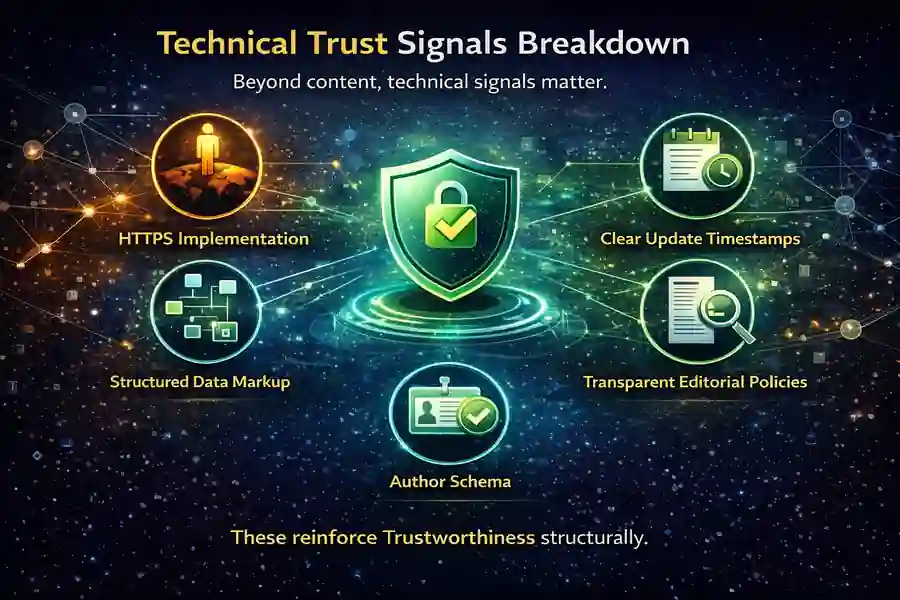
Key elements:
-
HTTPS implementation
-
Structured data markup
-
Author schema
-
Clear update timestamps
-
Transparent editorial policies
-
Accessible contact information
These reinforce Trustworthiness structurally.
Author Page Optimization for Strong E-E-A-T
A strong author page should include:
-
Professional background
-
Relevant certifications
-
Years of experience
-
Published works
-
External recognition
Consistency across website and social platforms strengthens identity signals.
Internal Linking & Topical Authority Strategy
E-E-A-T strengthens when content exists within a structured ecosystem.
Best practices:
-
Hub-and-spoke architecture
-
Deep topic clusters
-
Contextual internal links
-
Consistent subject focus
Topical depth reinforces Expertise and Authority.
Real-World Case Example — Engineering Blog
Before optimization:
-
Generic posts
-
No author credentials
-
Thin explanations
After E-E-A-T alignment:
-
Structured author bio
-
Case studies
-
Technical citations
-
Internal clusters
-
Updated content
Result:
Stronger trust perception and improved long-term visibility.
Common Misconceptions About E-E-A-T
-
E-E-A-T is not a direct ranking factor.
-
Backlinks alone do not guarantee authority.
-
AI content is not automatically low quality.
-
You cannot fake trust long-term.
Final Thoughts
So, what is E-E-A-T?
It is not a ranking switch.
It is not a checklist to manipulate.
It is not a temporary SEO trend.
E-E-A-T is a credibility architecture.
It represents the structural shift in search from:
Keyword optimization
→ to trust evaluation
Search systems are evolving to answer one fundamental question:
“Can this content be trusted?”
Experience proves authenticity.
Expertise proves competence.
Authoritativeness proves recognition.
Trustworthiness proves reliability.
And together, they form a long-term visibility foundation.
Websites that chase short-term tactics may rise briefly.
Websites that build strong E-E-A-T compound over time.
In 2026 and beyond, understanding what is E-E-A-T is not optional for serious publishers. It is the baseline requirement for sustainable organic growth.
If your content strategy is built around clarity, depth, transparency, and real experience — you are already aligned with how modern search evaluates quality.
E-E-A-T is not about gaming search engines.
It is about building something worth ranking.
It is Google’s framework for evaluating content credibility. It represents a shift from keyword-based ranking to trust-based ranking.
If your goal is sustainable organic growth, E-E-A-T must be embedded into your publishing strategy.
It is not a hack.
It is not a trend.
It is the foundation of long-term visibility.
Frequently Asked Questions About Google E-E-A-T
1. What is Google E-E-A-T in simple terms?
Google E-E-A-T stands for Experience, Expertise, Authoritativeness, and Trustworthiness. It is a quality framework used by Google to evaluate content credibility and website reliability in search results.
Google E-E-A-T focuses on:
-
Real-world experience
-
Subject-matter expertise
-
External authority recognition
-
Transparent and trustworthy content
2. Is Google E-E-A-T a direct ranking factor?
Google E-E-A-T is not a direct ranking factor like page speed or backlinks. However, Google’s algorithms evaluate signals that reflect E-E-A-T principles.
It influences rankings through:
-
Content depth and accuracy
-
Author credibility signals
-
Brand reputation patterns
-
Trust-related technical signals
3. Why did Google add “Experience” to E-E-A-T?
Google added the second “E” to emphasize first-hand knowledge and authenticity. This helps distinguish between theoretical summaries and real-world expertise.
Experience strengthens:
-
Product reviews
-
Case studies
-
Implementation guides
-
First-hand insights
4. How does Google measure E-E-A-T?
Google does not assign a visible “E-E-A-T score.” Instead, it evaluates patterns across content, authorship, and site reputation.
Evaluation signals include:
-
Author identity consistency
-
Citation quality
-
Backlink relevance
-
Content accuracy and updates
5. Does Google E-E-A-T apply to small websites?
Yes. Google E-E-A-T applies to all websites regardless of size. Trust and expertise matter even for niche blogs or new publishers.
Small sites can build Google E-E-A-T through:
-
Clear author bios
-
Deep topical content
-
Transparent policies
-
Consistent subject focus
6. What is the difference between E-A-T and E-E-A-T?
E-A-T originally included Expertise, Authoritativeness, and Trustworthiness. Google E-E-A-T added Experience to reflect first-hand involvement.
The difference includes:
-
Authenticity validation
-
Practical insight emphasis
-
Real-world testing importance
-
Stronger review credibility signals
7. Why is Google E-E-A-T important for SEO in 2026?
In 2026, search is trust-driven. Google E-E-A-T helps determine which websites deserve long-term visibility.
It supports SEO by improving:
-
Content credibility
-
User trust
-
Brand authority
-
Sustainable rankings
8. What are YMYL topics in relation to Google E-E-A-T?
YMYL (Your Money or Your Life) topics involve health, finance, legal, or safety advice. Google E-E-A-T standards are stricter for these categories.
YMYL content requires:
-
Verified expertise
-
Professional credentials
-
Accurate references
-
Strong trust signals
9. Can AI-generated content meet Google E-E-A-T standards?
AI content can align with Google E-E-A-T if it demonstrates real expertise and is reviewed for accuracy. AI alone does not guarantee or violate E-E-A-T.
To meet standards:
-
Add human review
-
Provide real-world examples
-
Cite credible sources
-
Maintain transparency
10. How can a website improve Google E-E-A-T quickly?
Improving Google E-E-A-T is gradual, but foundational improvements can begin immediately.
Start by:
-
Publishing detailed author bios
-
Updating outdated articles
-
Adding credible citations
-
Strengthening internal linking
11. Does backlink building increase Google E-E-A-T?
Backlinks contribute to Authoritativeness within Google E-E-A-T, but quality matters more than quantity.
Strong authority links are:
-
Relevant to your niche
-
From trusted domains
-
Contextually embedded
-
Naturally earned
12. What technical factors support Google E-E-A-T?
Technical signals reinforce Trustworthiness in Google E-E-A-T.
Important elements include:
-
HTTPS security
-
Structured data markup
-
Clear privacy policies
-
Visible contact information
13. How does brand reputation affect Google E-E-A-T?
Brand mentions and recognition strengthen Authoritativeness within Google E-E-A-T.
Reputation signals include:
-
Media citations
-
Industry mentions
-
Consistent branding
-
Positive public perception
14. How does internal linking impact Google E-E-A-T?
Internal linking builds topical authority, reinforcing Expertise signals under Google E-E-A-T.
Effective linking should:
-
Connect related topics
-
Support content depth
-
Build subject clusters
-
Improve semantic relevance
15. What is the future of Google E-E-A-T?
The future of Google E-E-A-T lies in stronger trust evaluation systems and reputation-aware indexing.
Search evolution may include:
-
Enhanced identity verification
-
Brand-level authority signals
-
Authenticity detection systems
-
Deeper credibility modeling
Related Articles
- How to make website crawl in AI engine
- Generative Engine Optimization
- Digital Marketing in 2025
- Technical SEO Audit
- SEO Plugins for WordPress