
Introduction
Generative Engine Optimization (GEO) is quickly becoming one of the most important topics in digital marketing and search visibility. For the past two decades, businesses have focused on Search Engine Optimization (SEO) to climb the rankings of Google, Bing, and other search platforms. But the rise of AI-powered search assistants—like ChatGPT, Google Gemini, Microsoft Copilot, and Perplexity—has changed the game.
Instead of presenting users with “10 blue links,” these AI systems generate direct conversational answers. That means the websites and articles that AI chooses to reference, summarize, or cite will get all the attention and traffic. If your content is not designed for AI engines, you risk being invisible to a huge share of future search traffic.
This is where Generative Engine Optimization (GEO) comes in. GEO is the practice of structuring, formatting, and writing content in a way that AI search engines can easily understand, summarize, and reuse. Just like SEO was about pleasing Google’s algorithm, GEO is about making sure your brand’s voice shows up inside AI-generated answers.
This complete guide will explore what GEO is, why it matters in 2025, key principles, comparisons with SEO, implementation strategies, benefits, challenges, and future predictions. It will also include examples, real-world use cases, tables, FAQs, and practical steps so that you can turn your website into an AI-ready hub of authority.
By the end, you’ll understand exactly how to optimize for AI engines, ensuring your content remains visible, relevant, and competitive in this new search era.
What is Generative Engine Optimization (GEO)?

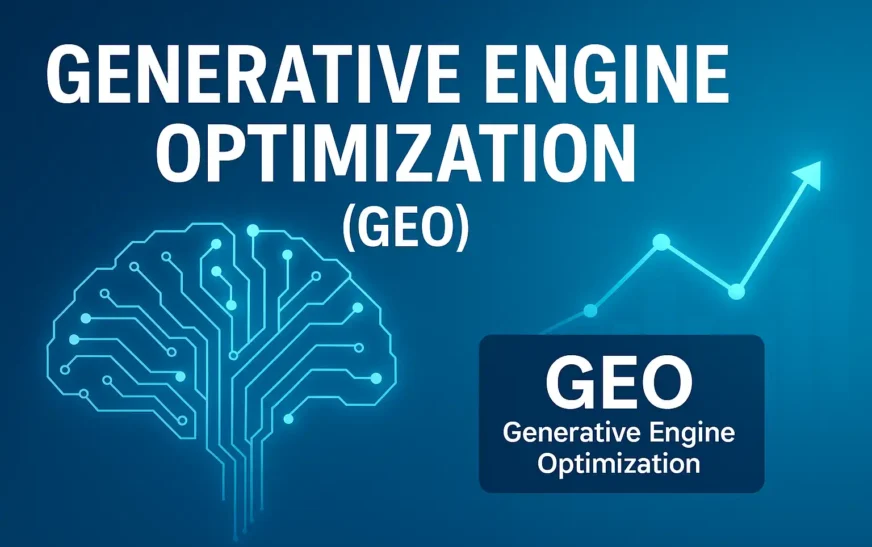
Generative Engine Optimization (GEO) is the process of optimizing digital content so that AI-powered search assistants and generative engines can easily understand, summarize, and feature it in their conversational answers.
In other words, GEO is to AI search engines what SEO is to traditional search engines.
Key aspects of GEO:
-
GEO ensures your content is AI-readable and easy to summarize.
-
It emphasizes structured formats such as FAQs, tables, and bullet lists.
-
It promotes entity clarity, meaning your brand, product, or topic is unambiguous to AI models.
-
GEO requires credible citations and authoritative references, so AI trusts your site.
-
It involves anticipating user questions and providing direct, conversational answers.
Why the term “GEO”?
The word “Generative” refers to generative AI, which creates text, summaries, and answers on the fly. The “Engine” refers to the new class of AI search assistants. And “Optimization” continues the tradition of SEO, signaling that we are adapting content for a new algorithmic gatekeeper.
A short history of GEO:
-
2000s–2020s → SEO dominated marketing strategies.
-
2022 → ChatGPT introduced conversational AI search to the mainstream.
-
2023–2024 → Perplexity, Copilot, and Gemini integrated AI search features.
-
2025 → GEO emerges as a recognized discipline, as businesses realize AI assistants are now a primary discovery channel.
👉 In simple terms: SEO made you rank on Google; GEO makes you appear in AI answers.
Why Generative Engine Optimization Matters in 2025

The digital world in 2025 is not just about Google search results. According to industry reports, over 30% of internet users already prefer asking AI tools for answers instead of searching on Google. This number is expected to double within 3 years.
Market shifts driving GEO adoption:
-
AI as the first point of search → Users ask ChatGPT or Copilot before Googling.
-
Zero-click answers → AI delivers complete responses without requiring a website click.
-
Voice assistants powered by AI → Siri, Alexa, and Google Assistant integrate LLMs for smarter responses.
-
Business discovery changing → Instead of seeing ads, customers rely on AI recommendations.
Real-world examples:
-
A student researching “What is blockchain?” might see a ChatGPT answer that cites The Tech Thinker.
-
A business owner asking Gemini “Best CAD software in 2025” could get your article as a cited source.
-
A doctor checking Perplexity for “AI in healthcare” may see links only from GEO-optimized sites.
Why GEO is essential now
-
Traditional SEO visibility is shrinking in AI search.
-
Brands not cited in AI results risk being “invisible.”
-
GEO ensures your brand remains discoverable in AI-driven channels.
-
Early adopters of GEO will gain a trust and authority advantage.
-
GEO will soon be a baseline requirement, not just a competitive edge.
👉 GEO is not a future trend—it’s already here.
Key Principles of Generative Engine Optimization

To optimize for AI search engines, you need to align your content with how generative models read and output information. GEO follows five major principles:
Structured Content & Formatting
-
Use clear H2/H3 headings for sections.
-
Write short paragraphs for readability.
-
Provide bullet points and numbered lists.
-
Insert tables and comparison charts for data clarity.
-
Break content into digestible chunks AI can reuse.
Entity Clarity
AI models sometimes confuse brands or terms. Solve this by:
-
Always defining acronyms (e.g., GEO = Generative Engine Optimization).
-
Mentioning your brand/product in context (“Sravani Infotech, an official ZWCAD reseller”).
-
Linking internally to related posts (helps AI connect concepts).
Conversational Q&A Style
AI loves question-answer pairs. Include:
-
FAQs → “What is GEO?” “Why is GEO important?”
-
Q&A in body text → anticipate real user queries.
-
Example: “How does GEO differ from SEO?” → followed by a clear, direct answer.
Authority & Citations
AI prefers trusted sources. You build authority by:
-
Linking to external authoritative sites (e.g., Gartner, Stanford, HubSpot).
-
Maintaining updated, fact-checked content.
-
Demonstrating original insights (examples, case studies).
Schema & Metadata
Schema makes your site machine-readable:
-
Use FAQ schema for Q&As.
-
Add HowTo schema for tutorials.
-
Apply Product schema for reviews and comparisons.
-
Include author bios for credibility.
👉 These principles turn your site into AI fuel—content that engines trust, cite, and summarize.
GEO vs SEO: A Broad Comparison
Generative Engine Optimization (GEO) and Search Engine Optimization (SEO) are not enemies — they’re complementary. But they differ in target platforms, optimization style, visibility, metrics, and future role. Let’s break it down in detail.
📊 Extended Comparison Table
| Factor | SEO (Traditional Search) | GEO (AI-Powered Search) |
|---|---|---|
| Target | Google, Bing, Yahoo SERPs | AI engines: ChatGPT, Gemini, Perplexity, Copilot |
| Core Objective | Rank higher on search engine results pages (SERPs) | Get cited and summarized inside AI-generated answers |
| Content Style | Keyword-focused blogs, backlinks, long-form guides | Structured, Q&A-driven, entity clarity, conversational tone |
| Ranking Signals | Keywords, backlinks, technical SEO, user signals | Clarity of entities, FAQ schema, credibility, structured data |
| Output | A list of 10+ links (blue links, snippets, ads) | A single conversational answer (with citations, if any) |
| User Journey | User reads snippets → clicks a link → explores website | User asks a question → AI answers directly → may cite sources |
| Traffic Source | Organic traffic from clicks on search results | Zero-click visibility: AI mentions your brand/site in answers |
| Example Query | “Best CAD software 2025” → Google shows 10 links | Same query in ChatGPT → GEO-optimized site cited in the answer |
| Measurement | Impressions, clicks, CTR, rankings | AI mentions, citations, presence in AI output |
| Content Formats | Blog posts, landing pages, technical SEO pages | FAQs, tables, comparison charts, case studies, schema data |
| Technical Needs | On-page SEO, site speed, mobile-first indexing | Structured data, AI-friendly formatting, entity clarity |
| Future Outlook | Stable, still necessary for web search | Rapidly evolving, critical for AI-first search |
Real-World Scenarios

Scenario 1: A Student Researching AI
-
SEO World: They Google “What is Artificial Intelligence?” → Your blog appears in top 10 results → They click and read.
-
GEO World: They ask ChatGPT “Explain Artificial Intelligence in simple terms” → AI summarizes and cites your GEO-optimized article directly.
Scenario 2: A Business Owner Choosing CAD Software
-
SEO World: They search “Best CAD software 2025” → See a blog listicle, scroll, and compare options.
-
GEO World: They ask Gemini “Which is better, ZWCAD or AutoCAD?” → Gemini pulls your comparison table (because it’s GEO-friendly) and cites your brand.
Scenario 3: A Doctor Exploring AI in Healthcare
-
SEO World: They Google “AI in healthcare applications” → Land on a health-tech company’s SEO-optimized page.
-
GEO World: They ask Perplexity “How is AI used in hospitals?” → The AI includes snippets from your GEO-structured case study.
Scenario 4: An E-Commerce Shopper
-
SEO World: They search “Best budget smartphones 2025” → Clicks on a top-ranking affiliate site.
-
GEO World: They ask Copilot “Which smartphone under $300 is best?” → Copilot generates a list citing GEO-ready e-commerce reviews.
💡 Key Takeaways from the Comparison
-
SEO = Visibility in Google search results.
-
GEO = Visibility inside AI answers.
-
SEO brings click-through traffic; GEO brings brand citations and trust.
-
Both will coexist: SEO drives traffic, GEO drives AI recognition + authority.
👉 In short: SEO makes you rank; GEO makes you remembered.
-
GEO world → User asks ChatGPT the same → ChatGPT answers with “According to The Tech Thinker…”
👉 That difference is existence vs invisibility.
How to Implement Generative Engine Optimization (GEO) on Your Website?

GEO is not just a buzzword—it’s a practical framework for structuring your content so AI engines recognize and reuse it. Here’s a complete step-by-step guide to implementing GEO across your digital presence.
Step 1: Define Your Focus Keyword Strategy

-
Pick evergreen, high-volume keywords that align with your industry.
-
Example: If you’re a CAD reseller → “Best CAD software 2025,” “BoCAD steel detailing software.”
-
Ensure keyword clarity → AI engines need unambiguous terminology.
-
Create cornerstone articles that serve as “topic hubs.”
Step 2: Structure Content for AI Readability

-
Use H2 and H3 headings consistently.
-
Keep paragraphs short (2–3 sentences).
-
Add bullets, lists, and step-by-step instructions.
-
Insert tables and charts where comparisons matter.
-
Ensure images have descriptive ALT text (e.g., “Generative Engine Optimization diagram”).
Step 3: Add Conversational Q&A Segments

-
Include FAQ sections with real questions.
-
Sprinkle mini-Q&A pairs inside the body.
-
Use question-based subheadings (e.g., “How is GEO different from SEO?”).
Step 4: Strengthen Authoritativeness

-
Cite external trusted sources (Stanford AI, Gartner, HubSpot).
-
Maintain updated statistics (AI adoption, search trends).
-
Add author profiles with credentials.
-
Publish original case studies and examples.
Step 5: Optimize Metadata and Schema

-
Apply FAQ schema for GEO Q&A sections.
-
Use HowTo schema for tutorials.
-
Add organization schema (logo, social links).
-
Include product schema if reviewing software.
Step 6: Improve Technical Foundations

-
Make site fast-loading (use caching/CDN).
-
Ensure mobile-friendly design.
-
Avoid blocked content (no walls that AI scrapers can’t read).
-
Provide clean URLs (with focus keyword).
Step 7: Build Internal & External Links

-
Internal links → point to related cornerstone posts.
-
External links → add DoFollow references to authority sites.
-
Balance SEO + GEO by showing both breadth and depth.
Step 8: Encourage AI Indexing

-
Use clear titles & intros so AI models can chunk your text.
-
Republish content in multiple formats (blog, PDF, LinkedIn post).
-
Share content on social media to increase citations.
👉 By following these steps, your website becomes AI-ready. Instead of hoping ChatGPT will pick you up, you engineer visibility into AI outputs.
Benefits of Generative Engine Optimization for Businesses
Why should businesses invest time in GEO? Because it’s not just about visibility—it’s about long-term trust and authority in an AI-driven digital economy.
Key Benefits:
-
Increased AI Citations → Your site gets mentioned in ChatGPT, Gemini, Copilot, and Perplexity answers.
-
Brand Authority → Being cited by AI improves user trust.
-
Sustainable Visibility → Evergreen content keeps showing up in AI conversations.
-
Early Mover Advantage → Few businesses are optimizing for GEO yet.
-
Higher Conversion Rates → Users trust AI-recommended sources more.
-
Cross-Industry Applicability → Works in healthcare, finance, retail, education, and tech.
Industry-Specific Examples:
-
Healthcare → Hospitals cited in “best hospitals near me” AI answers.
-
Finance → Banks mentioned in AI-generated comparisons of loan rates.
-
E-commerce → Product reviews reused in AI shopping assistants.
-
Education → Universities featured in AI answers about best courses.
-
Engineering → CAD blogs cited in “best CAD software 2025” prompts.
👉 For businesses, GEO is not just a marketing tactic—it’s a competitive survival strategy.
Challenges of Generative Engine Optimization
While GEO offers massive benefits, it also comes with real challenges.
Key Challenges:
-
Unclear ROI → Measuring GEO success is tricky (AI doesn’t always show citations).
-
Rapid AI Evolution → Models like ChatGPT and Gemini update frequently, changing optimization rules.
-
Data Privacy Concerns → AI might pull content in unexpected contexts.
-
No Standardized Framework Yet → GEO is still new; best practices evolve.
-
Content Fatigue → GEO requires consistent updates to stay relevant.
Example:
A company optimizes its AI content in 2024, but by 2025, Gemini introduces new ranking signals. Without continuous adaptation, that company risks losing visibility.
👉 The challenge is real: GEO is a moving target, just like SEO was in its early days.
The Future of Generative Engine Optimization
Where is GEO heading? In 2025 and beyond, GEO will expand beyond written text into voice, multimodal, and personalized AI search.
Predictions:
-
Voice AI Optimization → GEO will adapt for Alexa, Siri, and Google Assistant responses.
-
Multimodal GEO → Optimizing not just text, but also images, charts, and video transcripts.
-
Hyper-Personalization → AI engines will tailor answers to each user’s profile.
-
Integration with Wearables & AR → AI assistants in AR glasses will use GEO-optimized content.
-
AI-First Indexing → Just like “mobile-first indexing” in SEO, AI engines will prioritize GEO-friendly sites.
👉 In short: GEO is the future of discoverability.
Conclusion
Generative Engine Optimization (GEO) is the next frontier in digital visibility. As AI search assistants replace traditional engines, businesses must adapt or risk fading into invisibility. GEO ensures your content is structured, authoritative, conversational, and AI-ready.
👉 The future of search is AI-first, and with GEO, your brand can stay ahead of the curve.
Read Also
External Reference
FAQs for GEO
Q1. What is Generative Engine Optimization (GEO)?
Generative Engine Optimization (GEO) is the process of optimizing content so that AI-powered search engines like ChatGPT, Gemini, and Copilot can easily understand, summarize, and cite it in conversational answers.
2. Why is Generative Engine Optimization important in 2025?
GEO is important because AI assistants are replacing traditional search engines for many users. Without GEO, your content may not appear in AI-generated answers, reducing visibility and traffic.
3. How is GEO different from SEO?
SEO focuses on ranking in Google search results, while GEO focuses on being cited by AI search engines. GEO emphasizes structured content, FAQs, tables, and authoritative references.
4. How can I implement Generative Engine Optimization on my website?
You can implement GEO by using clear headings, adding FAQ schema, writing conversational Q&A-style answers, linking to authoritative sources, and including structured content like tables and bullet lists.
5. What are the benefits of GEO for businesses?
The benefits of GEO include higher AI citations, improved brand authority, evergreen content visibility, early adopter advantages, and increased trust from users who rely on AI answers.
6. What are the main challenges of Generative Engine Optimization?
Challenges include unclear ROI measurement, rapidly changing AI models, lack of standard frameworks, and the need to update content regularly to stay relevant.
7. Which industries benefit most from GEO?
Industries like healthcare, finance, education, e-commerce, and technology benefit the most, since their audiences increasingly rely on AI-generated answers for research and decision-making.
8. How long does it take to see results from GEO?
Like SEO, GEO is a long-term strategy. With consistent optimization, you may begin to see AI citations and mentions within 3–6 months.
9. Does Generative Engine Optimization replace traditional SEO?
No, GEO does not replace SEO. Both work together: SEO is essential for Google, while GEO ensures visibility in AI search engines. Businesses need both strategies to maximize reach.
10. What tools can I use for Generative Engine Optimization?
Tools like Rank Math (for SEO foundations), schema markup generators, AI content analyzers, and content optimization tools help implement GEO effectively.