
Bend Allowance Calculator (V2): Validation Upgrade for Real Engineering
Last Updated: April 2026
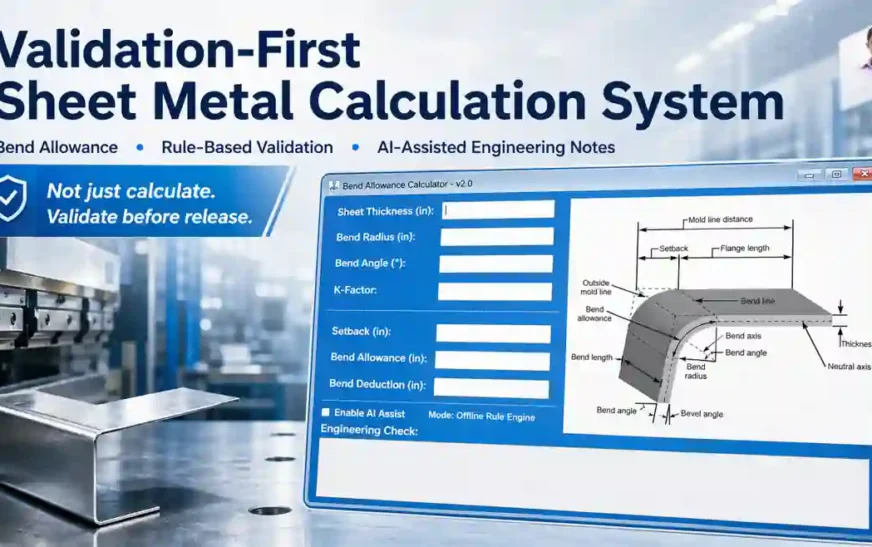
The bend allowance calculator developed by Ramu Gopal has been upgraded to Version 2 with a strong focus on engineering validation.
In Version 1, the bend allowance calculator was designed to quickly compute bend allowance, bend deduction, and setback values using standard formulas.
However, in real-world sheet metal design, calculation alone is not enough.
A value can be mathematically correct but still fail during manufacturing.
Version 2 addresses this gap by transforming the bend allowance calculator into a validation-first engineering tool, helping engineers move from calculation to confident decision-making.
What’s New in Bend Allowance Calculator V2
The updated bend allowance calculation System by Ramu Gopal, introduces validation and practical engineering checks that were not part of traditional calculators.
Key Improvements:
- ✅ Validates radius-to-thickness (R/T) ratio
- ✅ Checks K-Factor within practical engineering limits
- ✅ Adds rule-based validation for real manufacturing scenarios
- ✅ Introduces PASS / WARNING / REVIEW REQUIRED status
- ✅ Provides AI-assisted engineering notes for better understanding
These improvements ensure that the bend allowance calculator is no longer just a number generator, but a tool that supports engineering decisions.
Bend Allowance Calculation System: Version 1 vs Version 2
| Feature | Version 1 | Version 2 |
|---|---|---|
| Bend Allowance Calculation | ✅ | ✅ |
| Bend Deduction | ✅ | ✅ |
| Setback Calculation | ✅ | ✅ |
| Engineering Validation | ❌ | ✅ |
| Rule-Based Checks | ❌ | ✅ |
| Status Output (PASS/WARNING) | ❌ | ✅ |
| AI-Assisted Notes | ❌ | ✅ |
Version 2 of the bend allowance calculator introduces a structured validation layer that improves reliability in real-world applications.
Why Needed a Validation Upgrade
Most bend allowance calculators available today focus only on formulas.
They assume:
- Input values are correct
- Material behavior is ideal
- Manufacturing conditions are consistent
In practice, these assumptions rarely hold true.
Common issues in traditional calculators:
- Incorrect K-Factor selection
- Invalid bend radius for given thickness
- No visibility into manufacturability
- Lack of validation before production
👉 This is where many designs fail — not in calculation, but in lack of validation.
From Bend Allowance Calculator to Validation System
The upgraded bend allowance calculator now follows a more structured workflow:
| Step | Description |
|---|---|
| Input | Enter thickness, radius, angle, K-factor |
| Calculation | Compute bend allowance and related values |
| Validation | Apply engineering rules and checks |
| Output | Provide result with status (PASS/WARNING) |
| Insight | AI-assisted explanation for decision support |
This structured approach ensures that the output is not just correct, but also usable in real engineering scenarios.
Engineering Validation Layer in Bend Allowance Calculator
The core strength of Version 2 lies in its validation layer.
The bend allowance calculator now evaluates:
- 📏 Radius-to-thickness (R/T) relationship
- 📐 Bend feasibility based on geometry
- ⚙️ K-Factor consistency across conditions
- 🏭 Practical manufacturing constraints
Output Status System
Instead of only displaying numbers, the bend allowance calculator now provides:
- ✅ PASS – Safe for standard use
- ⚠️ WARNING – Needs attention or verification
- ❗ REVIEW REQUIRED – Engineering confirmation needed
This helps engineers quickly identify potential risks before production.
AI-Assisted Notes in Bend Allowance Calculator
Version 2 introduces a lightweight AI-assisted explanation layer.
This feature is designed to:
- Explain why a value is flagged
- Translate validation rules into simple language
- Assist communication between design and shop floor
👉 Important: AI does not replace engineering judgment.
👉 It only supports interpretation and understanding.
This updated bend allowance calculator is not just a formula tool—it is designed to validate real-world sheet metal conditions before release.
Change Log
- Version 1: Basic bend allowance calculator with standard calculations
- Version 2: Added validation layer, rule-based checks, status system, and AI-assisted notes
Bend Allowance Calculator is an essential tool for sheet metal engineers who need accurate flat pattern calculations before manufacturing. Even a small mistake in bend calculations can result in incorrect part dimensions, assembly issues, and costly rework.
In real-world engineering workflows, many designers still rely on manual formulas, Excel sheets, or assumptions while calculating bend allowance and bend deduction. However, these methods are often error-prone and time-consuming.
This guide explains the fundamentals of bend allowance, the formulas behind it, and introduces a free Bend Allowance Calculator tool designed by Ramu Gopal to simplify practical engineering calculations.
What Is a Bend Allowance Calculator?
A Bend Allowance Calculator is a tool used to determine the amount of material required to form a bend in sheet metal.
It calculates how much length is added due to bending, allowing engineers to generate accurate flat patterns before fabrication.
Key Inputs
-
Sheet thickness
-
Bend radius
-
Bend angle
-
K-factor
Key Outputs
-
Bend Allowance (BA)
-
Bend Deduction (BD)
-
Setback
This ensures that the final bent component matches the intended design dimensions.
Why a Bend Allowance Calculator Matters in Sheet Metal Design
In sheet metal design, accuracy is everything.
Even minor deviations can lead to:
-
Improper fit during assembly
-
Increased rework and scrap
-
Production delays
-
Material wastage
Benefits of Using a Bend Allowance Calculator
-
Eliminates manual calculation errors
-
Improves flat pattern accuracy
-
Speeds up design validation
-
Reduces dependency on trial-and-error
-
Helps maintain consistency across designs
For engineers working under tight timelines, this tool becomes a reliable validation companion.
Bend Allowance Calculator Inputs Explained
Understanding each input is crucial for accurate results.
Sheet Thickness
The thickness of the sheet directly affects how the material stretches during bending.
-
Higher thickness → more material resistance
-
Impacts neutral axis location
Bend Radius
The inside radius of the bend.
-
Larger radius → larger arc length
-
Affects material distribution
Bend Angle
The angle through which the sheet is bent.
-
Typically measured in degrees
-
Common value: 90°
-
Directly influences arc length
K-Factor
K-factor represents the location of the neutral axis relative to the material thickness.
Typical values:
-
Steel: 0.3 – 0.5
-
Aluminum: 0.33 – 0.4
-
Stainless steel: 0.35 – 0.45
👉 K-factor varies based on material and process conditions.
Bend Allowance Calculator Formula Explained
The Bend Allowance Calculator is based on a standard engineering formula.
Bend Allowance Formula
BA = (π / 180) × Angle × (Radius + K × Thickness)
Setback Formula
Setback = (Radius + Thickness) × tan(Angle / 2)
Bend Deduction Formula
BD = 2 × Setback − BA
Important Note
These formulas provide a theoretical estimate. Actual production values may vary depending on:
-
Tooling
-
Machine setup
-
Material properties
-
Company standards
Bend Allowance vs Bend Deduction: What Is the Difference?
Many engineers confuse these two concepts.
| Parameter | Bend Allowance | Bend Deduction |
|---|---|---|
| Definition | Material added due to bend | Material removed from flat length |
| Purpose | Calculate developed length | Adjust flat pattern |
| Usage | Design stage | Manufacturing stage |
👉 Both are essential for accurate sheet metal design.
Common Mistakes Engineers Make Without a Bend Allowance Calculator
Even experienced engineers face issues when calculations are done manually.
Common Errors
-
Using incorrect K-factor
-
Mixing units (mm vs inches)
-
Ignoring bend radius variation
-
Confusing bend allowance and deduction
-
Not validating with real production values
-
Over-relying on memory instead of calculation
These mistakes can significantly impact product quality and cost.
Free Bend Allowance Calculator Tool Overview
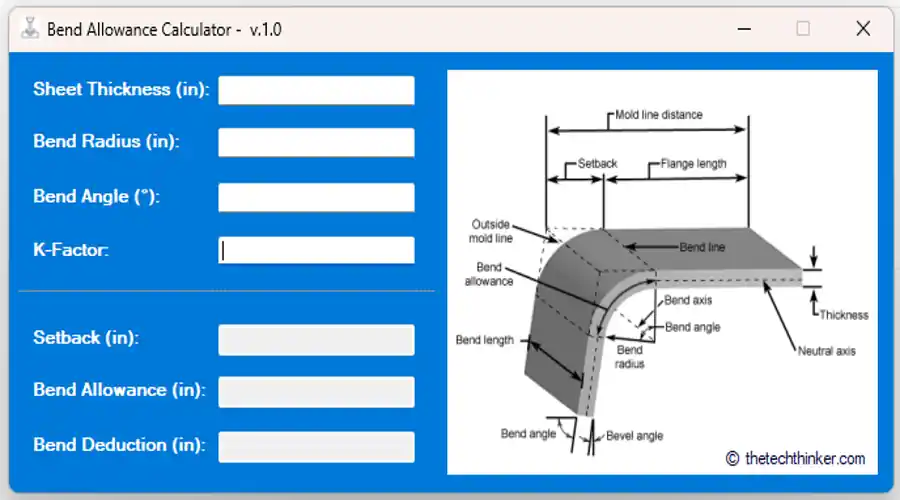
To simplify calculations, a Bend Allowance Calculator tool was developed by The Tech Thinker Ramu gopal specifically for practical engineering use.

Tool Features
-
Simple and clean user interface
-
Instant calculation results
-
Supports standard engineering inputs
-
Eliminates manual calculation errors
Tool Inputs
-
Sheet thickness
-
Bend radius
-
Bend angle
-
K-factor
Tool Outputs
-
Bend allowance
-
Bend deduction
-
Setback
This tool acts as a quick validation utility for engineers during design and fabrication.
Bend Allowance Calculator: Tool + Validation System (2026)

Free Bend Allowance Calculator V2 developed by Ramu Gopal, Founder of The Tech Thinker, for sheet metal engineers. Calculate bend allowance, bend deduction, and setback with validation-first engineering checks, status output, and AI-assisted notes.
Price Currency: USD
Operating System: Windows
Application Category: EngineeringApplication
Pros
- Simple and clean user interface
- Instant bend allowance, bend deduction, and setback results
- Validation-first engineering checks
- Radius-to-thickness and K-factor review support
- PASS, WARNING, and REVIEW REQUIRED status output
- AI-assisted engineering notes
- Supports sheet metal design and CAD validation workflows
- Reduces manual calculation and review errors
Cons
- Requires basic understanding of sheet metal concepts
- Validation output should be reviewed by an engineer
- Results may vary based on material, tooling, and shop standards
- AI-assisted notes are for explanation, not final approval
How to Use the Bend Allowance Calculator Step by Step
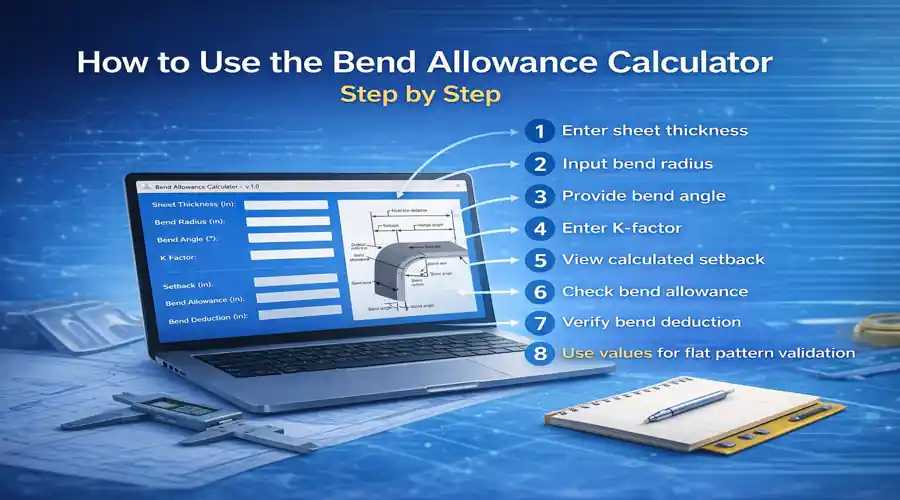
Using the tool is straightforward:
-
Enter sheet thickness
-
Input bend radius
-
Provide bend angle
-
Enter K-factor
-
View calculated setback
-
Check bend allowance
-
Verify bend deduction
-
Use values for flat pattern validation
Example Calculation Using the Bend Allowance Calculator
Let’s consider a simple case:
-
Thickness = 2 mm
-
Radius = 3 mm
-
Angle = 90°
-
K-factor = 0.33
Output
-
Bend allowance → calculated arc length
-
Bend deduction → flat pattern adjustment
This helps engineers quickly validate whether their design will match real-world bending conditions.
Bend Allowance Calculator for SolidWorks and Sheet Metal CAD Workflows
Even when using CAD tools like SolidWorks, understanding bend allowance is critical.
Why this tool helps
-
Cross-check flat pattern values
-
Validate bend tables
-
Support manual calculations
-
Help junior engineers understand concepts
-
Quick verification outside CAD
👉 It acts as a bridge between theory and CAD automation.
Manual Calculation vs Bend Allowance Calculator Tool
| Feature | Manual Method | Calculator Tool |
|---|---|---|
| Speed | Slow | Instant |
| Accuracy | Medium | High |
| Error Risk | High | Low |
| Ease of Use | Complex | Simple |
Limitations of Any Bend Allowance Calculator
While useful, no calculator is perfect.
Limitations
-
Depends on input accuracy
-
Does not replace bend tables
-
Cannot fully predict machine behavior
-
Requires validation for production-critical parts
👉 Always cross-check with real manufacturing data.
Where This Bend Allowance Calculator Fits in Engineering Automation
This tool represents a small but important step toward engineering automation.
It shows how:
-
repetitive calculations can be automated
-
engineers can reduce manual effort
-
workflows can be optimized
This approach can be extended to:
-
sheet metal validation tools
-
drawing checkers
-
CAD automation systems
-
rule-based design systems
Related Tools and Articles on The Tech Thinker
To build a complete engineering workflow, explore:
-
Drawing Checker Systems
-
Engineering Workflow Optimization
These topics are part of a broader ecosystem of engineering productivity tools.
Conclusion
The Bend Allowance Calculator is more than just a calculation tool—it is a practical engineering aid that improves accuracy, efficiency, and reliability in sheet metal design.
By combining engineering fundamentals with automation, this tool helps reduce errors and speeds up workflow validation.
For engineers aiming to build better designs and streamline their process, using a bend allowance calculator is not just helpful—it is essential.
Related Articles
- SolidWorks BOM Extractor Tool
- Engineering Drawing Change Detection
- SolidWorks Custom Properties Manager
FAQs on Bend Allowance Calculator
1. What is a bend allowance calculator?
A bend allowance calculator is a tool used to calculate the length of material required for a bend in sheet metal, helping engineers create accurate flat patterns.
2. Why is a bend allowance calculator important in sheet metal design?
A bend allowance calculator ensures correct flat pattern dimensions, reducing errors, rework, and material waste during fabrication.
3. What is bend allowance in sheet metal?
Bend allowance is the arc length of the material that stretches during bending, which must be added to the flat length.
4. What is bend deduction in sheet metal?
Bend deduction is the amount of material subtracted from the total length to achieve the correct final dimensions after bending.
5. What is the difference between bend allowance and bend deduction?
Bend allowance adds material length, while bend deduction removes material from the flat pattern calculation.
6. What formula does a bend allowance calculator use?
The bend allowance calculator uses:
BA = (π / 180) × Angle × (Radius + K × Thickness)
7. How is bend deduction calculated?
Bend deduction is calculated using:
BD = 2 × Setback − Bend Allowance
8. What is the setback formula in sheet metal?
Setback is calculated as:
Setback = (Radius + Thickness) × tan(Angle / 2)
9. Does bend angle affect bend allowance?
Yes, a higher bend angle increases the arc length, resulting in a higher bend allowance value.
10. Why is K-factor important in bend allowance calculation?
K-factor determines the position of the neutral axis, directly affecting bend allowance accuracy.
11. Can a bend allowance calculator be used for all materials?
Yes, but the K-factor must be adjusted based on material type such as steel, aluminum, or stainless steel.
12. How accurate is a bend allowance calculator in real manufacturing?
It provides a reliable estimate, but actual results may vary based on tooling, machine setup, and material behavior.
13. Why do different companies use different K-factors?
K-factor varies depending on material properties, bending method, and internal manufacturing standards.
14. Can I use a bend allowance calculator for CNC bending operations?
Yes, it helps in estimating flat length before CNC bending and reduces trial-and-error.
15. How does bend radius affect bend allowance?
A larger bend radius increases the arc length, resulting in a higher bend allowance.
16. What inputs are required in a bend allowance calculator tool?
Typical inputs include sheet thickness, bend radius, bend angle, and K-factor.
17. What outputs does a bend allowance calculator provide?
It provides bend allowance, bend deduction, and setback values for accurate flat pattern development.
18. Is a bend allowance calculator tool better than manual calculation?
Yes, it reduces errors, saves time, and provides consistent results compared to manual methods.
19. Can I use a bend allowance calculator with SolidWorks sheet metal?
Yes, it is useful for validating SolidWorks flat pattern calculations and bend table values.
20. How does a bend allowance calculator help in CAD automation?
It can be integrated into CAD workflows to automate sheet metal calculations and improve design accuracy.
21. Who developed this bend allowance calculator tool?
This Bend Allowance Calculator was developed by Ramu Gopal under The Tech Thinker platform. Version 2 extends the original tool with validation-first engineering features and AI-assisted engineering notes.
22. What is The Tech Thinker in engineering automation?
The Tech Thinker is a leading platform focused on CAD automation, engineering tools, and AI-driven productivity solutions for engineers.
23. What does “validation-first” mean in Bend Allowance Calculation System V2?
Validation-first means the bend allowance calculator not only performs calculations but also checks whether the inputs and outputs meet practical engineering conditions before they are used.
24. How does Bend Allowance Calculation System V2 handle real-world variability?
Version 2 considers practical factors like radius-to-thickness relationships and K-factor consistency to highlight conditions that may behave differently in actual manufacturing.
25. How should engineers use the status output in Bend Allowance Calculation System?
The status output helps prioritize actions. PASS indicates normal conditions, WARNING suggests attention is needed, and REVIEW REQUIRED signals that engineering verification should be done before production.
26. Can Bend Allowance Calculation System v2 be used as a validation tool for CAD outputs?
Yes. Version 2 can be used to cross-check CAD-generated flat pattern values and identify potential mismatches before releasing designs to production.
27. Why is a validation layer important in modern bend allowance calculation?
Because calculation alone does not guarantee manufacturability. A validation layer helps ensure that computed values are aligned with real engineering constraints and production conditions.