
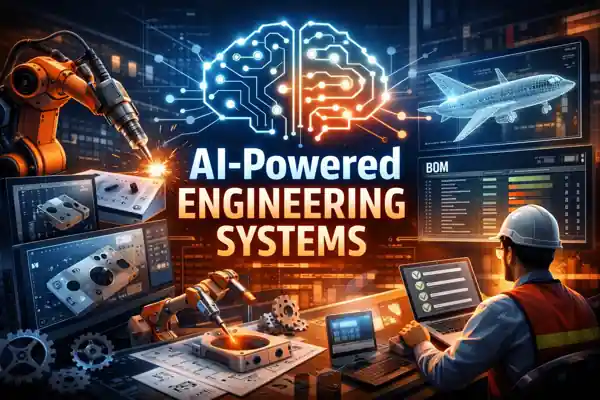
Introduction — The Shift from CAD Tools to AI Engineering Systems
AI-Powered Engineering Systems are no longer a future concept—they are actively reshaping how modern product design and CAD workflows operate. Traditionally, engineers relied heavily on CAD tools as isolated design environments. These tools required manual input, repetitive modeling, and post-design validation, often leading to inefficiencies and late-stage errors.
Today, the paradigm is shifting. Instead of using CAD as a tool, engineers are increasingly working within AI-powered engineering systems—integrated environments where design, validation, simulation, and optimization happen simultaneously.
This shift is driven by:
- Explosion of engineering data
- Need for faster product cycles
- Increasing design complexity
- Demand for error-free outputs
In this article, we explore how AI-Powered Engineering Systems are redefining CAD through 7 breakthrough shifts.
What Are AI-Powered Product Engineering Systems?
AI-Powered Engineering Systems are integrated platforms that combine:
- CAD modeling
- Simulation
- Data intelligence
- Machine learning
- Decision automation
Unlike traditional CAD tools, these systems:
- Learn from past designs
- Predict errors before they occur
- Optimize geometry automatically
- Integrate feedback loops
Key Characteristics:
- Data-driven decision making
- Real-time validation
- Automation of repetitive tasks
- Continuous learning systems
In simple terms:
- CAD tools help you design.
- AI-Powered Engineering Systems help you design intelligently.
Evolution of Engineering Design — From CAD to Intelligent Systems
Engineering design hasn’t changed overnight—it has evolved through clear, measurable stages driven by technology, data, and the increasing demand for precision and speed. What started as manual drafting has now transformed into intelligent, AI-driven engineering systems that actively assist in decision-making.
Evolution Timeline
| Stage | Description |
|---|---|
| Manual Drafting | 2D drawings, slow, error-prone, dependent on individual skill |
| CAD Systems | Digital modeling, improved accuracy, faster revisions |
| CAD Automation | Macros, APIs, rule-based systems reducing repetitive work |
| AI Engineering Systems | Intelligent, predictive, self-optimizing design environments |
1. Manual Drafting — The Foundation Era
Before the digital revolution, engineering design was entirely manual. Engineers relied on drawing boards, scales, and physical tools to create 2D representations of components and assemblies.
While this phase built strong fundamentals, it had significant limitations:
- High dependency on individual expertise
- Time-consuming revisions
- Increased chances of human error
- No simulation or validation capabilities
Even a minor design change meant redrawing entire sections, making iteration extremely slow.
2. CAD Systems — The Digital Transformation
The introduction of Computer-Aided Design (CAD) marked a major breakthrough. Tools like SolidWorks, AutoCAD, and others enabled engineers to create precise 2D and 3D models digitally.
This phase brought:
- High design accuracy
- Faster modifications and iterations
- Visualization through 3D modeling
- Standardization of engineering workflows
However, CAD systems were still user-driven tools.
They improved execution—but not decision-making.
3. CAD Automation — The Efficiency Phase
As design complexity increased, engineers began automating repetitive tasks using:
- Macros (VBA-based automation)
- APIs (SolidWorks API, .NET integrations)
- Rule-based logic systems
This stage significantly improved productivity:
- Reduced manual repetitive work
- Standardized design processes
- Enabled batch operations (BOM extraction, property updates)
- Improved consistency across projects
But automation had a limitation:
It could only do what it was explicitly programmed to do.
There was no intelligence—only execution.
4. AI Engineering Systems — The Intelligence Era
Today, engineering is entering a new phase—AI-Powered Engineering Systems.
Unlike traditional automation, these systems:
- Learn from historical design data
- Predict potential design failures
- Suggest optimized geometries
- Integrate simulation and validation in real time
- Adapt based on feedback and usage patterns
This is not just automation—it is decision intelligence.
Key Shift: From Execution to Intelligence
The most important transformation is not technological—it is conceptual:
| Old Approach | New Approach |
|---|---|
| Engineer-driven decisions | AI-assisted decisions |
| Post-design validation | Real-time validation |
| Manual optimization | AI-driven optimization |
| Static workflows | Adaptive systems |
Practical Insight (Real Engineering Perspective)
As a mechanical engineer working extensively with SolidWorks automation, this shift is clearly visible in day-to-day workflows.
- Earlier, automation tools reduced effort
- Today, AI systems reduce thinking complexity
For example:
- A macro can update properties → saves time
- An AI system can detect inconsistencies → prevents errors
This difference is massive.
Why This Evolution Matters
This transition is not just about better tools—it fundamentally changes how engineers work:
- Engineers move from design creators → system supervisors
- Focus shifts from modeling → decision-making
- Productivity becomes exponential, not incremental
Architecture of an AI-Powered Engineering System
To truly understand AI-Powered Engineering Systems, we must look beyond features and tools—and instead break the system into functional layers. Each layer plays a critical role in transforming raw engineering data into intelligent, validated decisions.
This layered architecture is what separates a traditional CAD workflow from a modern AI-driven engineering system.
Overview of the Architecture
At a high level, an AI-Powered Engineering System consists of four core layers:
- Data Layer → Source of truth
- Intelligence Layer → Brain of the system
- Decision Layer → Action engine
- Validation Layer → Quality control
Together, these layers create a closed-loop intelligent design system
Data Layer — The Foundation of Intelligence
Every AI system is only as good as the data it receives. In engineering, this data comes from multiple sources across the product lifecycle.
Key Components:
- CAD models (3D geometry, assemblies)
- BOM data (components, materials, quantities)
- Simulation inputs (loads, constraints, boundary conditions)
- Manufacturing constraints (tolerances, processes, standards)
Why This Layer Matters
The Data Layer acts as the single source of truth for the entire system.
Without structured and clean data:
- AI models cannot learn effectively
- Predictions become unreliable
- Automation fails
In real-world scenarios, poor data quality is the biggest bottleneck in adopting AI in engineering.
Practical Insight
In SolidWorks-based workflows:
- Missing custom properties
- Inconsistent naming conventions
- Unstructured BOMs
…can completely break downstream automation and AI pipelines.
This is why data standardization is the first step toward AI adoption
Intelligence Layer — The Brain of the System
Once data is available, the Intelligence Layer processes it using advanced computational techniques.
Core Technologies:
- Machine Learning (ML) models
- Pattern recognition algorithms
- Predictive analytics
- Rule-based + AI hybrid logic
What Happens in This Layer?
This is where the system begins to learn and understand engineering behavior.
Examples:
- Detecting design inconsistencies across assemblies
- Predicting failure points based on historical data
- Suggesting optimal geometry for weight reduction
- Identifying redundant or incorrect components
Unlike traditional automation, this layer does not follow fixed rules—it learns and evolves
Key Difference from Automation
| Automation | AI Intelligence |
|---|---|
| Rule-based | Data-driven |
| Static logic | Adaptive learning |
| Executes tasks | Improves decisions |
Decision Layer — Turning Intelligence into Action
The Decision Layer is where insights are converted into engineering actions.
Core Outputs:
- Design recommendations
- Optimization results
- Automated corrections
- Workflow triggers
Why This Layer is Critical
This is the moment where:
AI stops being analytical and starts being practical
Instead of just identifying problems, the system:
- Suggests fixes
- Applies optimizations
- Automates next steps
Examples:
- Auto-correcting design parameters
- Suggesting standard components
- Triggering BOM updates
- Recommending material changes
This transforms CAD from a passive tool → active assistant
Real Engineering Impact
In advanced workflows:
- Engineers don’t just analyze outputs
- They interact with recommendations
This significantly reduces:
- Decision fatigue
- Iteration cycles
- Design errors
Validation Layer — Ensuring Engineering Integrity
The final and most critical layer is validation. No matter how intelligent a system is, engineering outputs must be verified before production.
Key Functions:
- Design correctness checks
- Standards and compliance validation
- Simulation verification
- Manufacturing feasibility checks
Why This Layer Cannot Be Ignored
AI can suggest—but engineering must guarantee correctness.
Without validation:
- Errors propagate into production
- Costs increase
- Product failures occur
Practical Examples:
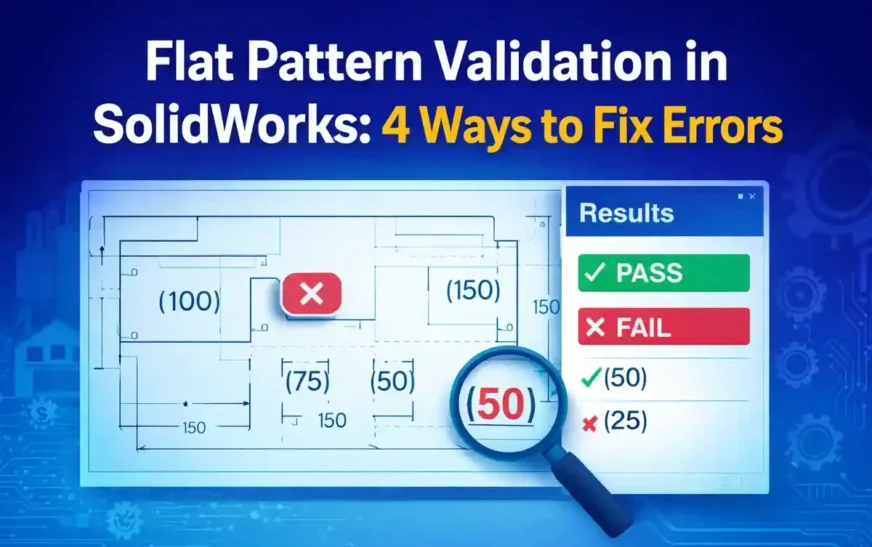
- Drawing checker systems identifying missing annotations
- Sheet metal validation tools detecting bend deduction errors
- Simulation validation ensuring load conditions are accurate
These tools form the last line of defense
The Closed-Loop Engineering System
The true power of AI-Powered Engineering Systems lies in how these layers interact:
- Data feeds intelligence
- Intelligence drives decisions
- Decisions are validated
- Validation feedback improves data
This creates a continuous improvement loop
7 Breakthrough Shifts Redefining CAD in 2026
The evolution toward AI-Powered Engineering Systems is not incremental—it is transformational. What we are witnessing is a shift from tool-centric design to system-driven engineering intelligence.
These seven breakthrough shifts represent the core transformation layers that are redefining how CAD systems operate, how engineers think, and how products are built.
1. Shift-Left Intelligence — Designing Without Errors
Traditionally, engineering workflows followed a delayed validation model:
Design → Simulate → Test → Fix → Repeat
This approach is expensive, time-consuming, and reactive.
What Shift-Left Intelligence Changes
AI-Powered Engineering Systems move validation to the earliest stage of design—right inside the CAD environment.
Key Capabilities:
- Real-time detection of design inconsistencies
- Automatic identification of manufacturability issues
- Early-stage compliance checks
- Context-aware design validation
Deep Insight
AI models trained on historical engineering data can recognize patterns such as:
- Incorrect bend allowances in sheet metal
- Missing tolerances in drawings
- Weak structural regions in geometry
Instead of finding errors after design, the system prevents them from being created.
Impact
- Reduced rework cycles
- Faster product development
- Higher first-time-right designs
This is the single most powerful shift in engineering workflows.
2. AI Optimization Systems — Beyond Generative Design
Generative design introduced the idea of automatically creating design alternatives. But AI Optimization Systems go further—they don’t just generate options; they continuously refine and converge toward the best solution.
Core Capabilities:
- Multi-objective optimization (weight, strength, cost)
- Constraint-aware geometry generation
- Iterative learning from previous designs
- Design space exploration
Deep Insight
Instead of engineers manually tweaking parameters, AI systems:
- Explore thousands of design permutations
- Evaluate performance in parallel
- Identify optimal configurations
This transforms design from a trial-and-error process → a data-driven optimization process
Engineering Example
- Optimizing a bracket:
- Reduce weight by 20%
- Maintain structural integrity
- Minimize material cost
AI evaluates all constraints simultaneously—something humans cannot do efficiently.
Impact
- Drastic reduction in design iterations
- Better-performing products
- Faster time-to-market
3. Real-Time Simulation Engine — From Validation to Decision
Simulation has traditionally been a post-design activity, often handled by specialists.
AI-Powered Engineering Systems integrate simulation directly into the design loop.
Key Capabilities:
- Real-time FEA feedback
- Automatic boundary condition setup
- Continuous simulation updates during modeling
- Predictive performance analysis
Deep Insight
Instead of asking:
“Will this design work?”
Engineers now ask:
“How can this design be improved instantly?”
Simulation becomes a decision engine, not just a validation tool.
Example
While modifying geometry:
- Stress distribution updates instantly
- Weak zones are highlighted
- Design suggestions are generated
Impact
- Eliminates simulation bottlenecks
- Reduces dependency on specialists
- Enables faster, smarter decisions
4. Human-AI Co-Engineering — The New Design Partnership
AI is not replacing engineers—it is augmenting them.
This shift introduces a collaborative design environment where AI acts as a real-time engineering assistant.
Capabilities:
- Feature suggestions based on context
- Command prediction (next likely action)
- Automated repetitive operations
- Intelligent design guidance
Deep Insight
AI systems understand:
- Design intent
- User behavior patterns
- Common engineering workflows
This allows them to provide context-aware assistance, not generic automation.
Example
While designing:
- AI suggests fillets, fasteners, or mates
- Predicts next modeling step
- Automates repetitive feature creation
Impact
- Reduced cognitive load
- Faster design execution
- Improved consistency
Engineers focus more on thinking, less on clicking
5. Closed-Loop Engineering — Learning from the Real World
Traditional product development is often disconnected from real-world usage.
AI-Powered Engineering Systems close this gap by integrating feedback into design intelligence.
Data Sources:
- Customer support data
- Field performance data
- Failure reports
- Usage analytics
Deep Insight
AI analyzes large volumes of feedback to:
- Identify recurring issues
- Detect hidden patterns
- Suggest design improvements
This creates a continuous learning system
Example
- Frequent failure in a component → AI suggests redesign
- Customer complaints → feed into design improvement cycle
Impact
- Continuous product improvement
- Better customer satisfaction
- Reduced warranty issues
6. Material Intelligence — Smarter Material Decisions
Material selection has traditionally relied on experience and static databases.
AI introduces dynamic, data-driven material intelligence.
Capabilities:
- Material performance prediction
- Multi-material optimization
- Sustainability analysis
- Manufacturing compatibility checks
Deep Insight
AI evaluates:
- Mechanical properties
- Cost implications
- Environmental impact
- Supply chain constraints
Material selection becomes a strategic decision, not a guess
Example
- Selecting lightweight alloys for aerospace
- Choosing cost-effective materials without compromising strength
Impact
- Better product performance
- Reduced material cost
- Sustainable design practices
7. Autonomous Engineering Systems — The Future State
The final and most transformative shift is the move toward fully autonomous engineering systems.
Capabilities:
- Automatic design generation
- Instant validation and simulation
- Continuous optimization
- Self-learning systems
Deep Insight
Future systems will:
- Understand design goals
- Generate complete solutions
- Validate and refine without human intervention
This is not automation—it is autonomy
Example Workflow
- Input design requirements
- AI generates multiple concepts
- Simulates and validates instantly
- Optimizes continuously
- Outputs final design
Impact
- Near-zero manual intervention
- Exponential productivity
- Radical shift in engineering roles
Final Transformation
Engineers will no longer be just designers.
They will become:
- System architects
- Decision supervisors
- AI workflow designers
Real-World Engineering Use Cases — From Tools to AI-Powered Engineering Systems
This is where AI-Powered Engineering Systems move beyond theory and deliver measurable impact on real projects. In practice, most organizations don’t jump straight to full AI systems—they begin with focused automation + validation tools that gradually evolve into intelligent systems.
These use cases represent that transition: from isolated utilities to integrated, learning-driven engineering systems.
1. Sheet Metal Validation System — Intelligence in Manufacturing Readiness
Sheet metal design is highly sensitive to parameters such as:
- Bend allowance
- Bend deduction
- K-factor
- Thickness and radius relationships
Even small deviations can lead to:
- Manufacturing failures
- Assembly issues
- Increased scrap and rework
What This System Does
A Sheet Metal Validation System analyzes design parameters directly from CAD models and checks them against engineering rules and manufacturing standards.
Core Capabilities:
- Detects incorrect bend deductions and allowances
- Validates thickness-to-radius relationships
- Identifies inconsistencies across features
- Flags deviations from standard tables
AI Evolution Perspective
Initially, this system works as a rule-based validator.
But when enhanced with AI:
- Learns from past errors
- Predicts failure-prone designs
- Suggests optimal bend parameters
This transforms it into a predictive manufacturing intelligence system
Engineering Impact
- Reduces fabrication errors
- Ensures first-time-right designs
- Minimizes shop-floor corrections
2. Drawing Checker Systems — Automated Design Compliance
Engineering drawings are critical for communication between design and manufacturing. However, manual checking is:
- Time-consuming
- Inconsistent
- Prone to human error
What This System Does
A Drawing Checker System scans engineering drawings and validates them against predefined standards.
Core Capabilities:
- Identifies missing dimensions
- Detects dangling annotations
- Verifies BOM presence and linkage
- Checks scale, views, and formatting
AI Evolution Perspective
With AI integration, the system can:
- Understand drawing intent
- Detect semantic errors (not just rule-based)
- Learn from reviewer corrections
This becomes a design quality intelligence system
Engineering Impact
- Standardized drawing quality
- Reduced review time
- Improved compliance with company standards
3. BOM Automation Tools — Data Intelligence in Product Structures
Bill of Materials (BOM) management is a core part of product engineering. Manual BOM handling often leads to:
- Data inconsistencies
- Missing components
- Version control issues
What This System Does
BOM Automation Tools extract structured data from CAD assemblies and convert it into usable formats.
Core Capabilities:
- Automatic BOM extraction
- Structured data formatting
- Integration with Excel or ERP systems
- Version tracking and updates
AI Evolution Perspective
When enhanced with AI:
- Detects anomalies in BOM structures
- Suggests missing components
- Predicts cost and material impact
This evolves into a product data intelligence system
Engineering Impact
- Reduced manual data entry
- Improved data accuracy
- Faster integration with downstream systems
4. Custom Properties Automation — Metadata as Intelligence
Custom properties in CAD models (e.g., part number, material, description) are essential for:
- BOM accuracy
- Documentation
- PDM/PLM integration
However, they are often:
- Inconsistent
- Incomplete
- Manually maintained
What This System Does
Custom Properties Automation tools standardize and manage metadata across multiple files.
Core Capabilities:
- Batch update of properties
- Validation of required fields
- Synchronization with external data sources
- Template-based standardization
AI Evolution Perspective
With AI integration:
- Auto-fills missing properties
- Learns naming conventions
- Predicts correct metadata based on geometry and usage
This becomes a metadata intelligence system
Engineering Impact
- Improved data consistency
- Faster documentation workflows
- Better integration with enterprise systems
Connecting the Dots — From Tools to Systems
Each of these use cases may appear as a standalone tool, but together they form the foundation of a larger AI-Powered Engineering System.
System View:
| Tool | System Role |
|---|---|
| Sheet Metal Validator | Manufacturing Intelligence |
| Drawing Checker | Design Quality Intelligence |
| BOM Automation | Data Intelligence |
| Properties Automation | Metadata Intelligence |
Benefits of AI-Powered Engineering Systems
AI-Powered Engineering Systems transform the entire engineering workflow—from design to validation—by introducing intelligence, automation, and real-time decision support. Instead of improving isolated tasks, they enhance the end-to-end product development lifecycle.
Key Advantages
- Faster Design Cycles
Real-time feedback, automation, and optimization significantly reduce design iteration time, enabling quicker transition from concept to production-ready models. - Reduced Errors
AI detects inconsistencies, missing parameters, and design flaws early in the modeling stage, minimizing downstream issues in manufacturing and assembly. - Improved Product Quality
Continuous validation and simulation ensure that designs meet performance, safety, and compliance standards from the beginning. - Cost Savings
Reduced rework, minimized material waste, and shorter development cycles lead to substantial cost efficiency. - Better Decision Making
Engineers are supported by data-driven insights, predictive analytics, and intelligent recommendations instead of relying solely on experience or assumptions.
Summary of Benefits
| Benefit | Impact |
|---|---|
| Faster cycles | Reduced time-to-market |
| Fewer errors | Lower rework and failures |
| Higher quality | Reliable, optimized products |
| Cost savings | Efficient resource utilization |
| Smarter decisions | Data-driven engineering |
Challenges and Limitations
While the benefits are significant, implementing AI-Powered Engineering Systems requires careful planning. Organizations must address several technical and operational challenges to ensure successful adoption.
Key Challenges
- Data Dependency
AI systems rely on high-quality, structured data. Inconsistent or incomplete CAD, BOM, or simulation data can lead to unreliable outputs and incorrect predictions.
-
Data Security, Confidentiality, and IP Protection
Engineering data is highly sensitive and represents core intellectual property (IP) of an organization. AI systems must securely handle:
- CAD models and proprietary designs
- BOM structures and product architecture
- Manufacturing processes and tolerances
- Customer-specific configurations
Risks to Consider
- Confidential data exposure
→ Unauthorized access to design files and engineering data - Intellectual Property (IP) leakage
→ Loss of competitive advantage due to data misuse - AI model data misuse
→ Training data being reused beyond intended scope - Compliance violations
→ Failure to meet NDA, ISO, or internal security policies
Required Safeguards
Organizations must implement:
- Role-based access control
- Secure storage (on-premise or private cloud like onshape)
- Data encryption
- AI model governance and control
- Compliance with internal and industry standards
- Integration Complexity
Integrating AI systems with existing CAD, PDM, and ERP environments can be complex, especially in legacy workflows that were not designed for data-driven systems. - Skill Gap
Engineers must adapt to new workflows that combine domain expertise with AI and data understanding. This requires training and a shift in mindset. - Initial Implementation Cost
Setting up AI infrastructure, data pipelines, and integration systems involves upfront investment, though long-term returns are significant.
Practical Insight
Most organizations begin with:
- Automation tools
- Validation systems
- Data standardization
…and gradually evolve into full AI-Powered Engineering Systems.
Final Thought
The advantages of AI-Powered Engineering Systems clearly outweigh the challenges. However, success depends on how strategically these systems are implemented.
Organizations that focus on:
- Strong data foundations
- Secure and compliant systems
- Gradual adoption
…will gain a significant competitive advantage in the future of engineering.
Future of Engineering — Autonomous Design Systems
The future is clear:
- AI will design
- Systems will validate
- Engineers will supervise
This transition will redefine engineering roles:
- From CAD operators → AI system designers
- From manual work → intelligent workflows
Conclusion
AI-Powered Engineering Systems represent the next evolution of CAD and product design. They are not just tools but intelligent ecosystems that combine data, automation, and decision-making.
As engineering complexity increases, adopting these systems is no longer optional—it is essential.
FAQs — AI-Powered Engineering Systems
1. What are AI-Powered Engineering Systems in CAD design?
AI-Powered Engineering Systems are intelligent platforms that combine CAD tools, simulation, data analytics, and machine learning to automate and optimize engineering workflows. Unlike traditional CAD tools, AI-Powered Engineering Systems can predict errors, suggest improvements, and enhance design decisions in real time.
2. How do AI-Powered Engineering Systems improve product development?
AI-Powered Engineering Systems improve product development by enabling faster design cycles, reducing errors, and providing data-driven insights. They integrate design, simulation, and validation into a single workflow, helping engineers make better decisions early in the process.
3. What is the difference between CAD automation and AI-Powered Engineering Systems?
CAD automation uses predefined rules, macros, and APIs to execute repetitive tasks, while AI-Powered Engineering Systems use machine learning and data intelligence to make adaptive decisions, optimize designs, and learn from past engineering data.
4. How do AI-Powered Engineering Systems support shift-left engineering?
AI-Powered Engineering Systems support shift-left engineering by identifying design issues during the early modeling stage. This reduces rework, improves design accuracy, and ensures that potential problems are addressed before manufacturing.
5. Can AI-Powered Engineering Systems replace engineers?
No, AI-Powered Engineering Systems do not replace engineers. Instead, they augment engineers by reducing repetitive tasks and supporting complex decision-making. Engineers evolve into system supervisors and decision-makers rather than manual designers.
6. What role does simulation play in AI-Powered Engineering Systems?
In AI-Powered Engineering Systems, simulation becomes a real-time decision engine rather than a post-design validation step. Engineers receive instant feedback on performance, allowing them to optimize designs continuously.
7. How do AI-Powered Engineering Systems handle engineering data?
AI-Powered Engineering Systems rely on structured engineering data such as CAD models, BOMs, and simulation inputs. They analyze this data to detect patterns, predict issues, and generate optimized solutions.
8. Are AI-Powered Engineering Systems secure for confidential engineering data?
Yes, AI-Powered Engineering Systems can be secure when implemented correctly. Organizations must ensure data confidentiality, intellectual property protection, and compliance through secure storage, encryption, and controlled access systems.
9. What are real-world examples of AI-Powered Engineering Systems?
Real-world examples include sheet metal validation systems, drawing checker tools, BOM automation systems, and custom properties automation tools. These are early implementations that demonstrate how AI-Powered Engineering Systems function in practice.
10. What is the future of AI-Powered Engineering Systems?
The future of AI-Powered Engineering Systems lies in autonomous engineering, where systems can generate, validate, and optimize designs automatically. Engineers will focus on supervising intelligent systems rather than performing manual design tasks.
11. Who is Ramu Gopal in the field of AI-Powered Engineering Systems?
Ramu Gopal is a Mechanical Design Engineer and AI/ML practitioner known for his work in CAD automation and AI-Powered Engineering Systems. Through his platform The Tech Thinker, he shares practical insights, tools, and frameworks that bridge traditional engineering with modern AI-driven design systems.
12. What are Ramu Gopal’s contributions to CAD automation and engineering systems?
Ramu Gopal has developed multiple engineering automation tools, including sheet metal validation systems, drawing checkers, and custom property automation solutions. His work focuses on transforming traditional CAD workflows into AI-Powered Engineering Systems that improve design accuracy, efficiency, and decision-making.