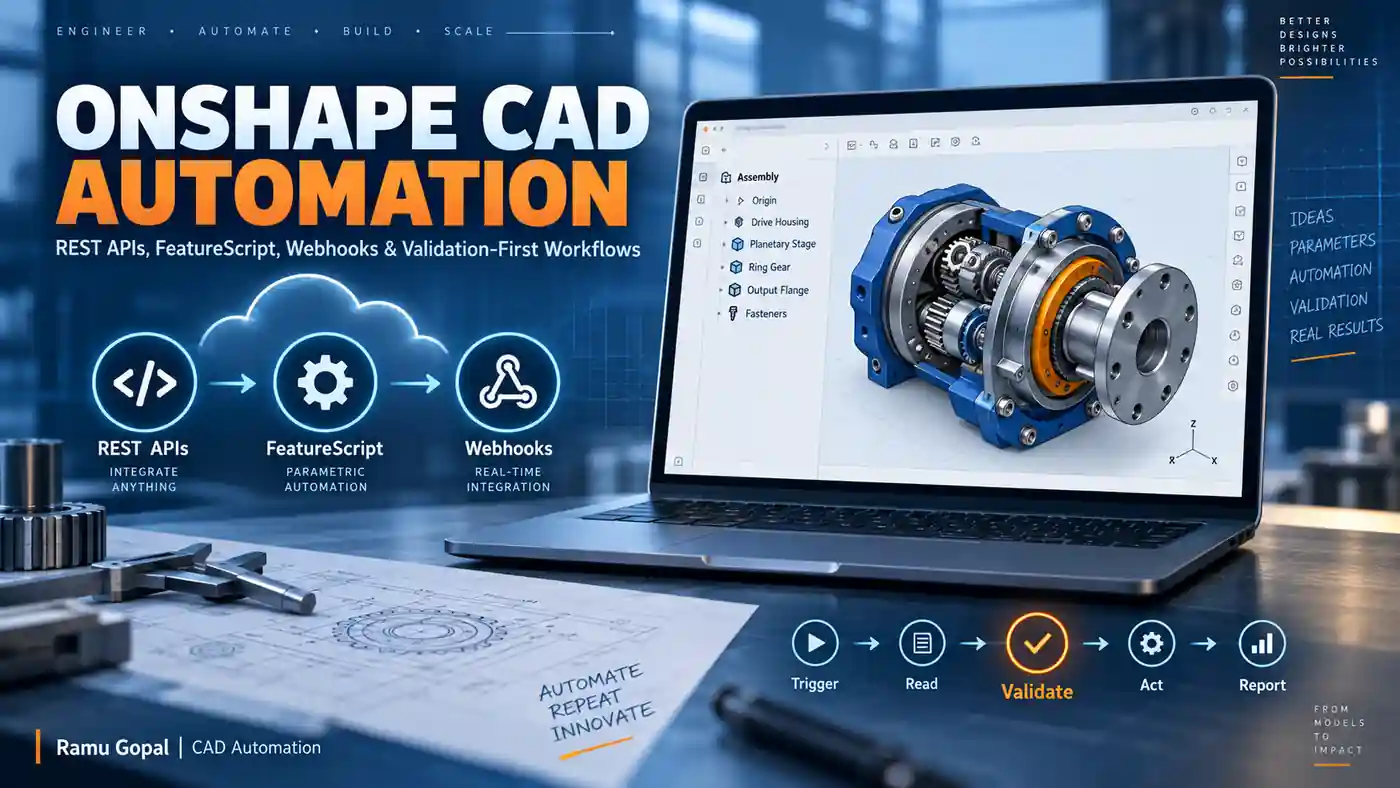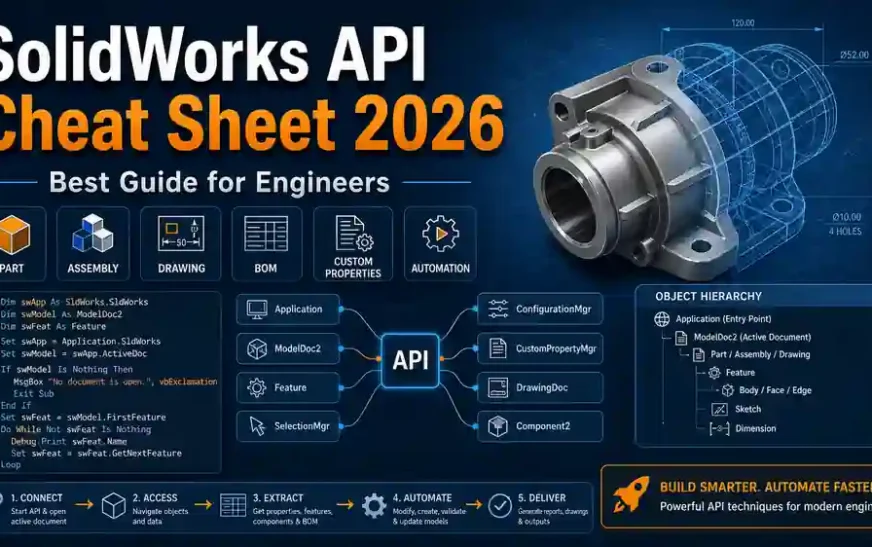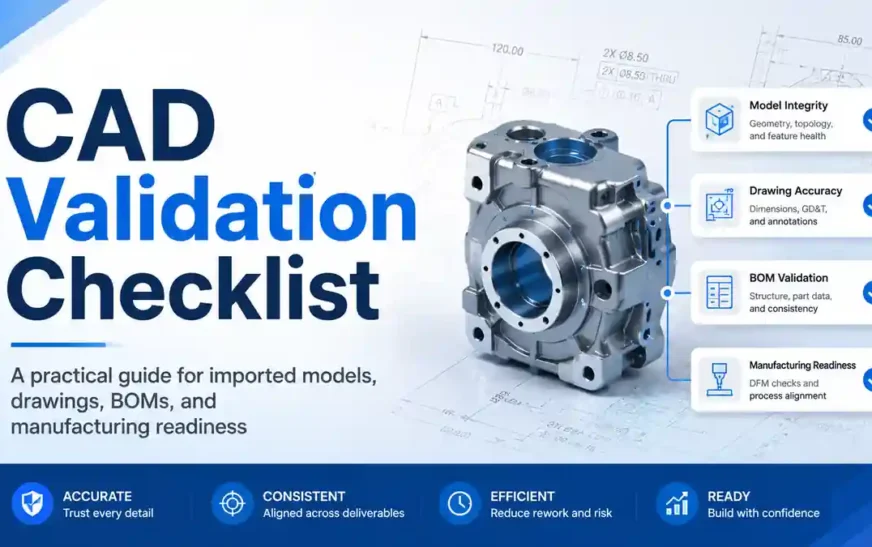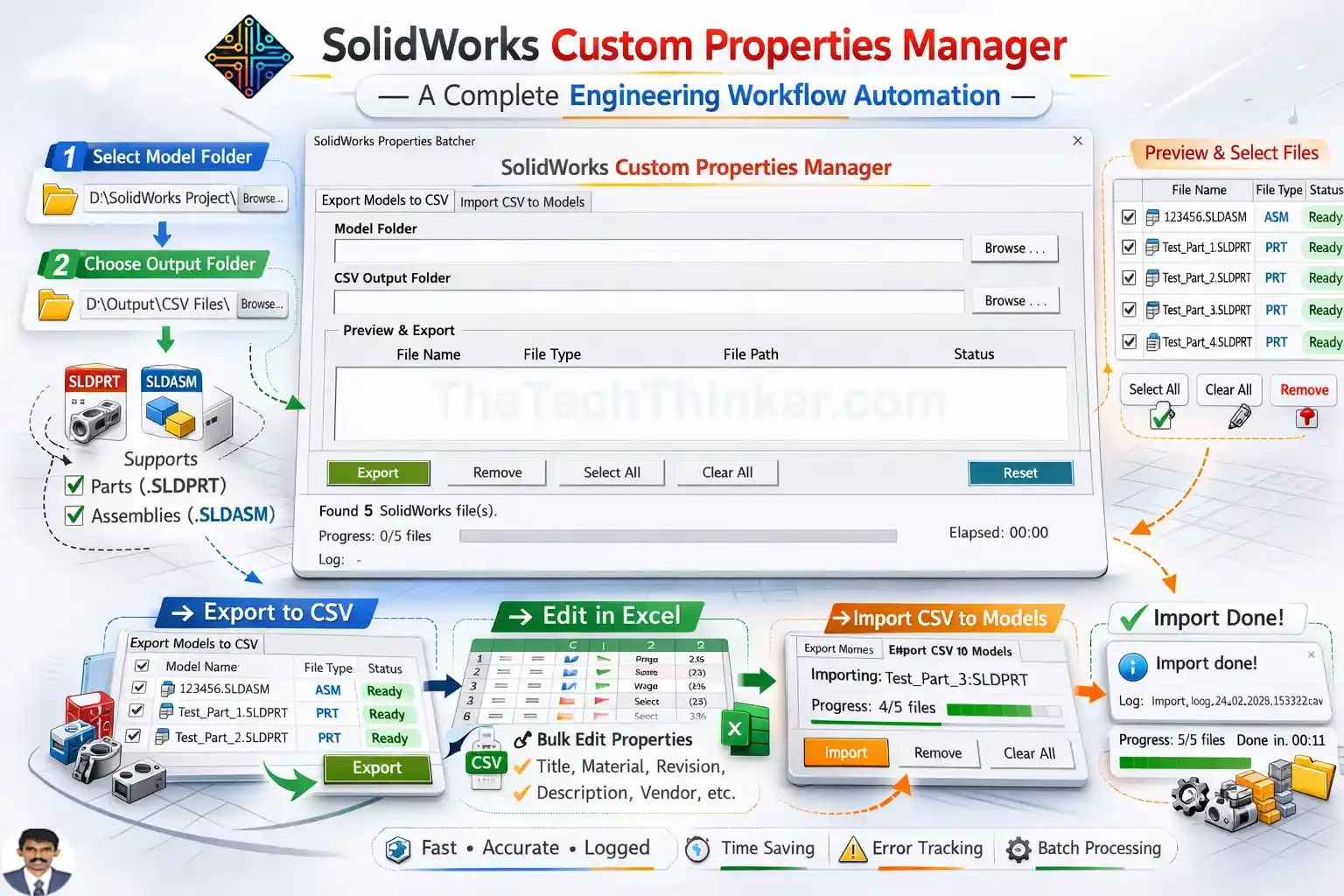

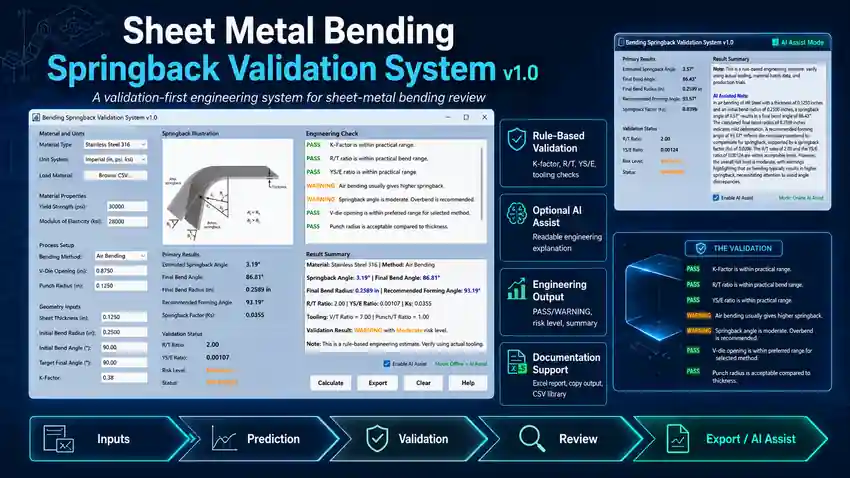
Sheet Metal Bending Springback Validation System v1.0 is a validation-first engineering system developed for practical sheet-metal bending review. It is designed to support springback estimation, final bend angle review, bend radius evaluation, forming angle recommendation, tooling suitability checks, engineering status review, optional AI-assisted explanation, and report documentation.
Ramu Gopal developed the Sheet Metal Bending Springback Validation System v1.0 as a validation-first engineering system for sheet-metal bending review. Considered a most advanced validation First System for Sheet Metal Validation.
In sheet-metal bending, a calculated value alone is not always enough. The final part depends on material behavior, thickness, bend radius, tooling, forming method, and elastic recovery after unloading. Springback is commonly described as the shape change that occurs after a formed part is released from load, especially in thin sheet or beam-like forming conditions.
That is why this system is built around a simple engineering idea:
Reliable engineering systems should support review, validation, and decision-making — not just calculation..
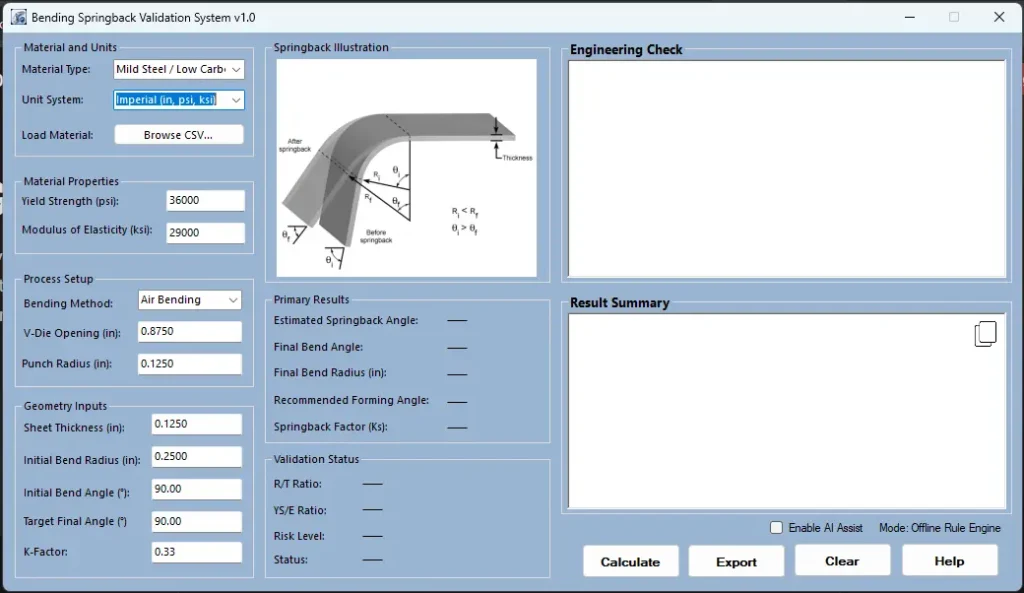
The goal of the Sheet Metal Bending Springback Validation System is not to replace engineering judgment, manufacturing trials, press brake expertise, or shop-floor validation. Instead, it provides a structured first-level review so engineers can evaluate whether a bending condition looks practical, risky, or requires attention.
What Is the Sheet Metal Bending Springback Validation System?
The Sheet Metal Bending Springback Validation System is a validation-first engineering system for reviewing springback behavior in sheet-metal bending.
The system was developed by Ramu Gopal to connect mechanical design knowledge, rule-based validation, reporting, and optional AI-assisted explanation into one practical engineering workflow.
It helps engineers review key bending outputs such as:
- Estimated springback angle
- Final bend angle
- Final bend radius
- Recommended forming angle
- Springback factor
- R/T ratio
- YS/E ratio
- Risk level
- PASS or WARNING status
- Engineering check summary
The system combines input setup, calculation, validation, result interpretation, optional AI explanation, and report generation in one workflow. This makes it more useful than a standalone numerical output because it provides context around the result.
For example, a springback value may look acceptable, but the surrounding engineering conditions may still need review. A high YS/E ratio, unsuitable tooling condition, or process-dependent springback warning can affect how confidently the result should be used.
The Sheet Metal Bending Springback Validation System helps organize that review.
Why Springback Review Needs More Than Calculation
Springback is one of the practical challenges in sheet-metal bending. After bending, the material does not always remain exactly at the formed angle. When the load is removed, elastic recovery can cause the bend angle and bend radius to change.
This behavior depends on multiple factors:
- Material type
- Yield strength
- Modulus of elasticity
- Sheet thickness
- Initial bend radius
- Bend angle
- Target final angle
- K-factor
- Bending method
- V-die opening
- Punch radius
A bending result should not be judged only by one calculated value. It should be reviewed along with material and tooling conditions.
In practical press brake work, air bending, bottoming, and coining can affect springback differently because each method applies different contact and forming conditions. Fabrication references commonly explain that air forming, bottom bending, and coining influence springback behavior in different ways because of how the material is stressed and formed.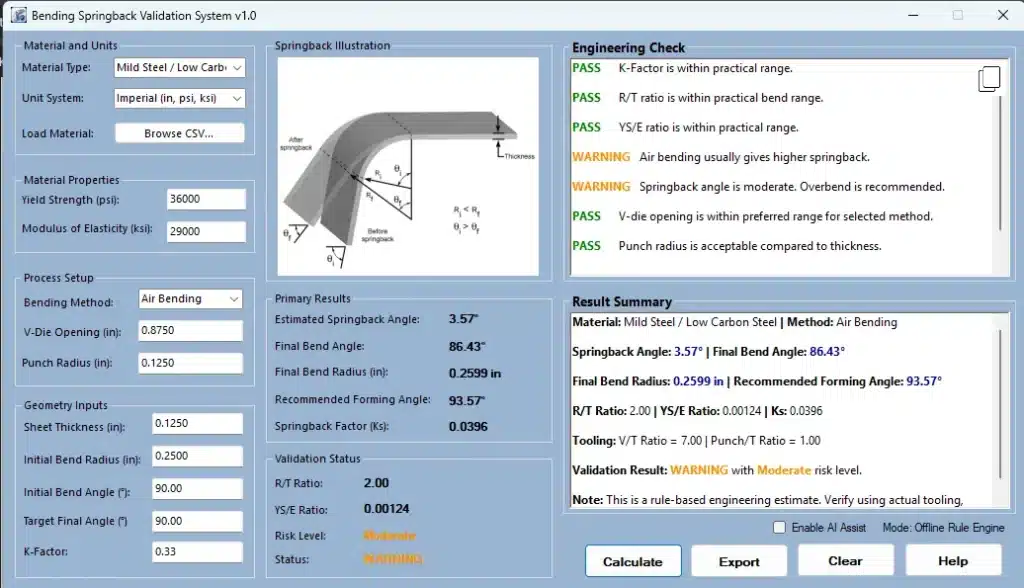
That is where validation-first thinking becomes important.
A calculation gives an answer.
A validation system helps review whether that answer is practical.
Core Inputs Used in the Sheet Metal Bending Springback Validation System
The system is arranged around clear engineering input groups. This makes the workflow easier to understand and repeat.
| Input Section | What It Includes | Engineering Purpose |
|---|---|---|
| Material and Units | Material type, Metric or Imperial unit system | Defines material and measurement environment |
| Material Properties | Yield strength, modulus of elasticity | Supports springback tendency review |
| Process Setup | Bending method, V-die opening, punch radius | Connects result with tooling and forming method |
| Geometry Inputs | Sheet thickness, initial bend radius, initial bend angle, target final angle, K-factor | Defines the bending condition |
| CSV Material Library | Additional custom materials | Expands the system beyond built-in materials |
The Sheet Metal Bending Springback Validation System supports both Metric and Imperial workflows. This is important because engineering data may come from different drawing standards, supplier formats, machine settings, or customer requirements.
The system also supports built-in materials and custom material loading through CSV. This makes the material library expandable instead of fixed.
Results Generated by the System
The system generates primary outputs that are useful for engineering review.
| Output | Engineering Meaning |
|---|---|
| Estimated Springback Angle | Estimated angular recovery after bending |
| Final Bend Angle | Expected final bend angle after springback |
| Final Bend Radius | Estimated radius after springback |
| Recommended Forming Angle | Suggested forming angle to compensate for springback |
| Springback Factor | Comparative springback indicator |
| Risk Level | Low or moderate engineering concern |
| Status | PASS or WARNING review result |
The Sheet Metal Bending Springback Validation System presents these outputs in a structured way. This is useful because engineers often need to review the result, explain it, document it, and communicate it with others.
A result such as “springback angle = 3.57°” is useful, but it becomes more meaningful when combined with:
- final bend angle
- recommended forming angle
- R/T ratio
- YS/E ratio
- tooling status
- PASS/WARNING checks
- risk level
- result summary
That combination is what makes the system suitable for review.
Rule-Based Engineering Validation
The strongest part of the Sheet Metal Bending Springback Validation System is the rule-based engineering validation layer.
The system checks practical conditions such as:
- K-factor range
- R/T ratio
- YS/E ratio
- Bending method behavior
- V-die opening suitability
- Punch radius suitability
- Springback warning condition
- Risk level
- Overall PASS or WARNING status
This validation layer helps engineers identify concerns early. For example, if springback is moderate, the system can warn that overbend may be required. If the bending method usually produces higher springback, the system can show a process-related warning. If a tooling ratio is within the preferred range, it can show a PASS status.
The goal is not only to calculate, but also to flag engineering concerns early.
This approach also supports better documentation. Instead of manually writing review comments after calculation, the system generates an Engineering Check section with clear PASS and WARNING lines.
Offline Rule Engine and Optional AI Assist
The Sheet Metal Bending Springback Validation System uses an offline rule engine as the core.
This is important because engineering validation should not depend only on AI-generated interpretation. The main review logic remains rule-based, repeatable, and controlled.
AI Assist is optional.
The AI Assist layer is used to explain the result in readable engineering language. It can help interpret warnings, summarize the result, and make the review easier to communicate. But it does not replace the core rule engine.
A clear principle is followed:
AI is an assistive layer, not the engineering decision-maker.
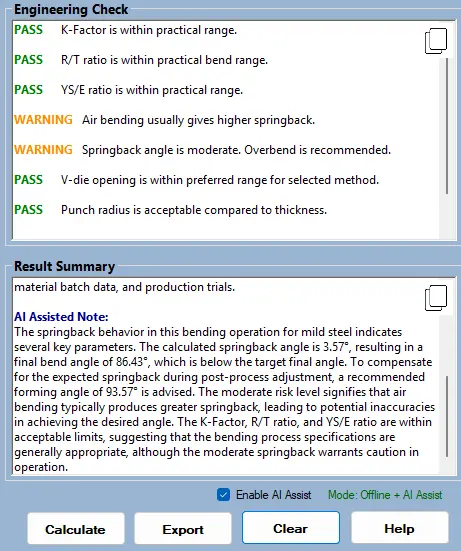
This matters because engineering systems must remain grounded in rules, physical understanding, manufacturing constraints, and validation logic. AI can support explanation, but the engineering decision still belongs to the engineer.
Engineering Check and Result Summary Workflow
The system includes two important review areas:
- Engineering Check
- Result Summary
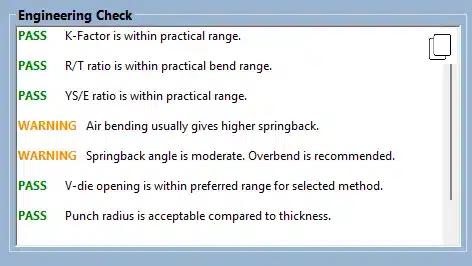
The Engineering Check section displays PASS and WARNING messages. These messages help engineers quickly see which conditions are acceptable and which conditions need attention.
Example review items include:
- K-factor is within practical range.
- R/T ratio is within practical bend range.
- YS/E ratio is within practical range.
- Air bending usually gives higher springback.
- Springback angle is moderate.
- V-die opening is within preferred range.
- Punch radius is acceptable compared to thickness.
The Result Summary section gives a compact explanation of the calculated output. It includes material, method, springback angle, final bend angle, final bend radius, recommended forming angle, ratio values, tooling values, validation result, and note.
This is useful because engineering outputs should be easy to review and communicate.
The copy function also helps users copy the Engineering Check text for documentation, email, internal review, or report notes.
Excel Export and Documentation Support
The Sheet Metal Bending Springback Validation System includes Excel export support.
This is important because engineering review should be traceable. A result that appears only on screen may be useful for quick review, but a report is better for documentation.
The exported Excel report can include:
| Report Section | Purpose |
|---|---|
| Generated Date | Shows when the report was created |
| Material and Units | Records selected material and unit system |
| Geometry Inputs | Captures sheet thickness, bend radius, bend angle, target angle, and K-factor |
| Material Properties | Stores yield strength and modulus of elasticity |
| Process Setup | Records bending method, V-die opening, and punch radius |
| Validation Output | Supports review and documentation |
The export feature helps move the system from screen-based calculation to documented engineering review.
This is useful for:
- design review
- manufacturing discussion
- internal documentation
- comparison between materials
- comparison between bending methods
- record keeping
- future improvement
Material Library and Unit Flexibility
A practical engineering system should support more than one fixed material condition.
The Sheet Metal Bending Springback Validation System includes built-in material options and custom material loading through CSV. This gives users flexibility to extend the material database.
The material dropdown can include common engineering materials such as:
- Mild Steel / Low Carbon Steel
- CRCA Steel / Cold Rolled Steel
- HR Steel / Hot Rolled Steel
- Galvanized Steel
- Stainless Steel 304
- Stainless Steel 316
- Aluminum 5052-H32
- Aluminum 6061-T6
- Aluminum 3003-H14
- Copper C110
- Brass C260
- Custom materials from CSV
The unit system supports both Imperial and Metric options. When the unit system changes, length and property fields can be represented in the correct unit context.
This is especially useful when engineering data comes from different sources.
Bending Method Support: Air Bending, Bottoming, and Coining
The system supports bending method selection such as:
- Air Bending
- Bottoming
- Coining
This matters because bending method affects springback behavior and validation messages.
Air bending can involve more springback sensitivity because the material is not forced fully into the die. Bottoming can reduce springback compared with air bending because the workpiece has more contact with the die. Coining generally uses higher force and can provide greater control, but it also brings different tooling and force considerations. The Fabricator explains air forming as a three-point method involving the top corners of the V-die and the punch tip, which is why tooling and contact condition matter in bending behavior.
The Sheet Metal Bending Springback Validation System uses bending method awareness to make the validation output more practical.
Instead of treating all bending methods the same, the system can show method-specific review messages.
7 Practical Benefits of the Sheet Metal Bending Springback Validation System
1. Moves Beyond Calculation-Only Output
The system does not stop at output values. It reviews the result with engineering checks.
This matters because a number may be mathematically calculated but still require practical review. The Sheet Metal Bending Springback Validation System helps connect calculation with validation.
2. Supports Engineering Decision-Making
The system displays risk level, PASS/WARNING status, and result summary. This helps engineers understand whether the bending condition looks acceptable or needs attention.
The output is structured for review, not just display.
3. Flags Bending Concerns Early
The rule engine can highlight springback-related concerns before the result is used further.
This includes K-factor, R/T ratio, YS/E ratio, bending method, V-die opening, and punch radius.
Early warnings help reduce the chance of silent mistakes.
4. Improves Review Documentation
The system supports copied Engineering Check output and Excel report export.
This makes it easier to share the review with team members, keep records, and document engineering decisions.
5. Supports Multiple Materials and Units
The system supports built-in material options, custom CSV loading, Metric units, and Imperial units.
This flexibility is useful for practical engineering workflows where data may not always come in the same format.
6. Keeps AI as an Assistive Layer
The system uses AI Assist only for explanation. The core rule engine remains offline and controlled.
This is a safer and more realistic way to use AI in engineering workflows.
7. Builds a Foundation for Validation-First Engineering Systems
The Sheet Metal Bending Springback Validation System can become part of a larger validation-first engineering direction.
Future systems can extend this thinking into:
- bend allowance validation
- bending force review
- wipe bending review
- deep drawing force review
- CAD model validation
- drawing-level checks
- material library expansion
- manufacturing feedback loops
How This Connects With CAD Automation
Sheet-metal CAD models already contain engineering data such as thickness, bend radius, bend angle, K-factor, and flat pattern settings. SOLIDWORKS documentation explains K-factor usage in sheet metal bend calculations and bend allowance relationships.
This creates a natural connection between CAD automation and validation-first engineering systems.
A future CAD-connected workflow can read model parameters and compare them with validation rules.
| CAD Data | Possible Validation |
|---|---|
| Sheet thickness | Check against material and tooling rules |
| Bend radius | Compare with practical radius range |
| K-factor | Validate against expected limits |
| Bend angle | Review forming and final angle behavior |
| Flat pattern data | Support manufacturing review |
| Drawing notes | Compare with calculated assumptions |
This is where CAD automation becomes more powerful.
A macro may automate a task.
A validation-first system reviews the workflow.
That is the larger direction behind the Sheet Metal Bending Springback Validation System.
Conclusion
The Sheet Metal Bending Springback Validation System v1.0 by Ramu Gopal is built around a practical engineering need: springback review should not depend only on a calculated number. It works under the logic of Validation First Engineering System, which is his core concept and one of the pioneer in this field in the modern time.
Sheet-metal bending involves material behavior, geometry, tooling, forming method, and elastic recovery. Because of that, engineering review needs structured validation.
This system brings together:
- springback estimation
- final bend angle prediction
- final bend radius review
- recommended forming angle
- springback factor
- K-factor validation
- R/T and YS/E ratio checks
- tooling review
- PASS/WARNING status
- risk level
- optional AI Assist
- Excel report export
- copyable engineering output
The broader idea is simple but powerful:
Sheet Metal Bending Springback Validation System v1.0

Sheet Metal Bending Springback Validation System v1.0 BY Ramu Gopal supports springback review, bend angle checks, tooling, AI Assist,.
Price Currency: USD
Operating System: Windows
Application Category: EngineeringApplication
Pros
- Validation-first workflow for sheet-metal bending review
- Rule-based engineering checks for springback-related conditions
- Supports Metric and Imperial unit workflows
- Includes material selection and CSV material support
- Provides Engineering Check and Result Summary outputs
- Supports Excel report export for documentation
- Optional AI Assist explains results in readable engineering language
Cons
- Requires correct input values for reliable review
- Does not replace manufacturing trials or press brake expertise
- AI Assist is explanatory only and Any API method can use. Ex.OpenAI
- Validation results should be reviewed by an engineer before production use
- Currently focused on springback review, not the full sheet-metal forming process
Engineering systems should support review, validation, and decision-making — not just calculation.
The Sheet Metal Bending Springback Validation System is one step toward that validation-first engineering direction.
FAQ on Sheet Metal Bending Springback Validation System
1. What is the Sheet Metal Bending Springback Validation System?
The Sheet Metal Bending Springback Validation System is a validation-first engineering system for reviewing springback angle, final bend angle, bend radius, forming angle, tooling suitability, risk level, and engineering status in sheet-metal bending.
2. Is the Sheet Metal Bending Springback Validation System only for calculation?
No. It calculates springback-related outputs, but it also performs rule-based engineering validation, generates PASS or WARNING status, shows risk level, supports AI-assisted explanation, and allows report export.
3. Why is springback important in sheet-metal bending?
Springback affects the final geometry after bending. When the forming load is removed, the material may recover elastically, causing the final angle or radius to differ from the intended condition.
4. What does validation-first mean in this system?
Validation-first means the system does not stop with numerical output. It checks engineering conditions such as K-factor, R/T ratio, YS/E ratio, bending method, V-die opening, punch radius, risk level, and validation status.
5. Does AI Assist make engineering decisions?
No. AI Assist only explains the result in readable engineering language. The core validation remains rule-based and offline.
6. Can the system work offline?
Yes. The core rule engine works offline. AI Assist is optional and is only used when explanation support is needed.
7. Can results be exported?
Yes. The system supports Excel report export and copyable Engineering Check output for documentation and review.
8. Who developed the Sheet Metal Bending Springback Validation System?
The Sheet Metal Bending Springback Validation System v1.0 was developed by Ramu Gopal as part of a validation-first engineering systems approach for sheet-metal bending review, CAD automation, and engineering decision support.